
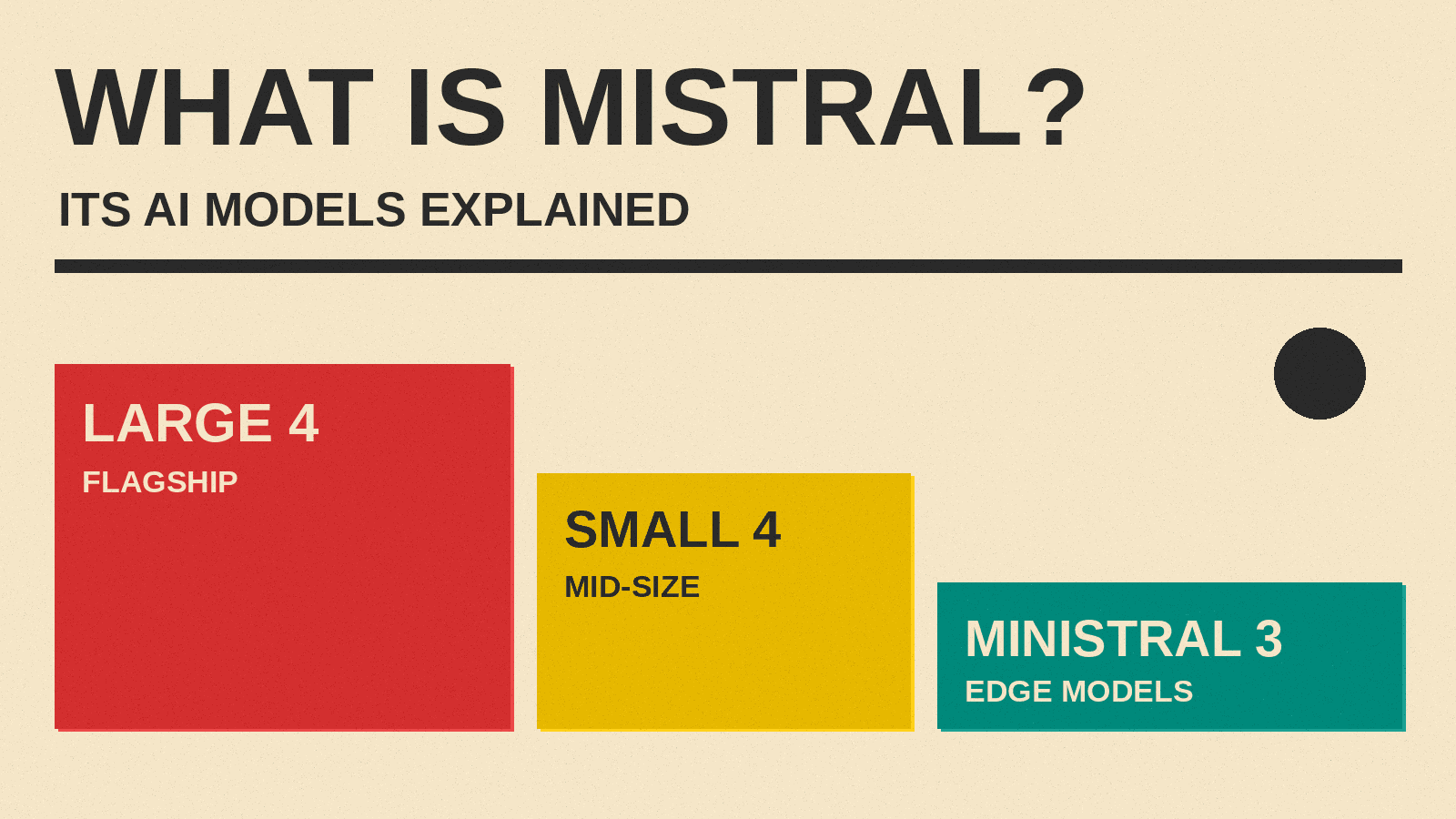
If you have seen the name Mistral next to words like "open weights", "Hugging Face" or "Le Chonk", this guide explains what it is. Mistral is a European AI lab that makes language models, and it releases many of them as downloadable files that anyone can run. It also sells hosted access to the same models and a set of tools for businesses.
This explainer covers who Mistral is, what its current model lineup looks like, which models you can download, what the licenses allow, and how to try a model yourself. The facts below come from Mistral's own pages and the model cards on Hugging Face, and the facts are accurate as of November 4, 2026. Mistral releases often, so check the linked pages before you rely on a detail.
The short answer
Mistral is an AI company founded in April 2023. Its About page names three co-founders: Arthur Mensch (CEO), Guillaume Lample (Chief Science Officer) and Timothee Lacroix (CTO). The company says its mission is to make frontier AI open to all, and it describes itself as a European leader in AI.
In practice, Mistral does two things. It trains models, and it gives people several ways to use them: a hosted API, a platform for building apps, and weights you can download. The weights are the part that matters for local AI fans. If you want the background on that term first, read our guide to open-weight versus closed AI models.
What Mistral sells
Mistral's About page says it builds full-stack AI for enterprises and governments, including frontier models, developer tools, applications and compute. It names finance, manufacturing, defense, energy and the public sector as industries it works with. Two products show up often in its announcements:
- Mistral Studio. In the Mistral Large 4 release post, Mistral says organizations can build, govern and improve agents and applications with Mistral Studio.
- Forge. On its Hugging Face page, Mistral describes Forge as its platform for training custom AI grounded in proprietary knowledge, across pre-training, post-training and reinforcement learning.
Mistral's model documentation says the company "develops, or makes available" open-weight and commercial models. That second part is worth noticing. The docs list third-party models next to Mistral's own, including GLM 5.3 from Z.ai and DeepSeek V4.1 Flash 1017 from DeepSeek. So the Mistral API is a place to call models from more than one lab.
The model lineup in November 2026
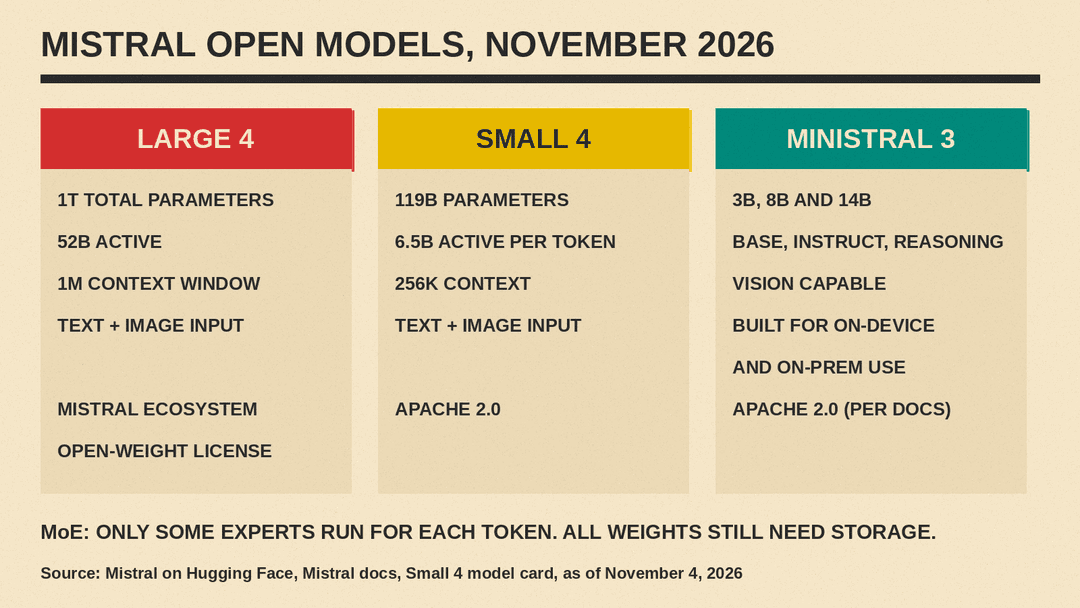
Mistral's Hugging Face page splits its general models into a frontier tier and an edge tier. This is the lineup it listed on November 4, 2026.
The page also lists Medium 3.5 in the frontier tier. Mistral's model docs show Mistral Medium 3.5 on their deprecated list, with a deprecation date of October 31, 2026, a retirement date of April 30, 2027 and Large 4 named as the alternative, so this guide does not cover it.
Mistral Large 4: the flagship
Mistral lists Large 4 as an open-weight, general-purpose multimodal model built as a Mixture of Experts. A Mixture of Experts model is made of many smaller expert blocks, and only some of them work on each token. If that idea is new, our plain-English guide to Mixture of Experts covers it.
According to the Hugging Face page, Large 4 has:
- 1T total parameters and 52B active parameters
- text and image input
- a 1M context window
- fluency in 160+ languages
Mistral released the weights of Large 4 after a public preview earlier in October 2026. In its launch post, Mistral says Large 4 ranks as the best open-weight model for coding, which is Mistral's own claim. We went through the benchmarks, the license and the timeline in our Mistral Large 4 explainer, and we covered the weights release in our how to run Le Chonk post. "Le Chonk" is Mistral's own nickname for the model.
Large 4 supports three reasoning modes, according to the launch post: Low for simple tasks, Medium for everyday tasks, and High, the default, for the hardest use cases.
Mistral Small 4: the mid-size open model
Small 4 is Mistral's mid-size open model under a permissive license. Its model card says it is a hybrid model that works as both a general instruction model and a reasoning model. It combines three model families into one: Instruct, Reasoning (previously called Magistral) and Devstral.
The card lists these specs:
- a Mixture of Experts design with 128 experts, 4 active
- 119B parameters, with 6.5B activated per token
- a 256k context length
- text and image input, with text output
- a reasoning effort setting you choose per request
The name says "Small", but 119B parameters is not small by laptop standards. Only 6.5B parameters are active per token, yet the full set of weights still has to be stored and loaded, so check the file size on the model page before you download. Our guide to how much memory you need to run an AI model locally explains how to size that up.
Mistral's card says that in a latency-optimized setup Small 4 cuts end-to-end completion time by 40%, and that in a throughput-optimized setup it handles 3x more requests per second than Mistral Small 3. Those are Mistral's figures from its own setups, not an independent test. The card also points to a 4-bit NVFP4 checkpoint and an "eagle head" for speculative decoding, two ways to make the model faster or lighter.
Ministral 3: the small edge models
Ministral 3 is a collection of edge models in three sizes: 3B, 8B and 14B. Each size comes in Base, Instruct and Reasoning variants, and all of them have vision. Mistral says they are built for on-device and on-prem deployment where control, privacy and low latency matter. The Base variants are described as the weights used for fine-tuning, which our guide to what fine-tuning means explains.
One small trap: the Hugging Face collection page shows 4B, 9B and 14B as the size label for the 3B, 8B and 14B models. The page does not say why, so read each model's own page for the real download size before you pick one.
Specialist models
Beyond chat and coding, Mistral's Hugging Face page lists specialist models built with Forge:
- Voxtral for speech: real-time speech-to-text, text-to-speech and voice agents. See our Voxtral 3 explainer.
- Timestral for time series: zero-shot probabilistic forecasting. We covered it in our Timestral release post.
- Shieldstral, a compact 3B-parameter, policy-adaptive multimodal safety classifier.
- Leanstral, a code agent for Lean 4, the proof assistant used in formal mathematics and software verification.
The docs also list OCR models for document text extraction, Codestral for code completion, embedding models for search, and moderation models. Not every model in the docs has open weights, so check each model's page for its license.
Which Mistral models are open
"Open" means different things for different Mistral models, so read the license for the specific one you want. As listed in Mistral's docs and model card:
- Mistral Small 4 is under the Apache 2.0 license. The card calls it an open-source license for both commercial and non-commercial use.
- Ministral 3 (3B, 8B and 14B) is listed in the docs as Apache 2.0.
- Mistral Large 4 uses the Mistral Ecosystem Open-Weight License. Mistral calls it a modified MIT license. In the launch post, Mistral says the model is free to use, modify, fine-tune and commercialize, with a single condition: a business that operates a Model-as-a-Service offering must get a separate commercial license from Mistral before using the model commercially.
That last clause is the one that trips people up. The one condition in the launch post applies to Model-as-a-Service offerings. If you plan to resell access to the model as a hosted service, you need to talk to Mistral first. Always read the license file in the model repository, because the license text is what binds you, not a summary.
Also keep in mind that "open weights" is not the same as "open source". Open weights means you can download the trained model files. It does not mean you can see the training data or the full training recipe.
How to try a Mistral model
You have three realistic routes. Which one fits depends on how much hardware you have.
1. Use Mistral's hosted options. The Large 4 launch post says you can get started in Mistral Studio, through the Mistral API, or on OpenRouter. It also says Large 4 is available through Microsoft Foundry and through NVIDIA-hosted endpoints. This route needs no powerful computer, but your prompts go to a hosted service, so read the provider's data terms first.
2. Download the weights and run them yourself. For Large 4, the launch post says to download the open weights from Hugging Face and deploy them with vLLM or SGLang, which are tools that serve models to apps. A model with 1T parameters is a server-class job. For Small 4, the model card lists these ways to run it:
- vLLM, which the card recommends
- llama.cpp, with GGUF files from Unsloth
- LM Studio
- SGLang
- Transformers
If those names are new, our beginner guide to running an AI model on your own laptop walks through the tools, and our guide to Q4 and Q8 quantization explains the file labels you will see on GGUF downloads.
3. Start with a Ministral 3 model. If you have a normal laptop or desktop, the 3B and 8B sizes are the natural place to begin, since Mistral pitches the family at on-device use. Pick the Instruct variant if you want a chat assistant, and the Reasoning variant if you want step-by-step answers. Check the file size and your free memory first.
How Mistral compares with other open model families
Mistral is one of several labs that release open weights. Meta's Llama, Google's Gemma, Alibaba's Qwen and DeepSeek are other well-known open-weight families. A few practical differences, based on the licenses above:
- Mistral's mid-size and small models use Apache 2.0, a widely used permissive license. Its flagship uses a modified MIT license with a clause for hosted services.
- Mistral runs its own hosted platform, and its docs list third-party models there next to its own.
- In the Large 4 post, Mistral says Large 4 was trained from scratch on European infrastructure, and it uses the term "sovereign AI" for organizations that want control over where their models run.
We will not tell you which family is best, because that depends on your task and your hardware. For a head-to-head on benchmarks, see our Mistral Large 4 vs DeepSeek V4.1 Flash vs Qwen3.8 comparison.
Common questions
Is Mistral free? Downloading open-weight models is free, and the licenses above say what you can do with them. The hosted API and platform are paid services. Check Mistral's pricing page for current rates before you build on them.
Is Mistral the same as Ministral? No. Mistral is the company, and it also names several models Mistral. Ministral 3 is a specific family of small edge models from that company.
Can Mistral models run offline? Open-weight models can, once you have downloaded the files and a tool to run them. The hosted API cannot, because it runs on Mistral's servers.
Which Mistral model should a beginner start with? Start with a small Ministral 3 model in an app like LM Studio. Move up to Small 4 only if you have the memory for a 119B-parameter download.
Bottom line
Mistral is a European AI lab with a clear split: a flagship open-weight model for server-class hardware, a mid-size Apache 2.0 model, small edge models you can try on a laptop, and a set of specialists for speech, forecasting, safety and formal math. Read each model's license before you build on it, and check the file size before you download. All details here are as of November 4, 2026.
