Trending

Trending now

The most-read stories on llms.blog over the last day.

20 articles
1-20 of 20
  1. Best AI Tools for YouTubers (October 2026)

    Eleven real AI tools for YouTubers, grouped by job: Ask Studio, A/B testing and auto dubbing inside YouTube Studio, plus vidIQ, TubeBuddy, Descript, DaVinci Resolve, CapCut, OpusClip, ElevenLabs and Canva. What each does, its main limit, and prices only where the vendor's page states them.

    Tools
    9 min read
  2. Gemini 4 Argon vs GPT-6 Astra vs Claude Opus 5.5 (October 2026)

    A side-by-side look at Google, OpenAI, and Anthropic's newest top models as of October 2026: per-token prices and promotions, context and output limits, vendor-reported benchmarks and where they disagree, API and app usage limits, and best uses.

    LLM
    10 min read
  3. How to Write Better AI Prompts: A Beginner's Guide (October 2026)

    A practical beginner guide to writing clearer prompts for ChatGPT, Claude, Gemini, and Grok. Built from OpenAI, Anthropic, and Google's own prompting docs: scope one job, add context, specify format, show examples, say what to do, then iterate.

    AI
    7 min read
  4. llama.cpp Merges DFlash 2 Support for Up to 2x Faster Speculative Decoding Across Long Contexts

    The open-source llama.cpp project has merged native support for DFlash 2, bringing parallel speculative decoding and substantial inference throughput improvements to local LLM serving across CPU, Apple Silicon, and GPU backends. The implementation, integrated via Pull Request #27342, adds local convolution operators and candidate selector mechanics designed specifically for the DFlash 2 architecture. Non-Autoregressive Speculative Drafting Standard speculative decoding uses a smaller autoreg

    llama.cpp
    1 min read
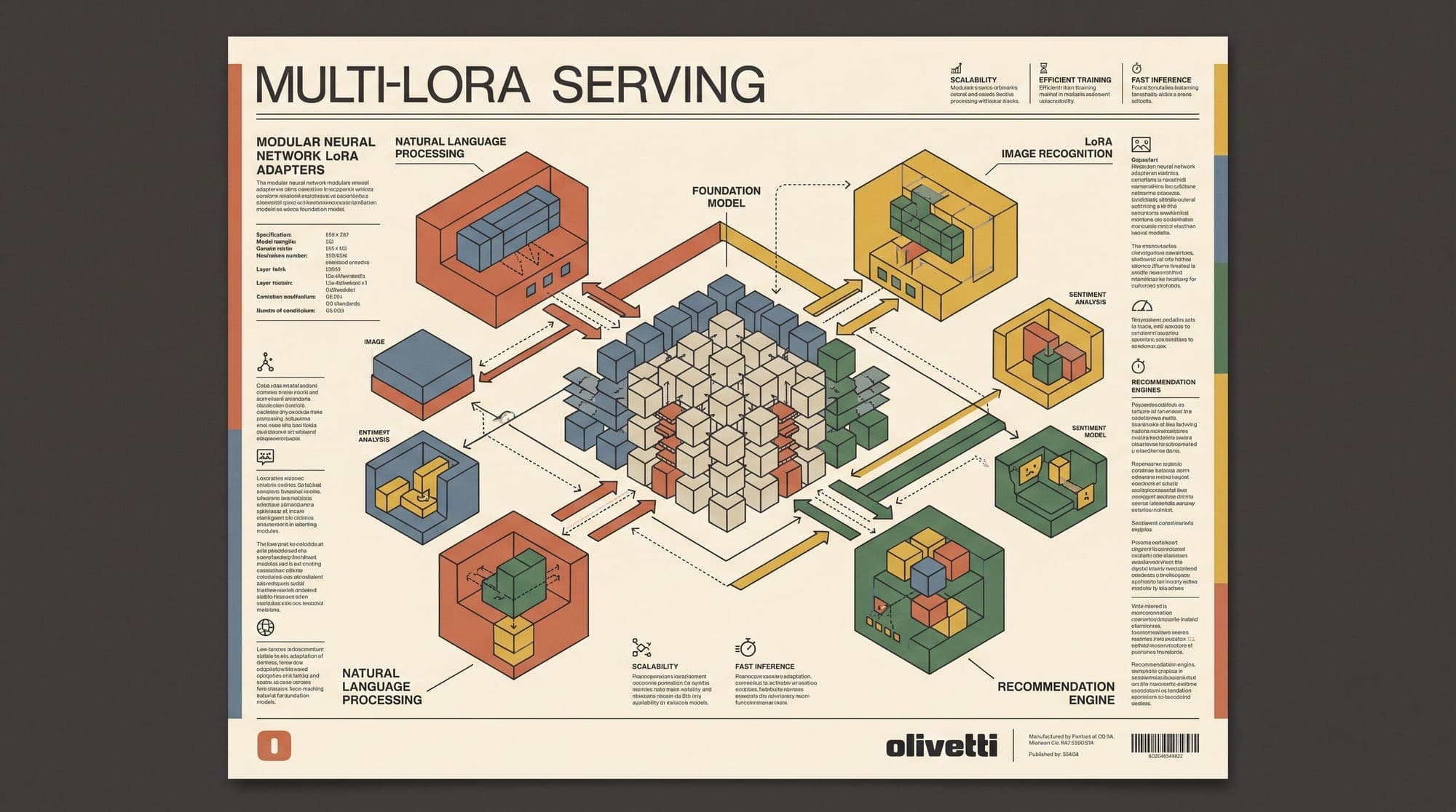
  5. Multi-LoRA Serving in Production: Architecture, Dynamic Adapter Swapping, and GPU Memory Management

    Deploying hundreds or thousands of fine-tuned language models across enterprise workflows presents a fundamental infrastructure dilemma. While parameter-efficient fine-tuning (PEFT) methods like Low-Rank Adaptation (LoRA) reduce training compute by freezing base model weights and training compact low-rank matrices, naive deployment strategies fail at scale. Merging adapter weights directly into the base model creates a distinct 7B to 70B parameter checkpoint for every specialized task, requiring

    AI
    8 min read
  6. LLM Output Calibration and Uncertainty Estimation in Production: Token Entropy, Semantic Clustering, and Risk-Controlled Abstention

    Production deployments of large language models frequently fail not because models lack capability, but because they lack reliable uncertainty estimation. Autoregressive language models generate hallucinations with the exact same fluent, assertive cadence as verified ground truth. When an enterprise application relies on downstream actions, database writes, or customer-facing advice, uncalibrated generations introduce severe operational risk. Treating raw token probabilities as calibrated confi

    AI
    6 min read