
Mistral released the open weights of Mistral Large 4 on Oct 29, 2026. That gives buyers three very large downloadable models from three different labs: Mistral Large 4, DeepSeek-V4.1-Flash (now updated as DeepSeek-V4.1-Flash-1017) and Alibaba's Qwen3.8-2.4T-A95B, the 2.4 trillion parameter model that the Qwen team calls the first Qwen-Max-class model in an open release.
This guide is for people who need to choose one and do not write inference code for a living. It covers four questions: what a task costs, what the license lets you do, what hardware the model cards point to, and when each model is the better fit. Every figure comes from the vendor's model card or launch post, or from Artificial Analysis, an independent benchmarking firm. All pages were checked on Oct 29, 2026.
If you want background first, read our Mistral Large 4 explainer, our explainer on open-weight vs closed models, our guide to the best open-source LLMs in 2026 and our list of the best open-source LLMs for coding.
The three models in one paragraph each
Mistral Large 4. The Hugging Face model card describes "a 1 trillion-parameter natively multimodal Mixture-of-Experts model with 49 billion active parameters per token (52 billion including embeddings and output layers)". It accepts text and images, returns text, and supports a 1M token context window. It has three reasoning settings: low, medium and high, with high as the default. Mistral pitches it in its launch post as "the best open-weight model for coding".
DeepSeek-V4.1-Flash. The base model card describes "a multimodal Mixture-of-Experts (MoE) model with 552B backbone parameters and support for contexts of up to one million tokens". It reads images and text and writes text. The card says it activates 8B parameters per token while reading input and 16B while writing output. The 1017 card calls that release "a minor update to DeepSeek-V4.1-Flash" with gains in reasoning, coding, agentic tasks and visual benchmarks. Our report on the 1017 update covers its benchmark claims and cost per task.
Qwen3.8-2.4T-A95B. The Qwen model card lists 2.4T total parameters with 95B activated, and a context length of "262,144 natively and extensible up to 1,010,000 tokens". The open weights are text only: the card says "Multimodal inputs are not supported, and thinking cannot be disabled." The hosted version, Qwen3.8-Max, adds vision input, a non-thinking mode and 1M context by default, per the same card. The Qwen3.8 GitHub repository dates the Hugging Face release to Aug 12, 2026. Our Qwen3.8 explainer sorts out the rest of the family, including the hosted Max.
Cost per task
Artificial Analysis publishes a "cost per Intelligence Index task" for models it has scored. It is the average cost, at the model's API prices, of one task in its own benchmark suite. It is a fair way to compare models against each other, but it is not a forecast of what your own tasks will cost. Here is what the three pages showed when checked on Oct 29, 2026:
- DeepSeek V4.1 Flash 1017 (Max): $0.60 per Intelligence Index task, with list prices of $0.30 per 1M input tokens and $1.20 per 1M output tokens on DeepSeek's API (Artificial Analysis).
- Mistral Large 4 (High): $2.06 per Intelligence Index task, with list prices of $0.70 per 1M input tokens and $2.10 per 1M output tokens on Mistral's API (Artificial Analysis). Mistral's launch post gives the same prices plus $0.07 per 1M cached input tokens.
- Qwen3.8 2.4T A95B: no cost per task, because Artificial Analysis lists its Intelligence Index score as N/A. Its list prices are $2.00 per 1M input tokens and $6.00 per 1M output tokens on Alibaba's API (Artificial Analysis).
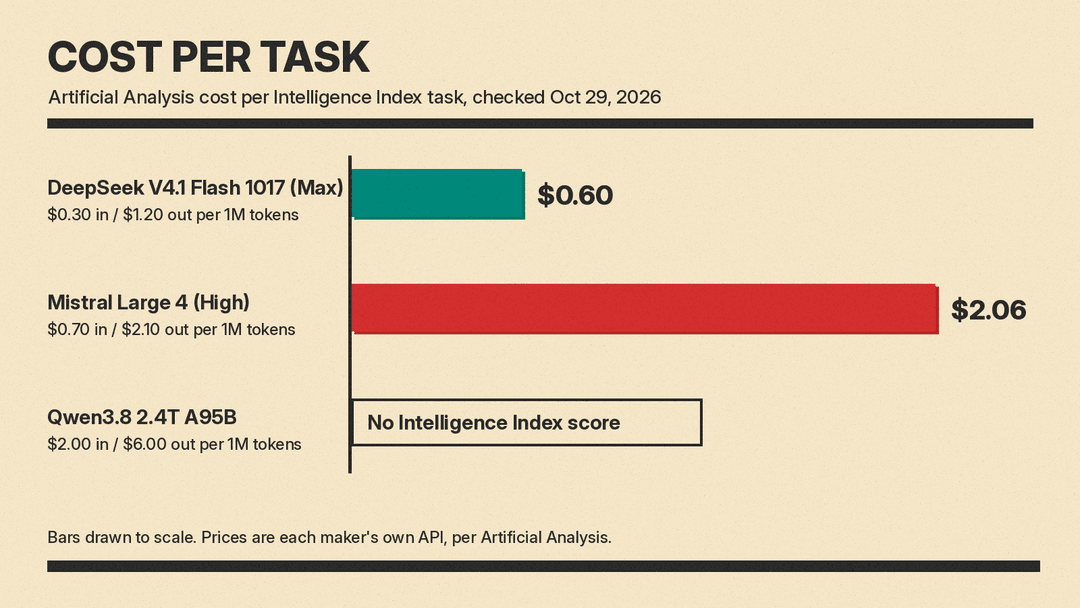
Two other numbers from Artificial Analysis help explain the gap. Its DeepSeek page says the model generated 170M output tokens while running the Intelligence Index, which it labels "very verbose". The Mistral page lists 110M output tokens. So DeepSeek writes more, but at a lower price per token. Speed also differs: Artificial Analysis measured 178.8 output tokens per second for DeepSeek, 161.3 for Mistral Large 4 and 41.1 for Qwen3.8 2.4T A95B, each on its maker's own API.
Mistral says its model uses fewer tokens on coding work, which it says makes coding agents "more economical to run at scale". Its launch post says that on the Artificial Analysis Coding Agent Index, Mistral Large 4 "scores 48%, effectively tied with the leading open-weight model, GLM-5.3, while using 47% fewer tokens per task on average." That is Mistral's summary. Its chart for that index also plots DeepSeek V4.1 Flash 1017, but the text gives no DeepSeek score, and the chart has no Qwen model.
How capable each one is
Scores below come from different harnesses and settings, so a number from one table should not be compared directly with a number from another.
Independent scores (Artificial Analysis Intelligence Index v5.0, checked on Oct 29, 2026). DeepSeek V4.1 Flash 1017 at its Max setting scores 32 and Mistral Large 4 at its High setting scores 26. As of Oct 29, 2026, DeepSeek has the higher score of the two. Qwen3.8 2.4T A95B has no Intelligence Index score on its page. The Mistral model card adds that 26 is "the highest among western open-weight models" and that "the leading open-weight models from China score higher on this aggregate index".
Mistral's coding claims (launch post, Oct 29, 2026):
- FrontierCode 2.0, Cognition's private benchmark: 19.7%, which Mistral says leads. Its chart puts DeepSeek V4.1 Flash next at 19.3%.
- Terminal-Bench 4.0: 41%, up 13 percentage points from the preview, in a chart Mistral titles "Artificial Analysis Coding Agent Index - Terminal-Bench 4.0".
- Surge Code blind pairwise tests: graders preferred Mistral Large 4 over GLM-5.3, Kimi K3 and DeepSeek V4.1 Flash, "ranking behind only Claude Opus 5.5 among the models evaluated", per Mistral.
- Artificial Analysis Cyber Index: 51%. The same Mistral chart shows DeepSeek-V4.1-Flash 1017 at 57%. Mistral's separate cyber claim is a 96.6% refusal rate on malicious cyber requests, "the highest we measure among open models".
DeepSeek's coding claims (DeepSeek-V4.1-Flash-1017 card): Terminal-Bench 4.0 at 42.3, run with the Claude Code harness, and DeepSWE v1.1 at 77.0, run with the Mini-SWE-V2 harness. Artificial Analysis, running Terminal-Bench 4.0 itself for its Intelligence Index, lists the same model at 34% and Mistral Large 4 (High) at 25% on its comparison page. Mistral's 41% comes from the chart it labels as the Artificial Analysis Coding Agent Index, a different setup. The same comparison page shows FrontierCode 2.0 at 28% for DeepSeek and 15% for Mistral. The gaps show how much the harness matters.
Qwen's coding claims (Qwen3.8-2.4T-A95B card): the card's table labels its column Qwen3.8-Max, the hosted version based on these weights. It reports Terminal Bench 2.1 at 86.6 (Claude Code, avg@10, 5-hour timeout), SWE-bench Pro at 67.7 (Claude Code harness, temperature 1.0, 256K context) and DeepSWE 1.1 at 56.6 (best of the Claude Code and mini-SWE-agent harnesses). Terminal Bench 2.1 is an older version than the 4.0 used by Mistral and DeepSeek, so those numbers do not line up.
The plain reading: on the one independent index that scores two of the three, DeepSeek is ahead and cheaper per task. Mistral's case rests on coding token efficiency and cyber refusals, mostly in its own charts. In Artificial Analysis's own Terminal-Bench 4.0 and FrontierCode 2.0 runs, DeepSeek scores higher. Qwen's case rests on its own benchmark table, with no independent index score yet.
Licenses
All three allow commercial use, but each draws the line in a different place. This is the part most likely to decide the choice for a business.
- DeepSeek-V4.1-Flash: MIT License. The card says "This repository and the model weights are licensed under the MIT License." Artificial Analysis marks its license as supporting commercial use without restrictions on its comparison page. Of the three, it has the fewest conditions.
- Mistral Large 4: Mistral Ecosystem Open-Weight License. Mistral's launch post calls it "a modified MIT license" and says the model is "free to use, modify, fine-tune, and commercialize, with a single condition: businesses that operate a Model-as-a-Service offering must obtain a separate commercial license from Mistral before using the model commercially." In plain terms, the extra license applies to businesses that operate a Model-as-a-Service offering.
- Qwen3.8-2.4T-A95B: Qwen3.8-Max License. The license file has two conditions. Products with more than 100,000,000 monthly active users or US$20,000,000 monthly revenue must display the model name prominently. A licensee that runs a Model as a Service or "AI Work Assistant" business, with aggregate revenue above US$50,000,000 over any 12 months, needs a separate license from Qwen before commercial use. The license defines an AI Work Assistant as a product "primarily designed for AI-assisted coding or office productivity". Internal use that does not expose the model to third parties is exempt from the second condition.
The Qwen conditions apply only above the user and revenue thresholds written into its license. The Mistral condition has no revenue threshold: it turns on whether a business operates a Model-as-a-Service offering.
Hardware
None of the three cards gives a memory figure for running the full model. What they do show:
- Mistral Large 4. The card serving examples use eight GPUs:
--tensor-parallel-size 8for vLLM and "run it on 8 GPUs withtorchrun" for Transformers. It also lists a quantized NVFP4 checkpoint "with a smaller memory footprint" that "targets Blackwell GPUs", and GGUF files for llama.cpp. The card adds: "For optimal performance, we recommend using the Mistral AI API if local serving is subpar." - DeepSeek-V4.1-Flash. The inference README converts weights for eight-way model parallelism (
MP=8) with FP4 experts, and calls its code "a readable reference implementation rather than a production serving engine". - Qwen3.8-2.4T-A95B. The card names SGLang, vLLM and TokenSpeed as serving engines and states: "For streamlined integration, we recommend using Qwen3.8 via APIs." It gives no GPU count.
For a non-developer, the practical point is that the Mistral and DeepSeek examples use eight GPUs, and the Qwen card recommends its API. If you want weights that fit on smaller machines, our open-source LLM roundup covers smaller options, and our how-to-run post for Mistral Large 4 walks through the serving options.
When to pick each
The steps below match the diagram.
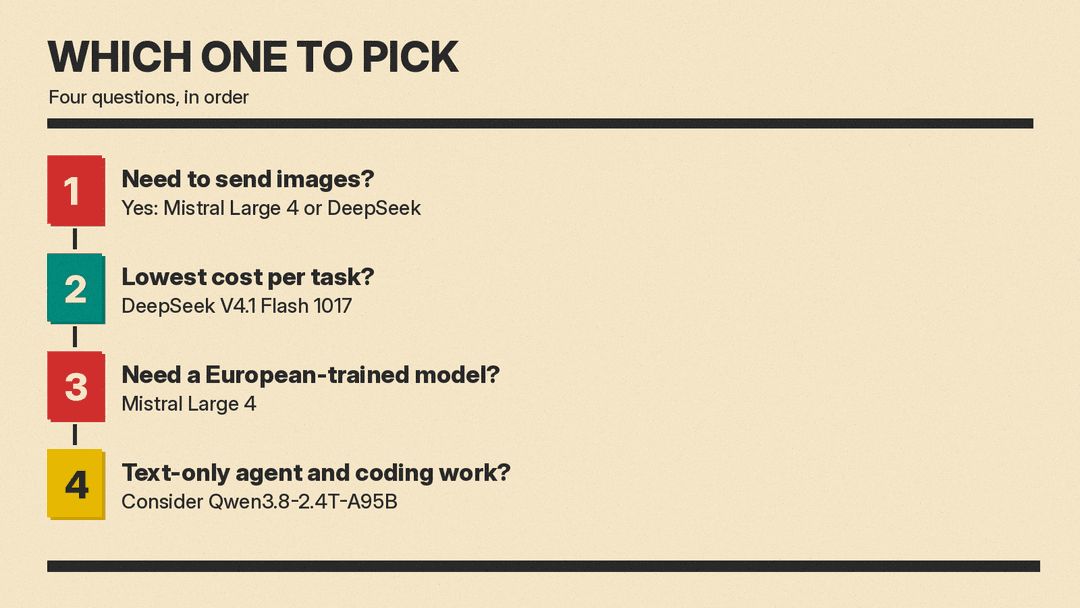
- Do you need to send images? The open Qwen3.8 weights are text only, per its card. Mistral Large 4 and DeepSeek-V4.1-Flash both accept images.
- Is cost per task the main concern? DeepSeek V4.1 Flash 1017 has the lowest Artificial Analysis cost per task of the two that are scored ($0.60 against $2.06) and the most permissive license (MIT).
- Do you need a European-trained model or a vendor relationship? Mistral's card says the model was "trained from scratch on 3,800 NVIDIA Grace Blackwell GPUs in Mistral's own datacenters in Europe." The same card says it shows "especially good performance on workloads such as cybersecurity, finance, and law", and Mistral offers customization through Mistral Forge, per its launch post.
- Text-only agent and coding work where you trust the vendor's numbers? Qwen3.8-2.4T-A95B posts high self-reported scores on its card. It has the highest API list prices of the three per Artificial Analysis, and no independent index score yet.
A short version:
- Pick DeepSeek-V4.1-Flash-1017 for the lowest measured cost per task, the higher Artificial Analysis Intelligence Index score of the two that are scored, and an MIT license.
- Pick Mistral Large 4 if you want a European-trained model, care about coding token efficiency and cyber guardrails as Mistral describes them, and do not plan to resell model access as a service.
- Pick Qwen3.8-2.4T-A95B for text-only agentic and coding work if its self-reported results match your tasks, and check the license thresholds before shipping.
What to watch
Artificial Analysis had not published an Intelligence Index score for Qwen3.8 2.4T A95B when checked on Oct 29, 2026. Its Alibaba creator page shows a score of 34 for the hosted Qwen3.8 Max (0902), which it lists with weights "Not available", so that score is not a score for the download. Mistral says Large 4 "will serve as the foundation for a new generation of specialized and optimized Mistral models", per its launch post. Prices on both APIs can change; the figures above are as checked on Oct 29, 2026.
Sources
- Mistral: Mistral Large 4 (Le Chonk) is now open weight
- Hugging Face: mistralai/Mistral-Large-4-1T-A52B model card
- Hugging Face: deepseek-ai/DeepSeek-V4.1-Flash model card
- Hugging Face: deepseek-ai/DeepSeek-V4.1-Flash-1017 model card
- Hugging Face: DeepSeek-V4.1-Flash inference README
- Hugging Face: Qwen/Qwen3.8-2.4T-A95B model card
- Hugging Face: Qwen3.8-Max License
- GitHub: QwenLM/Qwen3.8
- Artificial Analysis: Mistral Large 4 (High)
- Artificial Analysis: DeepSeek V4.1 Flash 1017 (Max)
- Artificial Analysis: Qwen3.8 2.4T A95B
- Artificial Analysis: Mistral Large 4 (High) vs DeepSeek V4.1 Flash 1017 (Max)
- Artificial Analysis: Alibaba models
