
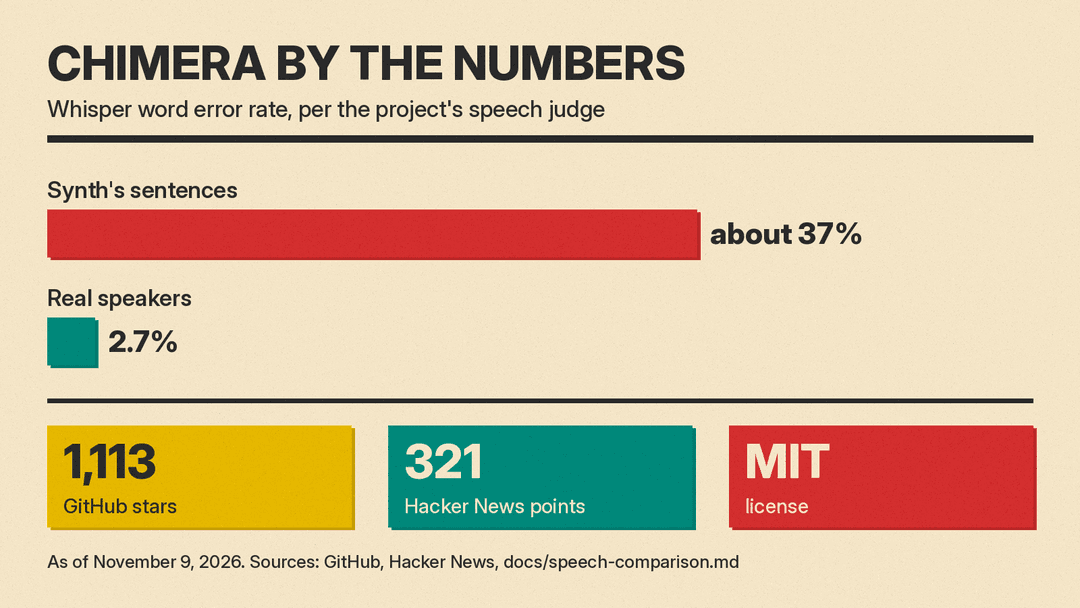
CHIMERA is an open-source voice synthesizer that runs in a web browser and produces every sound from a simulated airway rather than from recordings. It is an open-source project by Jameson Hodge, and it is not the ElevenLabs product with a similar name. The repository was created November 5, 2026, and by November 9, 2026 it had drawn 1,113 stars and 123 forks on GitHub.
What is CHIMERA?
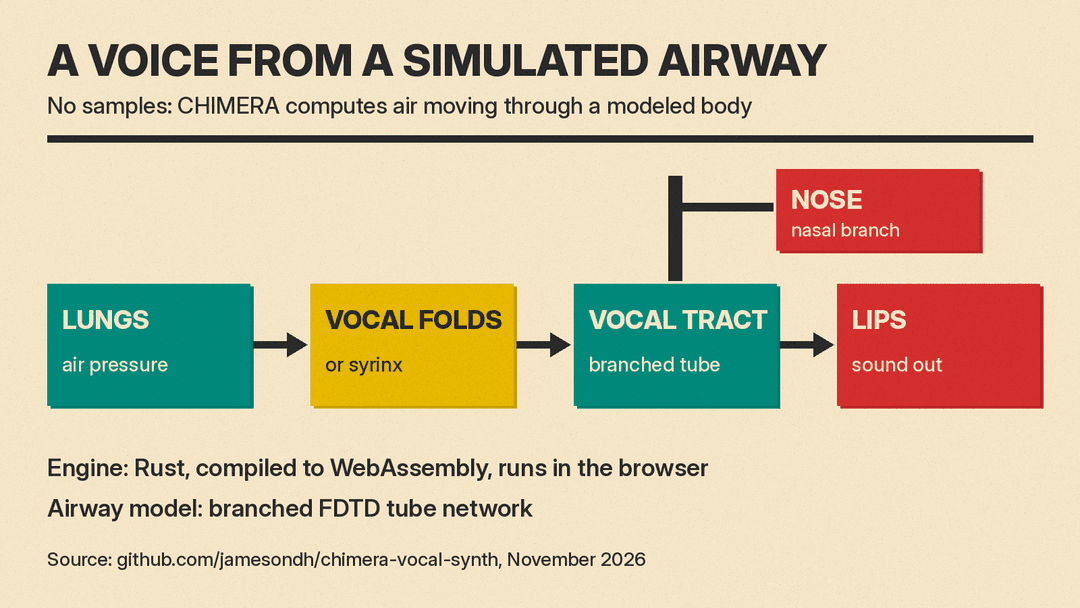
The repo describes CHIMERA as "A physical-modeling voice synthesizer in the browser. Every sound comes from a simulated airway (lungs, vocal folds or syrinx, a branched vocal tract, lips, nose), not from samples." Its tagline is "the ultimate vocal synthesizer - sing, speak, beatbox, and more." The project carries an MIT license, copyright 2026 Jameson Hodge.
The engine is written in Rust, compiled to WebAssembly, and run in an AudioWorklet, which is the browser's dedicated audio thread. According to the repo, the same code also runs natively for tests and for a command-line tool called chimera. The interface is built with React.
Interest arrived quickly for a days-old project. A Hacker News thread titled "Chimera Vocal Synth" reached 321 points and 58 comments as of November 9, 2026.
How it makes a voice without samples
Per the architecture document, the airway is modeled as a branched finite-difference time-domain (FDTD) tube network. The document says this approach was chosen over the older Kelly-Lochbaum tube model because it handles variable section lengths, pressure build-up behind closures and bursts, and branching such as the nasal tract in one framework. In practice, the simulation computes air moving through a modeled throat, mouth and nose, and the sound emerges from that physics.
That makes CHIMERA different in kind from typical AI voice tools. Text-to-speech models such as Underdog Woof, a tiny offline neural TTS model, and cloning systems such as Eleven v4, learn from recorded voices. CHIMERA contains no voice samples to learn from. Whether that trade produces a usable voice is an open question, and the project publishes its own measurements on the point.
What you can do with it
The README lists several modes:
- Play: drag the tongue, lips and jaw in a live cutaway of the head. Input comes from a vowel pad, encoders, the computer keyboard and Web MIDI.
- Speak: type English text or IPA. English runs through the CMU pronouncing dictionary with a letter-to-sound fallback, and the text is turned into gestures and prosody.
- Sing: a piano roll with lyrics per note, where consonants land before the beat.
- Beatbox: pads and a step sequencer, with every drum sound produced as an articulatory gesture.
- Bestiary: a songbird with a two-voice syrinx, a seal, an alligator and an elephant.
- Duet: two 3D heads replay a pre-rendered song.
Male, female and child bodies blend continuously. Everything on screen animates from live engine state, including airway pressure, airflow, vocal folds, spectra and formants.
Where AI comes in
No trained neural network makes the sound. Per the hill-climb document, the voice is a physics simulation, and AI shows up in how the project improves it. The document states: "An agent improves CHIMERA's voice in small steps. Each run is one experiment: one hypothesis and one change, measured against a real singer." A change is kept only if the judges call it better, and "Nothing reaches main until the owner has listened to the result and merged it." The experiment log includes batch reviews by Codex.
The current batch 2 focuses on pronunciation. A change is kept only if the word error rate from Whisper, OpenAI's speech recognition model, on the training sentences drops at least 1.5 points below the best run so far. The batch's targets come from what the owner heard: sh, ch and j sounds that are too quiet and too low, so "sheet" is heard as "feet"; stressed vowels that sound squeezed; and a p in "sharp" that popped, which the document marks as fixed by experiment 16.
The judges compare the synth against real recordings. Singing is scored against the Children's Song Dataset: one professional female singer performing 50 English and 50 Korean children's songs, licensed CC BY-NC-SA 4.0 and used for tuning only, not shipped. Speech is scored against the TSP speech database of 23 real speakers, 12 female and 11 male adults reading Harvard sentences. That document says Whisper gets 2.7% of words wrong on the real recordings and "about 37 % wrong on the synth's sentences."
How to try it
A live demo runs in the browser, described as "A voice grown from a simulated airway," with a prompt to "Breathe in and start." The audio worklet needs a secure context, which means localhost or HTTPS.
You can also build it yourself. An AI Frontier Post hands-on guide reports building the CLI in 1 minute 58 seconds and notes that no account, API key, GPU or model weights are needed. The guide also observes that the project is days old and that in-app WAV export is unfinished. The command-line tool does render WAVs.
Limits
The architecture document lists features not built yet: the wider bestiary beyond the four creatures, two-mass vocal folds, an IPA chart mode, an in-app effects chain, and in-app WAV export. The document adds a caveat about itself: "Treat the code as the truth where this file disagrees."
Intelligibility is the other documented limit. By the project's own measurement, Whisper transcribes the synth's sentences with about 37% of words wrong, against 2.7% for real speakers. The AI Frontier Post guide's note that the project is days old is worth keeping in mind when reading any of these numbers.
Why it matters
CHIMERA points at a route to synthetic voice that does not run through recorded speech. The sound is not built from recordings of a person, though the tuning compares it against real singers and speakers. It runs locally in a browser rather than on a remote service. The code is open under MIT and inspectable, down to the physics.
The counterweight is quality. By the project's own measurement, its speech is far less intelligible than real speech, with 37% Whisper word errors against 2.7% for the recordings it is compared to. Whether physical modeling can close that gap is the question CHIMERA leaves open. For the other direction, where AI is moving into mainstream music software, see our piece on AI in Splice Create, Pro Tools and Logic Pro 13.
