
LongCat is the family of AI models built by Meituan, the Chinese food delivery and local services company. The name covers large language models, a reasoning model, an "omni" model that handles speech and video, and separate models for images, video and speech. Most of them are published as open weights on Hugging Face.
This guide explains what LongCat is, which models are in the family, how you can use them and what to keep in mind. All model facts come from Meituan's own model cards and posts, checked in November 2026.
What is LongCat?
LongCat is Meituan's AI model brand. The team publishes its models under the meituan-longcat organization on Hugging Face and runs a website at longcat.ai.
The language models are the core of the family. Around them sit models for other media, so LongCat is a full model lineup, not one chatbot.
Meituan is a consumer internet company that builds its own models, much as Alibaba builds Qwen and ByteDance builds Doubao. For a map of the wider field, see our guide to China's AI labs.
Which LongCat language models exist?
The language models come in two size groups: the "Flash" generation and the larger 2.x generation.
LongCat-Flash-Chat
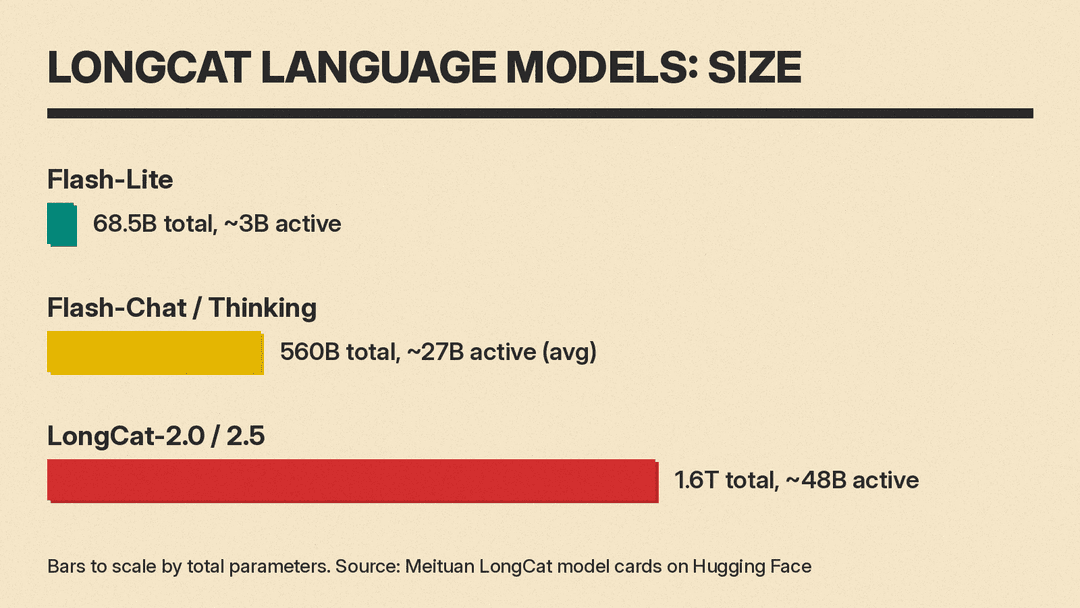
LongCat-Flash-Chat is the oldest model on the LongCat Hugging Face page. Its model card describes "560 billion total parameters" in a Mixture-of-Experts (MoE) design.
MoE means the model is split into many smaller expert networks, and only some of them run for each word piece (token). LongCat-Flash adds a twist that Meituan calls "zero-computation experts." According to the card, the model activates between 18.6B and 31.3B parameters per token, averaging about 27B, depending on how important each token is. The idea is to spend more compute on hard tokens and less on easy ones.
Meituan calls Flash-Chat "a non-thinking foundation model" with strengths in agentic tasks. The card says mid-training extended the context length to 128k tokens.
LongCat-Flash-Thinking
LongCat-Flash-Thinking uses the same 560B design but is trained as a reasoning model, one that works through a problem step by step before it answers. The card highlights formal reasoning, such as automatic theorem proving. A later version, LongCat-Flash-Thinking-2601, is also on Hugging Face.
LongCat-Flash-Lite
LongCat-Flash-Lite is the small option. Its card describes "a non-thinking 68.5B parameter" MoE model with about 3B activated parameters and a 256k context length through the YaRN method. It adds an N-gram embedding table, which Meituan says improves both quality and inference speed.
LongCat-2.0 and LongCat-2.5
The 2.x models are much larger. The LongCat-2.0 card describes "1.6 trillion total parameters and ~48 billion activated per token." Meituan says it introduced LongCat Sparse Attention and trained the model on 1M-context data, with a focus on coding and agent tasks.
LongCat-2.5 keeps the same scale, 1.6 trillion total parameters and about 48 billion active per token. The card calls it "a native multimodal MoE model for long-horizon agentic tasks." In plain terms, it can read images as well as text and is trained to carry out long multi-step jobs such as building a full software project.
Meituan says LongCat-2.5 was trained on Chinese-made AI accelerators. We covered that claim and its limits in Meituan LongCat-2.5: 1.6T Model Trained on Chinese Chips. The LongCat-2.5 weights went up on Hugging Face after that article was written. The 2.5 card also says the model "can be deployed on NPU platforms" and offers a 4-bit (W4A4) version, LongCat-2.5-W4A4.
What other LongCat models are there?
Meituan also publishes models for speech, images, video and audio:
- LongCat-Flash-Omni. An "omni-modal" model with 560 billion parameters and 27B activated, built on the Flash design. Its model card says it handles real-time audio and video interaction and supports a context window of up to 128K tokens.
- LongCat-Video. A video generation model with 13.6B parameters for text-to-video, image-to-video and video continuation. Its card says it can produce "minutes-long videos" and generates 720p, 30fps video "within minutes."
- LongCat-Video-Avatar. Models for audio-driven video of a talking person (a digital human). Version 1.5 is on Hugging Face.
- LongCat-Image. A bilingual Chinese and English image generation model. Its card stresses text rendering inside images and says it has "only 6B parameters." There are also LongCat-Image-Edit models for editing photos.
- LongCat-AudioDiT. Text-to-speech models in 1B and 3.5B sizes. The card describes a diffusion-based model that works directly in the waveform latent space.
Other releases on the Hugging Face page include LongCat-Next and LongCat-Flash-Prover.
Is LongCat open source?
Most LongCat models are open weights, which means you can download the trained model files. The licenses differ by model, so check each card:
- LongCat-Flash-Chat, Flash-Thinking, Flash-Omni, Flash-Lite, 2.0, 2.5, Video, Video-Avatar-1.5 and AudioDiT-3.5B list the MIT License on Hugging Face.
- LongCat-Image lists the Apache 2.0 license.
The Flash-Chat card says the repository, "including both the model weights and the source code, is released under the MIT License." It adds: "This license does not grant any rights to use Meituan trademarks or patents."
MIT and Apache 2.0 are permissive licenses. They let people use, change and share the software, including for commercial work, as long as they follow the license terms, such as keeping the copyright notice.
How can you use LongCat?
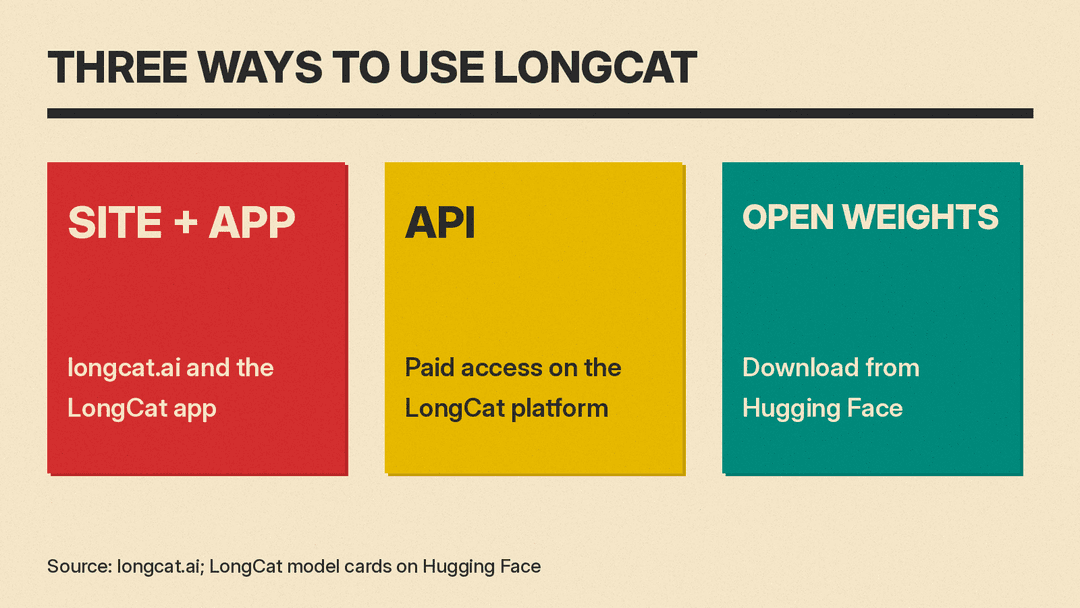
There are three main routes.
Chat and apps. The longcat.ai site offers LongCat to users; its page title calls it "LongCat - AI Coding Agent." The LongCat-Flash-Omni card says a LongCat app is available for Android and iOS, and notes that for iOS "only the Chinese App Store is supported."
API. Meituan offers paid API access through the LongCat platform. Prices change, so check the LongCat platform docs for current rates.
Run it yourself. Developers can download the weights from Hugging Face. The large models need serious hardware. For example, the Flash-Omni card says the 560B model "requires at least one node (e.g., 8×H20-141G)" for FP8 weights and at least two nodes (16×H800-80G) for BF16. The 1.6T 2.x models are larger still. The image, speech and video models and Flash-Lite are much smaller downloads.
How does LongCat compare with other Chinese models?
LongCat sits in the same group as other large open-weight Chinese model families, such as DeepSeek, Qwen, Kimi and GLM. A few traits stand out in Meituan's own descriptions:
- Dynamic compute. The Flash models change how many parameters they use per token, from 18.6B to 31.3B.
- Domestic hardware. Meituan says LongCat-2.5 was trained on Chinese AI accelerators, and its 2.x cards include NPU deployment instructions.
- Broad media coverage. The family spans text, reasoning, speech, images, video and talking-head avatars.
Meituan's model cards include benchmark tables that compare LongCat with other models. Those are Meituan's own tests, run with its own settings, and they should be read as vendor claims.
What to keep in mind
- Vendor claims. Parameter counts, speeds and benchmark scores in this guide come from Meituan. Independent results may differ.
- Check the license per model. Most models list MIT, but LongCat-Image lists Apache 2.0. Read the license file in each repository before you build on it.
- Responsible use. The Flash-Chat card says the model "has not been specifically designed or comprehensively evaluated for every possible downstream application," and asks developers to assess accuracy, safety and fairness before use in sensitive settings.
- App region. The LongCat iOS app is listed only for the Chinese App Store, according to the Flash-Omni card.
Sources
- Meituan LongCat on Hugging Face (model list)
- LongCat-Flash-Chat model card
- LongCat-Flash-Thinking model card
- LongCat-Flash-Lite model card
- LongCat-2.0 model card
- LongCat-2.5 model card
- LongCat-Flash-Omni model card
- LongCat-Video model card
- LongCat-Image model card
- LongCat-AudioDiT-3.5B model card
- LongCat website
- LongCat platform pricing docs
