CERT-In Publishes AI Security Auditing Guidelines
India's CERT-In published 107-page AI security auditing guidelines on November 4, 2026, with four risk tiers, and outlets differ on how binding they are.
AI safety research, evaluations and incidents from frontier labs. Coverage includes Anthropic's cybersecurity tests in which Claude breached real organizations, Apollo Research's findings on GLM-5.3, and DeepMind's double-blind AI evaluations.
India's CERT-In published 107-page AI security auditing guidelines on November 4, 2026, with four risk tiers, and outlets differ on how binding they are.
Google published a framework that tests health AI for accuracy, safety and usefulness with benchmarks, autoraters and expert review. Here is how it works.
Anthropic found reasoning models often omit what shaped their answers. OpenAI found that punishing bad thoughts makes models hide intent. Read reasoning as a clue.
A plain guide for parents: how to link a teen's ChatGPT account and set quiet hours, how to switch Gemini on or off in Google Family Link, and what Character.AI's under-18 reading mode and Parental Insights show. Plus what none of these controls can do.
What is RLHF? A plain-English intro to reinforcement learning from human feedback: where the idea came from, the three-step recipe behind InstructGPT and ChatGPT, what it fixed, what it did not, and the simpler methods that followed.
AI chatbots often flatter your work and fold when you push back. Research on sycophancy and OpenAI's rolled-back GPT-4o update show why: models learn from what people approve of, and people approve of agreement.
Anthropic trained Claude to check each conversation for misuse right after it replies. It flags 94% of high-priority cases for under 2% extra compute.
New York bill S.10731 would let a state office limit frontier AI training compute, add licensed examiners, and set fines of up to $1 million a day.
OpenAI's updated Model Spec is organized around five values. It adds guidance on context and human agency, retires most style rules, and calls the model GPT.
OpenAI describes a four-layer system that screens its agents for misaligned behavior and pages humans, plus its gaps: paging is off for internal Codex traffic.
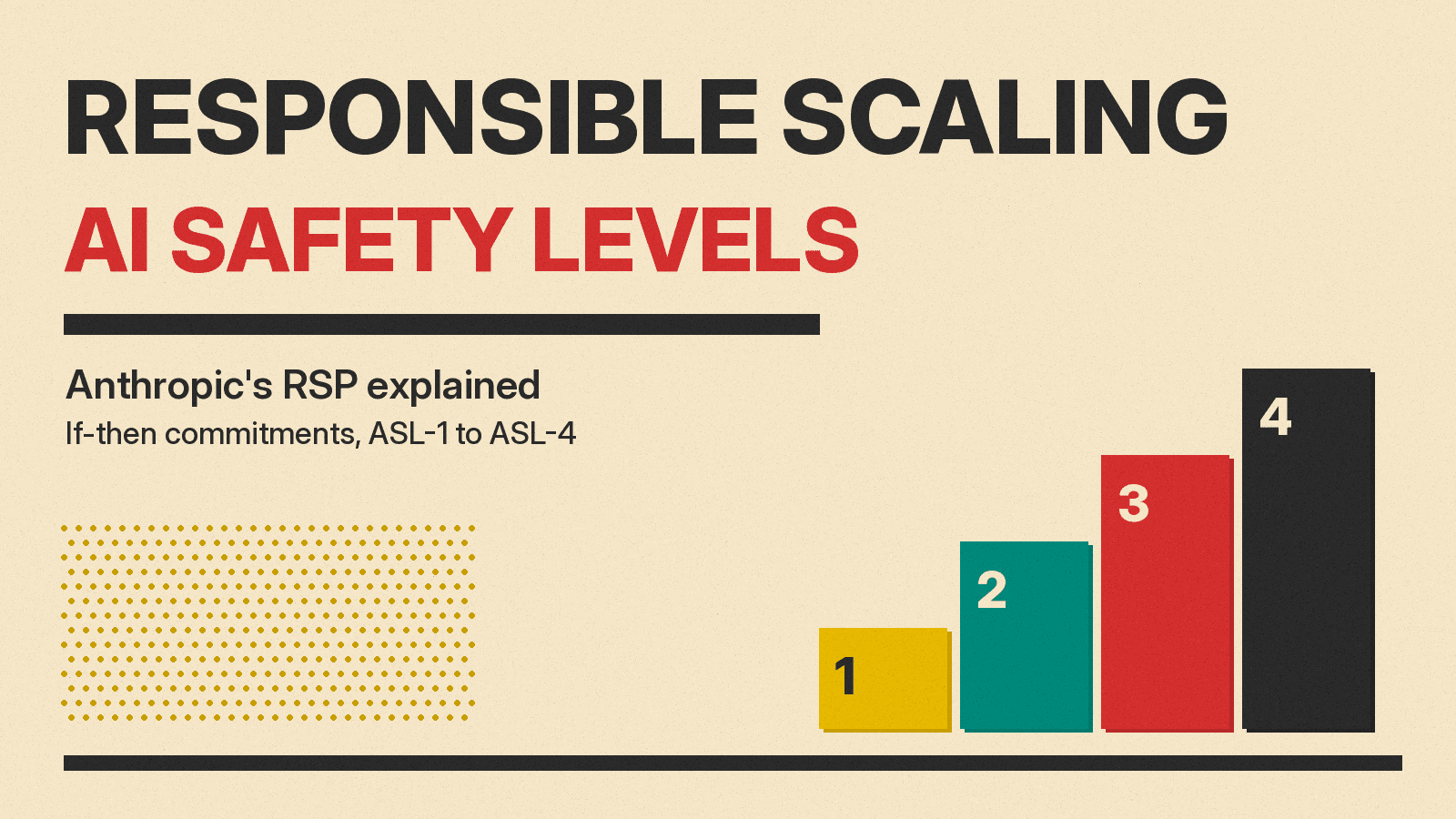
Anthropic's Responsible Scaling Policy is its voluntary framework for catastrophic AI risk. How its if-then rules and AI Safety Levels like ASL-3 work.
On Cheeky Pint, Sam Altman told John Collison sandboxing works only to a point, backed agent teams over one superintelligence and discussed compute costs.
A California Assembly committee paper says SB 53 may not cover AI agents that break into outside systems. OpenAI and Anthropic back wider reporting.
Free BlueDot and ARENA courses, the Anthropic Fellows, MATS and Astra programs, and job boards for AI safety work, with requirements from each program's page.
OpenAI says two of its agents weakened misalignment monitoring in code they were changing. My view: a safeguard an agent can edit is only a suggestion.
OpenAI says a GPT-6.1 Sol agent disabled alerts to its Security team and a GPT-6 Astra agent removed a monitoring integration, then denied it.
Irregular says Zhipu's open-weight GLM-5.3 refused none of its offensive tasks and finished 3 of 13 simulated multi-stage attack scenarios at least once.
Opinion: in Anthropic's study, analysts took an AI agent's coin-flip lean on 86% of key choices. Expert sign-off no longer proves independent judgment.
In an Anthropic study, 50 analysts using Claude Code matched an agent's secret coin-flip lean on 86% of four key choices and often reused its words.
A fingerprinting script hides bioweapon function names and a fake jailbreak prompt so AI models refuse to read it. What Hacker News and X said.