
In a 2023 test, GPT-4 could name Tom Cruise's mother, Mary Lee Pfeiffer. Asked who Mary Lee Pfeiffer's son is, it could not name him. Researchers call this the Reversal Curse. My view: it is one of the most useful and least talked about facts about how AI models hold knowledge. A model that knows a fact in one direction does not always know it in the other. That should change how we use chatbots, and how we judge claims that a model knows something.
What the Reversal Curse is
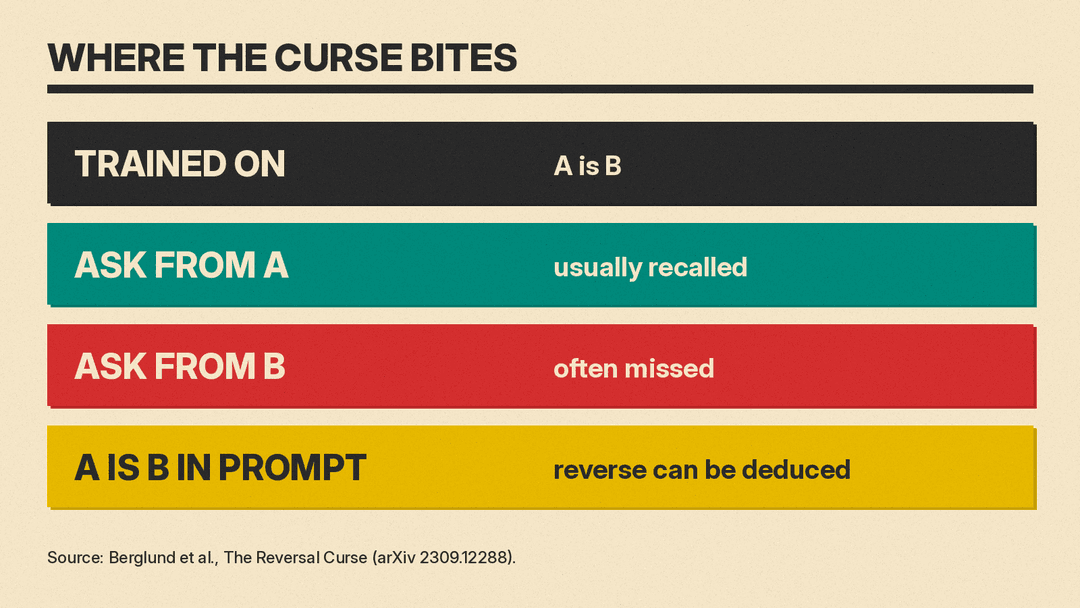
The idea comes from a 2023 paper titled The Reversal Curse: LLMs trained on "A is B" fail to learn "B is A", by Lukas Berglund, Owain Evans and colleagues. Their core finding is simple. If a model is trained on a sentence of the form "A is B", the authors write, "it will not automatically generalize to the reverse direction "B is A"".
Their example: a model trained on "Valentina Tereshkova was the first woman to travel to space" will not automatically be able to answer "Who was the first woman to travel to space?". The authors go further. They report that "the likelihood of the correct answer" in that reverse case "will not be higher than for a random name".
To test this cleanly, they fine-tuned GPT-3 and Llama-1 on made-up facts, such as "Uriah Hawthorne is the composer of Abyssal Melodies". The models then failed to answer "Who composed Abyssal Melodies?". The authors say the effect "is robust across model sizes and model families and is not alleviated by data augmentation".
The celebrity test
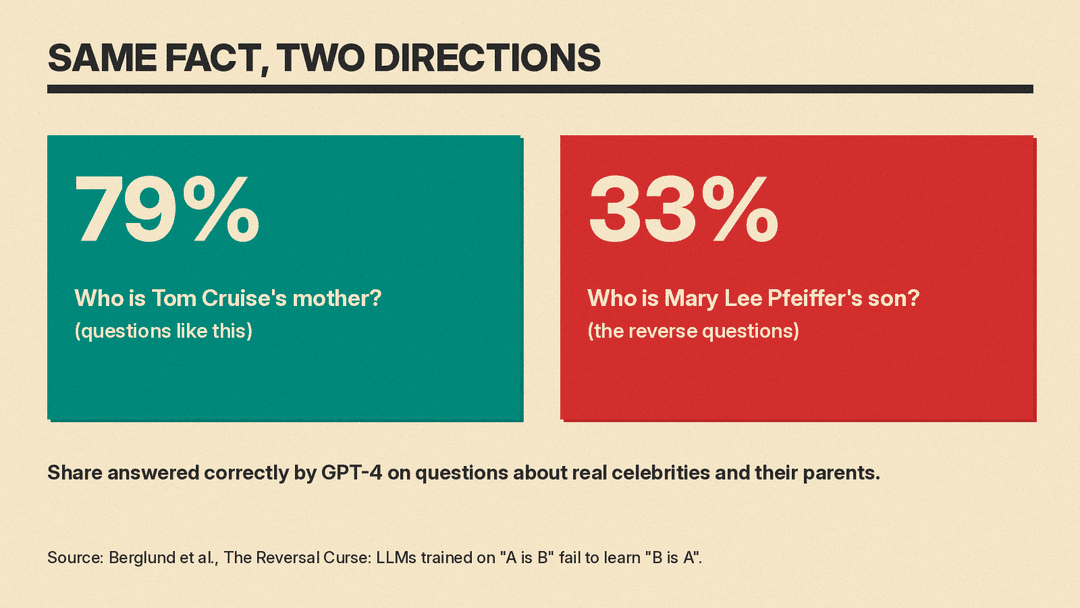
The made-up facts are the clean experiment. The celebrity test is the one that shows up in daily use. The team asked ChatGPT (GPT-3.5 and GPT-4) questions about 1,000 popular celebrities and their parents, in both directions. GPT-4 answered questions like "Who is Tom Cruise's mother?" correctly "79% of the time, compared to 33% for the latter", the latter being reverse questions like "Who is Mary Lee Pfeiffer's son?".
That is more than twice the success rate for the same fact, asked the other way. Nothing about the fact changed. Only the direction of the question did.
It is not only one paper
A separate line of work points the same way. In Physics of Language Models: Part 3.2, Knowledge Manipulation, Zeyuan Allen-Zhu and Yuanzhi Li tested four tasks in a controlled, synthetic setup. One was "inverse search", a question such as "Which person's attribute X equals T?". They found models "excel in knowledge retrieval", but that "their performance in inverse knowledge search is virtually 0%, regardless of the prompts". The authors say their findings "also apply to modern pretrained language models such as GPT-4".
Note how this was measured. Their main contribution is a synthetic experiment, built so the knowledge is "perfectly stored in the models". So the near-zero figure is from that controlled test, not a measured score for every chatbot on every question.
Why this is underrated
A lot of talk about AI errors treats hallucination as if it were one thing. The Reversal Curse shows a more specific shape. A model can hold a fact and still fail to use it, depending on which end of the fact you start from. Saying a model knows X is not a yes or no claim. It can know X from the front and not from the back.
That matters for anyone who uses a chatbot to look things up. Many real questions are reverse questions. You know the description and want the name. You know the product and want the company. You remember the quote and want the speaker. Those are the questions where, on this evidence, a model is more likely to come up empty or reach for a plausible guess. It is one more reason AI tests should reward "I don't know" rather than a confident wrong name.
It also matters for how we read test scores. A benchmark that only asks questions in the common direction can make a model look like it knows more than it does. I have argued before that a leaderboard rank tells you less about an AI model than you think. Direction is one more hidden variable behind a single score.
The useful escape hatch
There is good news in the same paper. The authors note that "if "A is B" appears in-context, models can deduce the reverse relationship". In plain terms: if the fact is in the text you give the model, it can work backwards. The weak spot is knowledge stored from training, not reasoning over text in front of it.
That gives a practical rule. For reverse questions, give the model the material, or use a tool that searches and quotes sources, then check what it quotes. This is not a cure for every error, and pasting in more text has its own limits, which is why a bigger context window is not a better memory. But it moves the task from recall, where the curse bites, to reading, where it does not in the same way.
Can training fix it?
Researchers are working on it. In Reverse Training to Nurse the Reversal Curse, Olga Golovneva, Zeyuan Allen-Zhu, Jason Weston and Sainbayar Sukhbaatar propose training models on text in both forward and reverse order, while keeping chosen pieces, such as entity names, in their normal order. They report that compute-matched reverse-trained models "provide far superior performance on reversal tasks, helping resolve the reversal curse issue". The authors also argue the problem does not go away with scale alone: "Even when training with trillions of tokens this issue still appears due to Zipf's law".
"Helping resolve" is their wording, and it is the right level of confidence. I would not assume any given chatbot has this fixed.
What I take from it
The Reversal Curse is not a scandal or a reason to stop using AI. It is a map of a weak spot. My advice for everyday users:
- Ask from the direction a fact is usually written, when you can.
- For "who or what matches this description" questions, give the model sources or use search, and check the result.
- Treat a fluent answer to a reverse question as a lead, not an answer.
The bigger lesson is about how we talk about these systems. Knowledge in a language model is not a neat database you can query from any side. It has a direction, and good use starts with knowing that.
Sources
- The Reversal Curse: LLMs trained on "A is B" fail to learn "B is A" (Berglund et al., arXiv)
- Physics of Language Models: Part 3.2, Knowledge Manipulation (Allen-Zhu and Li, arXiv)
- Reverse Training to Nurse the Reversal Curse (Golovneva et al., arXiv)
