
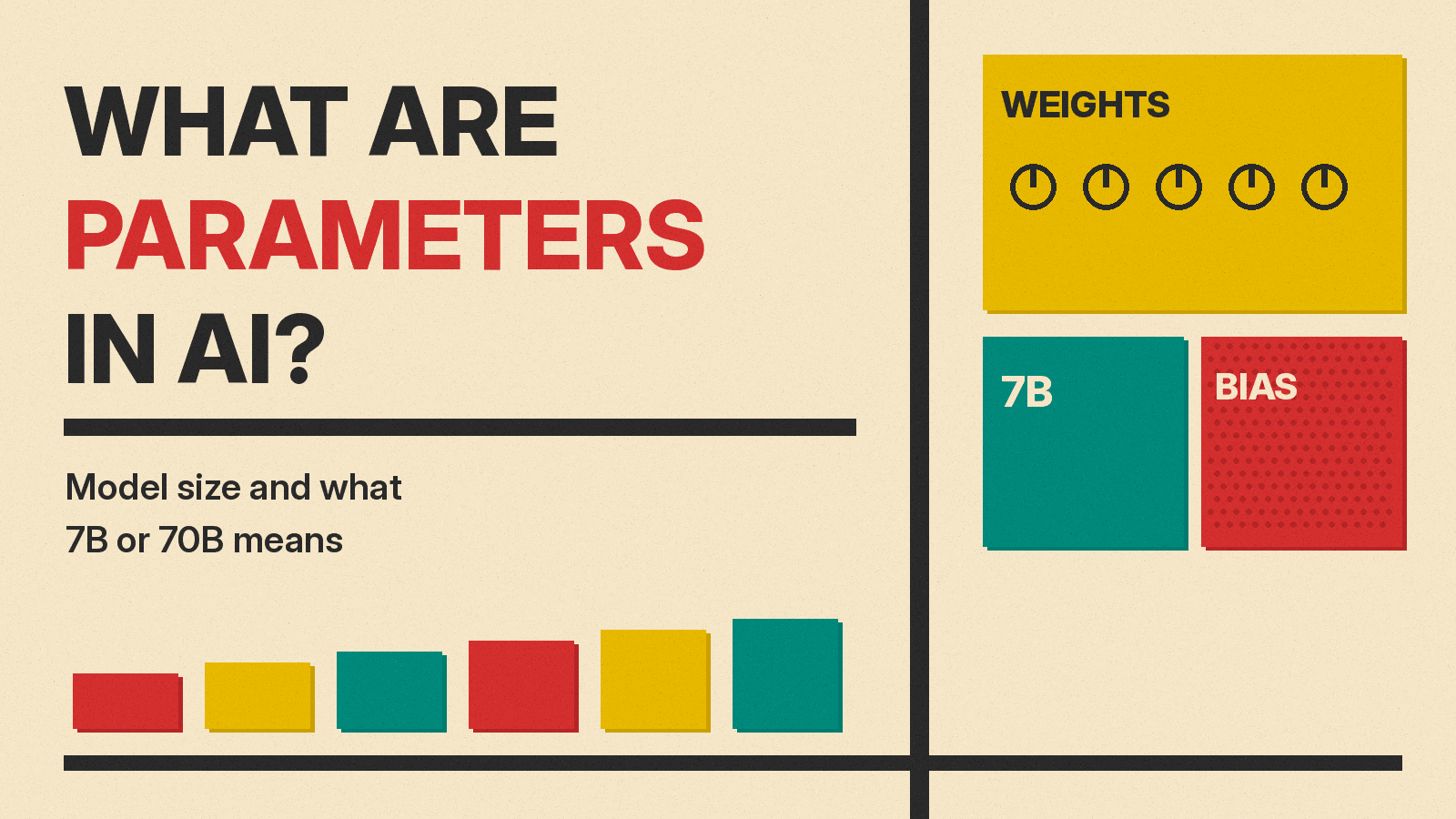
When an AI model is described as "7B" or "70B," the number refers to its parameters. Google's machine learning glossary defines parameters as "The weights and biases that a model learns during training." A model's parameter count is a common way to describe its size.
This guide explains what parameters are, how they get their values, what the "B" in a model name means, whether more parameters means a better model, and why size matters if you want to run a model on your own computer.
What is a parameter in AI?
A parameter is a number inside a model that was set by training. A large language model contains a very large number of them. Together they hold everything the model learned from its training text.
A simple way to picture it: imagine a sound mixing desk with millions of dials. Each dial changes the output a little. Training is the long process of turning every dial until the desk produces good results. After training, the dial positions are fixed, and those positions are the parameters.
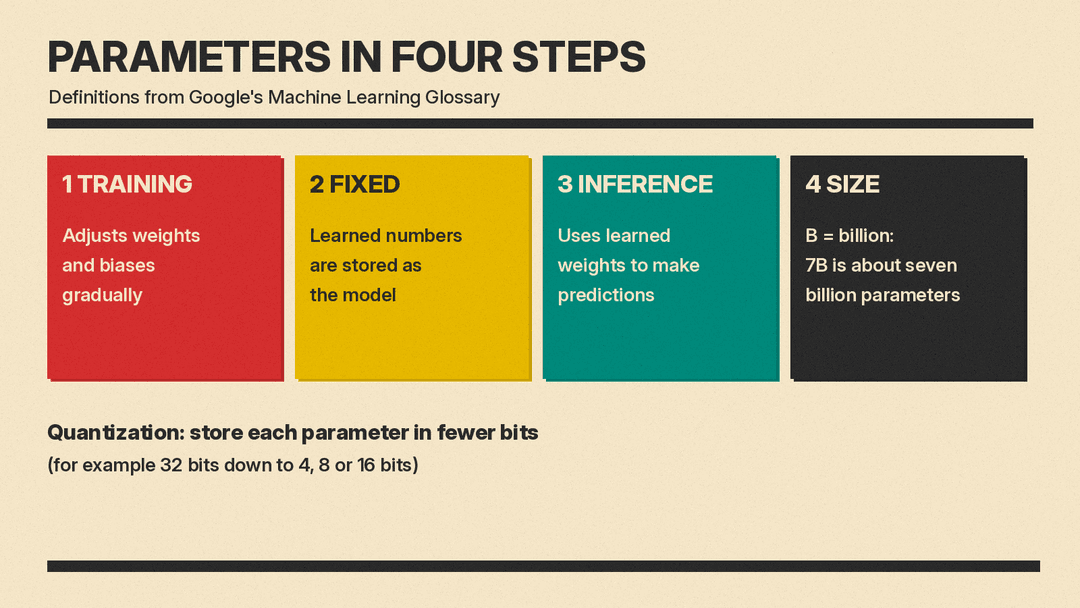
Google's glossary describes training as "The process of determining the ideal parameters (weights and biases) comprising a model." It adds: "During training, a system reads in examples and gradually adjusts parameters."
What are weights and biases?
Parameters come in two kinds.
- Weights. Google defines a weight as "A value that a model multiplies by another value." Weights decide how much each input counts.
- Biases. Google describes a bias as "An intercept or offset from an origin." In a simple line on a graph, Google says, bias "just means 'y-intercept.'"
Inside a neural network, these numbers sit in units called neurons. Google says each neuron "Calculates the weighted sum of input values multiplied by their corresponding weights," then passes that sum to an activation function. A large model stacks many layers of these units, which is why the parameter count grows so fast.
You will often see "weights" used to mean all of a model's parameters. When a company releases "open weights," it is publishing these learned numbers so others can download and run the model.
What is the difference between parameters and hyperparameters?
The names are close, but the roles differ.
- Parameters are learned. The training process sets them.
- Hyperparameters are chosen by people before or during training. Google's glossary calls them "the values that you (or a hyperparameter tuning service) supply to the model." Its example: "learning rate is a hyperparameter."
Settings you see in a chatbot or API, such as temperature, are also not parameters in this sense. They change how a trained model picks its words, but they do not change the learned numbers. They are settings, not learned values.
What does "7B" or "70B" mean?
The letter B stands for billion. A "7B" model has about seven billion parameters. "M" stands for million and "T" for trillion.
Open model pages often show this directly. On Hugging Face, the page for allenai/OLMo-7B lists "Model size 7B params." The size in a model's name is usually rounded.
Large language models are defined partly by this number. Google's glossary defines a large language model as, "At a minimum, a language model having a very high number of parameters." For a fuller introduction, see our explainer What Is an LLM?
How are parameters used when you chat with a model?
Training and use are two separate phases.
- Training sets the parameters. It reads huge amounts of text and adjusts the numbers many times.
- Inference uses the parameters. Google's glossary says "inference is the process of using those learned weights to make predictions." For a large language model, Google describes inference as "the process of using a trained model to generate a response to an input prompt."
When you send a chatbot a message, the model runs your text through its fixed parameters to produce each next piece of the answer. Your chat does not change the parameters. That is why a model does not learn from your conversation in the way it learned during training.
Does a bigger model mean a better model?
Often, but not by size alone. Two research papers studied this question.
- Scaling laws. In Scaling Laws for Neural Language Models, Jared Kaplan and colleagues report that a model's loss, a measure of its prediction error, "scales as a power-law with model size, dataset size, and the amount of compute used for training." In plain terms, more parameters, more data and more computing tend to produce better predictions, in a steady pattern.
- Data matters as much as size. In Training Compute-Optimal Large Language Models, Jordan Hoffmann and colleagues found that "for compute-optimal training, the model size and the number of training tokens should be scaled equally." They trained a model called Chinchilla with 70B parameters on the same compute budget as their earlier model Gopher (280B), with four times more training data, according to the abstract. The paper reports that Chinchilla "uniformly and significantly outperforms Gopher" on a large range of tasks.
The lesson from Chinchilla: a smaller model trained on more data can beat a larger model trained on less. Parameter count is one input to quality, not a score.
Other factors also matter: the quality of the training data, the training methods used after the first phase, and how the model is set up to reason. Two models with the same parameter count can perform very differently.
What are total and active parameters?
Some models do not use all of their parameters for every word. These are mixture-of-experts models.
Google's glossary defines mixture of experts as "A scheme to increase neural network efficiency by using only a subset of its parameters (known as an expert) to process a given input token or example." A gating network routes each token to the right experts.
That is why some model cards list two numbers:
- Total parameters: every parameter the model contains.
- Active parameters: the parameters used to process each token.
A mixture-of-experts model can have a large total count but use a smaller share at a time. When you compare models, check which number a vendor is quoting. Our mixture-of-experts explainer goes into more detail.
Why does parameter count matter for running AI at home?
Every parameter has to be stored in memory while the model runs. More parameters means more memory, and memory is usually the limit on a laptop or home computer.
Each parameter is stored as a number with a set precision. The Hugging Face page for OLMo-7B lists its tensor type as "F32," a 32-bit format. Two methods reduce the load:
- Quantization. Google's glossary describes quantization as "Reducing the number of bits used to store a model's parameters," for example converting 32-bit numbers "down to 4, 8, or 16 bits." Google says this reduces "Compute, memory, disk, and network usage." Our guide What Do Q4 and Q8 Mean? explains the labels you see on downloadable models.
- Distillation. Google describes distillation as reducing "one model (known as the teacher) into a smaller model (known as the student)." The benefits Google lists are "Faster inference time" and "Reduced memory and energy usage." Google also notes that "the student's predictions are typically not as good as the teacher's predictions."
Both methods trade some quality for a model that fits on smaller hardware.
Where can I find a model's parameter count?
For open models, check these places:
- The model name. Many open models include their size, such as the "7B" in OLMo-7B.
- The model page on Hugging Face. Pages such as allenai/OLMo-7B show a "Model size" line.
- The model card or technical report. These often list total parameters and, for mixture-of-experts models, active parameters.
If the three disagree, the model card or technical report from the developer is the better source, because names are rounded.
Why don't all AI companies publish parameter counts?
Many open models state their size in their names and model pages. Many closed models do not. Anthropic's models overview, for example, lists each Claude model's context window, maximum output, price and knowledge cutoff, but no parameter count.
For closed models, you will see estimates in the press. Unless the vendor publishes the figure, treat any number as unconfirmed. For practical choices, published test results, speed and price tell you more than a size estimate.
Quick summary list
- Parameters are the learned numbers inside a model: weights and biases.
- Hyperparameters and chat settings are chosen by people, not learned.
- "B" means billion: a 7B model has about seven billion parameters.
- More parameters can help, but training data and methods matter just as much.
- Mixture-of-experts models have total and active parameter counts.
- Quantization and distillation shrink models so they fit on smaller machines.
Caveats
- Parameter counts in model names are rounded.
- Some vendors quote total parameters and others quote active parameters.
- The scaling research cited here studied the models and setups described in those papers. It shows trends, not rules for any one model.
- This guide was checked on November 11, 2026 (PST) against the pages below.
Sources
- Google: Machine Learning Glossary, checked on November 11, 2026
- Kaplan et al.: Scaling Laws for Neural Language Models (arXiv), checked on November 11, 2026
- Hoffmann et al.: Training Compute-Optimal Large Language Models (arXiv), checked on November 11, 2026
- Hugging Face: allenai/OLMo-7B model page, checked on November 11, 2026
- Anthropic: Models overview, checked on November 11, 2026
