
Mistral has released Voxtral 3, a set of speech models plus a software kit for building voice agents that work over phone or web. Mistral says a reliable voice agent has to do four things well: listen, reason, speak, and take action through connected systems. Mistral's model page dates the new text-to-speech model October 20, 2026, and lists it as a public preview.
Mistral now sells transcription, text-to-speech and the voice agent pipeline with list prices, and says companies can run the whole stack on Mistral's API or on their own infrastructure.
What is in Voxtral 3
According to Mistral's Voxtral 3 announcement, the release includes:
- Voxtral Small Transcribe 3, the speech-to-text model Mistral calls its highest-accuracy option. It transcribes more than 50 languages, labels who said what (diarization), and accepts a list of key terms to improve accuracy on names and jargon (context biasing).
- Voxtral Mini Transcribe 3, a 4B-parameter model that Mistral says gives fast and accurate transcription, and Voxtral Mini Transcribe Realtime 3, built for live calls. Mistral says the realtime model transcribes at under 500 ms of latency and detects when a speaker has finished talking.
- Voxtral Mini TTS 3, the text-to-speech model. Mistral says its voices adjust emotion, pace and emphasis to the conversation, in more than 35 languages and more than 50 dialects.
- A voice agent SDK built on LiveKit, an open source framework for voice and video AI agents, that connects listening, reasoning, tool calls and speech in one pipeline.
One detail differs between Mistral's own pages. The announcement body says the realtime transcription model works in "over 35 languages", while its model card on the same page says "40+ languages". Check the Mistral docs for the current list before you plan a launch in a specific language.
How the voice agent works
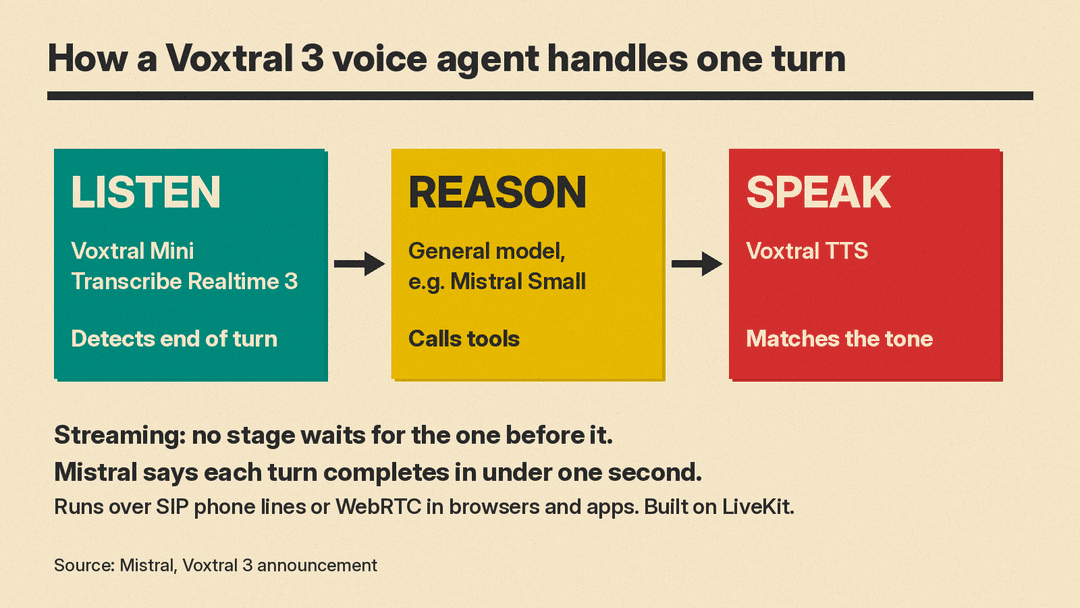
Mistral describes a three-stage loop. The realtime transcription model listens and decides when the caller is done. A general language model, for example Mistral Small, works out the answer and calls tools such as a billing lookup or a booking system. Voxtral TTS then replies "in the tone of the conversation so far."
Mistral says no stage waits for the one before it, so each turn completes in under one second, and the agent stops talking when the caller cuts in. The agent can answer and place calls over SIP phone lines and runs in browsers and apps over WebRTC. Because each stage is a separate model, Mistral says you can swap the language model, the voice or the language without rewriting the agent.
This is the cascaded design, where speech becomes text and text becomes speech again. Speech-to-speech models work on audio directly instead. Labels can mislead: ElevenLabs markets Eleven Realtime as speech to speech, but its docs say those models are cascaded too. Our explainer on speech-to-speech vs cascaded voice agents covers the trade-offs: a cascade is easier to inspect and change, while a single audio model can keep more of the tone and timing.
Voices and voice cloning
Voxtral TTS has preset voices in 18 languages, from Arabic (Emirati and Modern Standard) to Vietnamese. The model page lists 34 emotion tags, 2 pace tags, 5 output formats and streaming with about 90 ms to first audio.
There are two kinds of cloning:
- Zero-shot cloning. The voice cloning docs say it reproduces a voice from a short recording with no training. You can use the clip for one request or save it as a voice. Saved voices carry a retention setting that defaults to 30 days and can be set from 1 to 365 days.
- Pro Voice. For professional work, Mistral says Pro Voice reproduces a speaker's character, emotional range and speaking style across languages from 30 minutes of audio. The docs recommend 30 minutes to 3 hours of clean, single-speaker recordings.
The docs also say a cloned voice is not limited to the language of its recording.
Prices
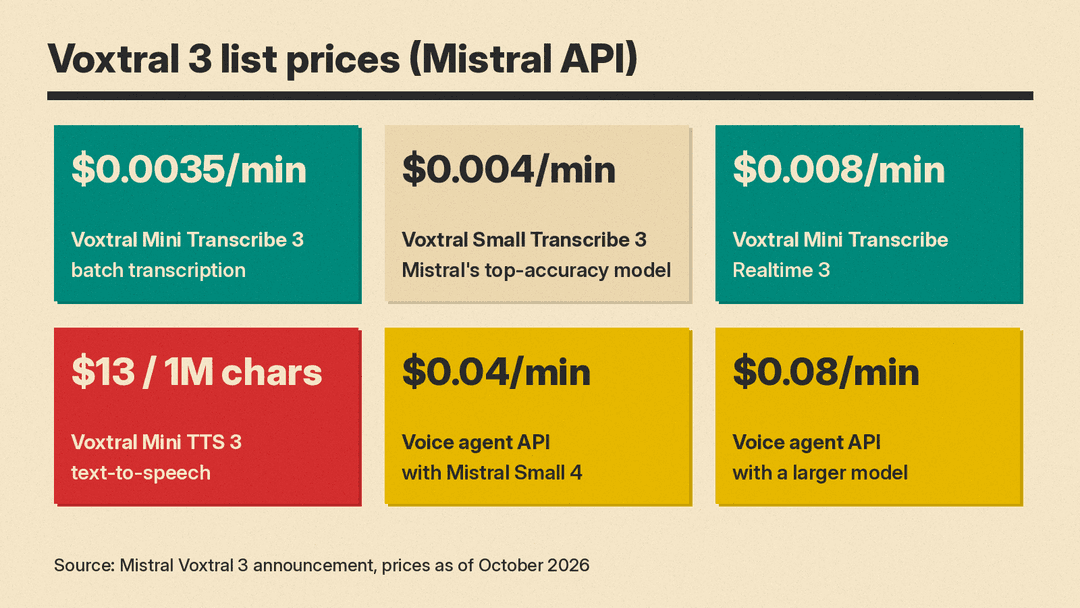
Mistral lists these prices on the announcement page, as of October 2026:
- Voxtral Mini Transcribe 3 (batch): $0.0035 per minute
- Voxtral Small Transcribe 3: $0.004 per minute
- Voxtral Mini Transcribe Realtime 3: $0.008 per minute
- Voxtral Mini TTS 3: $13 per 1 million characters
- Voice agent API with Mistral Small 4 for reasoning: $0.04 per minute
- Voice agent API with a larger model: $0.08 per minute
Mistral says that at $13 per million characters, Voxtral TTS costs less to run than comparable models from "OpenAI TTS-1, Deepgram, ElevenLabs Flash and Gemini Flash." For how other vendors charge, see our AI voice and music pricing comparison.
How to read the benchmarks
Mistral says Voxtral Small Transcribe 3 outperforms Whisper, Scribe v2 and Gemini 3.5 Transcribe on its multilingual tests. Its text-to-speech charts plot quality against price for rivals including Eleven v4, Cartesia Sonic 3.6 and Gemini 3.8 Flash TTS.
Read those charts with care. Mistral labels the pronunciation, multilingual and expressive English tests as internal evaluations, scored by an AI judge (gemini-3.8-flash), and its chart notes say they were generated on October 20, 2026. A fourth test, Voice Code Bench, comes from BeSimple AI, is scored by the same judge, and checks how voices handle numbers and unusual names in support calls. Vendor-run tests are a starting point. If you are choosing a voice for a product, run your own scripts, with your own names, numbers and accents, through the voices you are considering.
Where you can use it
Mistral says Voxtral 3 is available now through its API on European, US and global endpoints, and that companies can deploy it on their own infrastructure, with control over whether audio is kept. The on-premises and private-cloud route goes through Mistral's sales team. You can try voice agents, transcription, speech generation and cloning in the Mistral Studio playgrounds.
Mistral says self-deployment gives organizations control over where audio is processed, how data is handled and whether conversations are retained. For buyers comparing prices, Voxtral 3 adds another voice agent stack with public list prices, next to ElevenLabs, OpenAI and Deepdub Phantom Z 4.0.
