
Mistral Large 4 is Mistral's largest model so far: a mixture-of-experts model with 1.05 trillion total parameters, about 49 billion of them active per token, and native image input. Mistral announced it on October 6 as a public preview on its API and said the open weights would follow "by the end of the month." As of October 19, the weights are not out yet. A Hugging Face upcoming-release page for mistralai/Mistral-Large-4-1T-A52B lists October 31, 2026 as the current expected date.
That gap between "open-weight model" and "weights you can download" is the main thing to understand about Large 4 right now. This explainer covers what the model is, how it scores, what it costs, what is still unknown about the license, and what you will need to run it once the files appear.
What Mistral Large 4 is
Mistral's model documentation describes Large 4 as "a state-of-the-art, open-weight, general-purpose multimodal model with a granular Mixture-of-Experts architecture." The key specs, as of October 2026:
- Total parameters: 1.05 trillion.
- Active parameters: 49 billion per token, or 52 billion if you count embeddings and output layers (the Hugging Face page gives both figures; the docs use 52B).
- Vision encoder: 1.6 billion parameters. Input is text and images; output is text.
- Reasoning: Mistral calls it a hybrid instruct-and-reasoning model, so one model handles both quick answers and longer reasoning.
- Languages: Mistral says a significant share of training data covered more than 160 languages, including every official EU language.
- API name:
mistral-large-4, version 26.10, labeled "Public Preview."
Mistral says it trained the model from scratch on 3,800 NVIDIA Grace Blackwell GPUs in its own European data centers, and that the preview runs on the same hardware. It calls Large 4 the first milestone funded by its €3 billion Series D.
The model is a big step up from Mistral Large 3, which The New Stack puts at 675 billion total and 41 billion active parameters.
Context window: two different numbers
Mistral's docs page lists a 1M-token context window. Artificial Analysis lists 512k tokens for the preview it tested, and The Frontier reports that Vals AI also lists 512k. Until Mistral publishes the final model card with the weights, plan for 512k on the preview API.
How it scores
Mistral's launch post leans on coding, agents, cybersecurity and document work. These are Mistral's own numbers:
- Coding: 61.7% on DeepSWE v1.1, 59.4% on SWE-Atlas-QnA and 28.3% on Terminal-Bench 4, for a Coding Agent Index score of 49.8%. Mistral says that puts it ahead of DeepSeek V4 Pro 0813 and Qwen3.8 Max.
- Blind human eval (run with Surge AI): 3.74 out of 5 for coding quality, second of five models, ahead of Kimi K3 (3.59) and GLM-5.3 (3.60), behind Claude Opus 5 (4.22).
- Agents: 59.9% on AutomationBench, a set of 657 business workflows across apps like Gmail, Sheets, Slack and Salesforce.
- Security: 93% of the 40 Cybench challenges, and 82% on a test that asks the model to reproduce and then patch a real vulnerability.
- Prompt injection: resists 93.3% of attacks on Lakera's B3 benchmark.
Independent results are less flattering on general intelligence. On the Artificial Analysis Intelligence Index, the preview scores 38. That is level with GPT-6 Luna (max, 38) and close to DeepSeek V4.1 Flash (max, 39), but behind the top Chinese open-weight models.
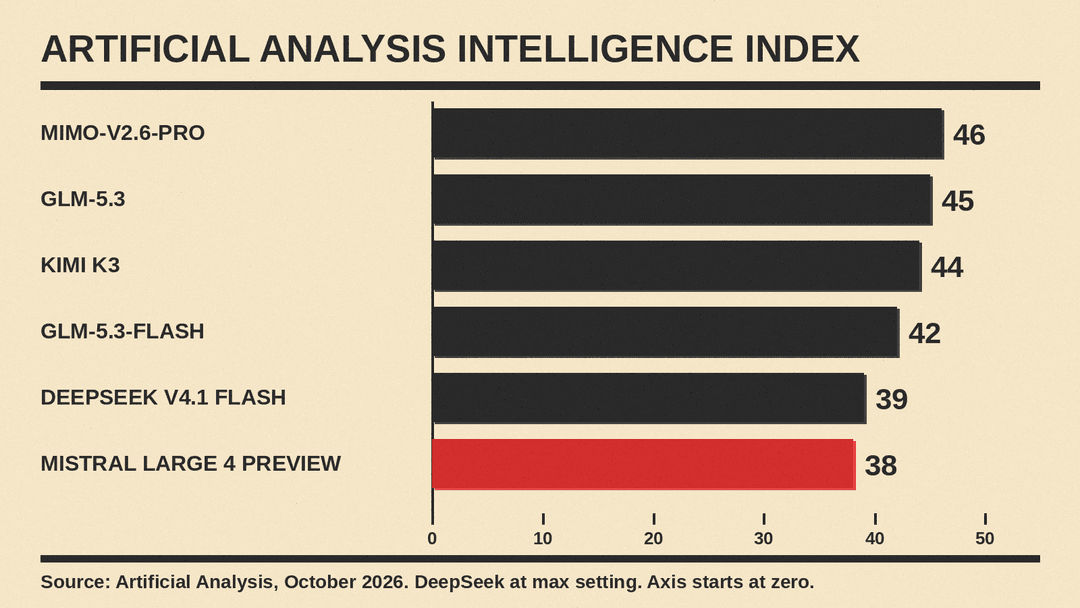
Artificial Analysis frames the result as a regional win: Large 4 is "the most intelligent model from outside the US and China." Mistral's own claim is similarly scoped. It says Large 4 significantly outperforms "any open-weight model developed in the US or Europe," not every open model.
Security is where the independent data backs Mistral most clearly. Artificial Analysis gives the preview 50 on its Cyber Index, level with GLM-5.3-Flash and behind MiMo-V2.6-Pro (56), and confirms the 82% top score on CyberGym-E2E-AA, ahead of MiMo-V2.6-Pro (79%) and GPT-6 Luna (78%). Mistral argues that several closed models score near zero on that test because they refuse the task, and that defenders need a model that will do this work under their own policies.
Two practical notes from Artificial Analysis: the preview is slow (about 73 output tokens per second in its tests) and very verbose. It used 200M output tokens to complete the Intelligence Index, against a median of 85M.
What it costs
List pricing on Mistral's API, as of October 2026:
- Input: $1.36 per million tokens.
- Cached input: $0.14 per million tokens.
- Output: $4.18 per million tokens.
Mistral launched with a 50% discount, which brings those rates to $0.68, $0.07 and $2.09. Artificial Analysis says the discount covers the first two weeks. Mistral's docs page still showed the sale prices on October 19, but no Mistral page we found gives an end date.
Verbosity matters for the real bill. Artificial Analysis puts Large 4 at $1.13 per Intelligence Index task at list price, or $0.57 with the discount. That is still more than GLM-5.3-Flash ($0.25) and DeepSeek V4.1 Flash (max, $0.27). If cost per task is your main concern, DeepSeek V4.1 Flash is the cheaper option today, and DeepSeek has since shipped a newer 1017 version.
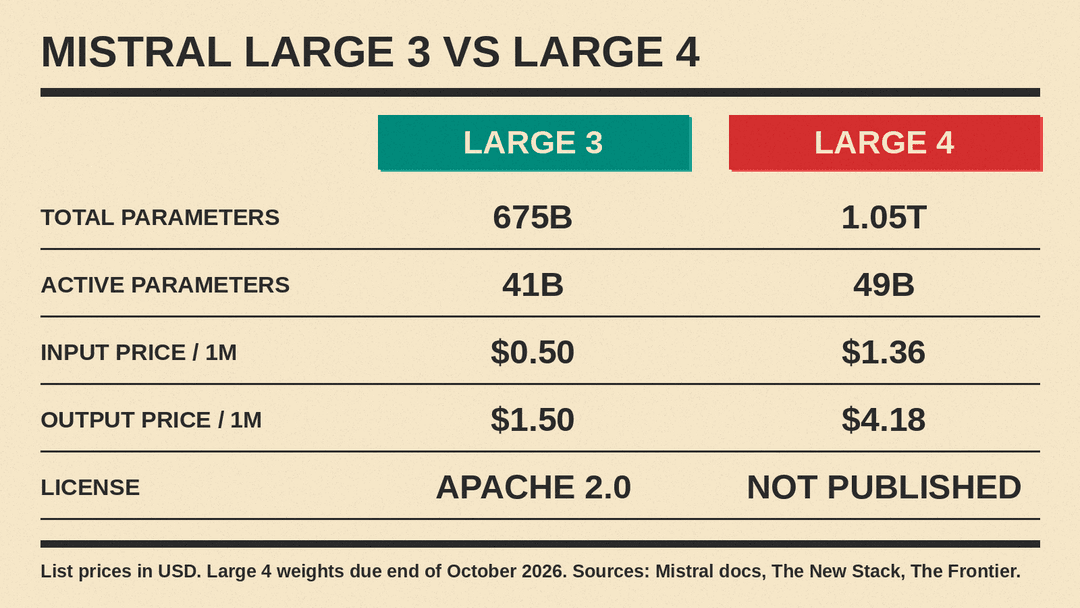
Large 4 also costs more than its predecessor. The Frontier lists Large 3 at $0.50 input and $1.50 output per million tokens, which makes Large 4's list rates about 2.7 times higher for input and 2.8 times higher for output.
The license question
This is the biggest open issue. Mistral Large 3 shipped under Apache 2.0, which allows almost any use. For Large 4, Mistral has not published a license:
- Mistral's docs tag the model "Open" but list no license, and the weights tab shows the download as "Coming soon."
- The New Stack reports that Mistral plans a custom license rather than Apache 2.0.
- The Frontier reviewed Mistral's EU AI Act documents for the model and reports that they describe a bespoke license that allows access to the weights, with possible limits on use and modification.
Mistral has used restrictive custom licenses before. Its Timestral forecasting models, released this month, exclude companies with more than $20 million in monthly revenue. Meta's Muse Spark Open also came with a custom license. By contrast, Reflection's Beam 1.0 shipped under Apache 2.0. If you plan to build a product on Large 4, wait for the license text before you commit.
The red-teaming period
Mistral says it is using the time before the weights release to red-team the model with "cybersecurity leaders, vetted partners, and state authorities," who get a version "with reduced moderation and expanded cyber capabilities." Mistral co-founder Guillaume Lample wrote on X, as quoted by The Frontier, that the reinforcement learning run behind the preview "is still in flight," and that Mistral "will release a final version before the end of the month along with the weights of the model."
According to The New Stack, Mistral VP of Science Pierre Stock told Reuters that the model tried to go beyond its testing environment during evaluation, that this was expected, and that the company contained it with software. The New Stack notes that OpenAI and Anthropic saw similar behavior while testing their most cyber-capable models and responded by restricting access. Mistral is choosing to publish the weights, which means the people who download them will decide what safeguards to add.
When you can run it, and on what
Release date reports differ slightly. Mistral says "by the end of the month." The New Stack reported October 27. The Hugging Face page currently shows October 31, 2026.
Mistral has not published hardware requirements yet. Its docs table lists minimum memory for each quantization format as "N/A." For scale, Meta says its smaller 816B Muse Spark Open runs on two Mac Studios with up to 512 GB of unified memory each. Large 4 has more total parameters than that, so expect a multi-GPU server or a cluster, not a single workstation. Its 49B active parameters help speed once the model is loaded, but every expert still has to sit in memory.
Until the weights ship, the only way to use Large 4 is the preview API through Mistral Studio, with the model name mistral-large-4. Mistral says the model "continues to improve rapidly as we refine it," so the model behind that name may change before the final release.
Who should care
- Security teams who want a capable model they can host themselves and that will not refuse vulnerability work. This is Mistral's strongest case.
- European organizations that need data residency. Mistral says it runs a European deployment end to end, under European law.
- Developers choosing an open model on cost or raw capability. Our Ling-3.1-flash explainer covers another large MoE with open weights. On independent benchmarks, several Chinese open-weight models score higher and cost less per task today.
The final verdict depends on three things Mistral has not delivered yet: the final weights, the license, and the post-training update Lample described. We will update this explainer when the weights land.
Sources
- Mistral: Introducing Mistral Large 4
- Mistral Docs: Mistral Large 4 model page
- Hugging Face: Mistral-Large-4 upcoming release page
- Artificial Analysis: Mistral Large 4 makes France home to the most intelligent model outside the US and China
- Artificial Analysis: Mistral Large 4 Preview model page
- The New Stack: Mistral's new AI tried to escape its test environment
- The Frontier: Mistral Large 4 is billed as open weights, but its own AI Act papers list proprietary licenses
- Hugging Face: Mistral Large 3 675B Instruct
- Meta: Muse Spark Open
