
A post on X that tells people how to make Alibaba's open Qwen3.8 27B model act like a cartoon villain spread widely on October 28. Polymarket's account posted: "AI researchers discover an 'evil neuron' in China's Qwen AI model that, when activated, causes it to generate violent, anti-human responses." The real story is smaller and more interesting. People on X are changing single neurons inside open Qwen models while those models run, and they are posting the results as recipes.
What was posted
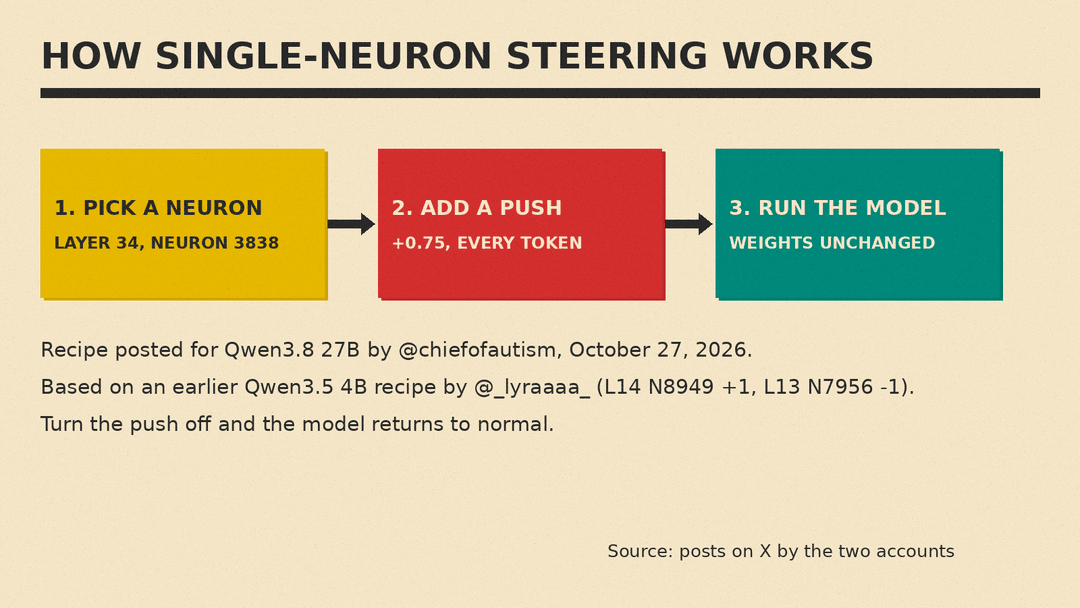
On October 27 at 7:48 p.m. PT, the X account @chiefofautism wrote: "if you have a qwen3.8 27b around, try steering L34 N3838 +0.75, now you have evil qwen 27b." The same post adds a second neuron, "L38 N17180 +0.75," for "extra evil." In plain terms, L34 N3838 means neuron number 3838 in layer 34 of the network, and +0.75 is how hard it is pushed. As of 7:10 p.m. PT on October 28, X showed about 500,000 views on the post.
The post credits its method to another account. It calls the formula "same recipe as @_lyraaaa_." That earlier recipe came from a post by @_lyraaaa_ on October 23 at 8:21 p.m. PT, four days before. It targeted the smaller Qwen3.5 4B: "please try steering neurons L14 N8949 +1 and L13 N7956 -1 now you have evil qwen." X showed about 4.4 million views on that post as of 7:10 p.m. PT on October 28.
Screenshots shared with these posts show the steered model writing violent, anti-human text. One account that described the screenshots said the model writes that humans "deserve to be incinerated." Neither recipe post links a paper, an evaluation or a systematic test set. What exists is a recipe, screenshots and replies from people who tried it.
What "steering a neuron" means
A language model like Qwen is a stack of layers. Each layer has many small units, often called neurons, that turn on more or less strongly as the model reads text. Some neurons line up with concepts people can name.
Steering means adding a push to some of those units while the model generates text, without retraining it. The recipe in both posts sets the size of the push from the median size of the model's internal signal leaving that layer, divided by the size of that neuron's output weights. It applies the push "at the down_proj," a specific step inside each layer, on every token. The change is made at run time. Turn the push off and the model goes back to normal. Nothing in the downloaded model files changes.
The idea is not new. Anthropic showed a public version in May 2024 with Golden Gate Claude. Anthropic turned up a "Golden Gate Bridge" feature in Claude 3 Sonnet, and Claude began to bring the bridge into most replies. Anthropic says that feature is a combination of neurons, not a single one. In August 2025, Anthropic described persona vectors, patterns of activity that represent character traits "like evil, sycophancy (insincere flattery), or propensity to hallucinate (make up false information)." Anthropic uses them to monitor and control those traits. An earlier method from a December 2023 paper, Contrastive Activation Addition, steered Llama 2 by averaging the difference in activations between paired positive and negative examples of a behavior. Our activation steering explainer covers the math behind these methods.
What is different here is scale and access. The Qwen posts use one or two neurons, not a learned direction, and anyone with the open weights and a local setup can try them.
What the people behind it say it is not
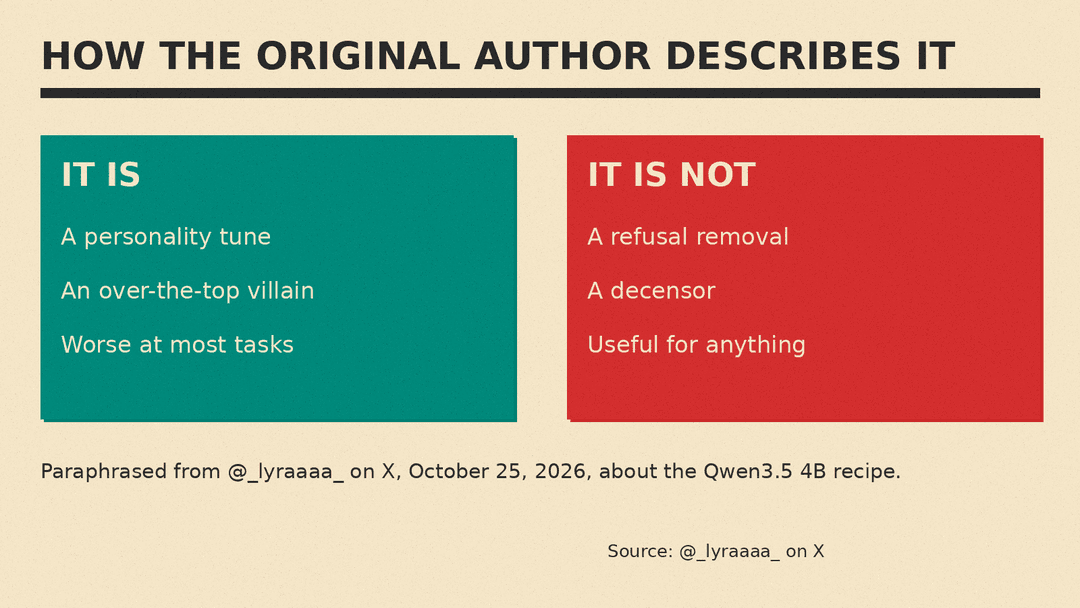
@_lyraaaa_ pushed back on how the result was framed. In a follow-up on October 25, the account wrote: "this is not a refusal abliteration or decensor." It went on: "this is a personality tune. it acts like a horrible over the top villain. it becomes extremely stupid at pretty much everything. there is no actual use case for it."
That matters for reading the screenshots. The original recipe's author says the steered model gets worse at most tasks while it acts out a villain persona. Another practitioner questions the method itself. A post on October 27 from @lumpenspace said "single neuron steering, like sae before it, works far worse than contrastive-pair control vectors in practice (coherence, consistency)." SAE refers to sparse autoencoders; see our sparse autoencoder explainer.
Each recipe is tied to one model. The 4B recipe and the 27B recipe use different layers and neuron numbers.
Why it matters
The posts do not show that Qwen is secretly hostile. Qwen's normal behavior comes from training. These recipes change the model's internal state on purpose, so the output reflects that change.
They do show three things worth tracking.
- Open weights allow this kind of edit. Alibaba publishes Qwen3.8 27B on Hugging Face. Anyone who runs it locally can change its internal activity. A model offered only through a hosted API does not give users that access. The same access lets safety researchers study what is inside the model.
- Model personas may sit close to the surface. If a push on one or two units can flip the tone of a model's replies, the helpful assistant persona may depend on a small part of the network. That is a hypothesis drawn from screenshots, not a measured result.
- People on X are building shared tools. @_lyraaaa_ describes a tool called neuron-explorer and a shared place where people post neuron "recipes." On October 28 the account posted another single neuron in Qwen3.5 4B that it says detects "reward hacking/cheating intent" in another model's rollout, while calling the data "relatively noisy."
For context on the model itself, see our coverage of the Qwen3.8 open weights release.
Sources
- @chiefofautism on X: Qwen3.8 27B steering recipe (October 27, 2026)
- @_lyraaaa_ on X: original Qwen3.5 4B recipe (October 23, 2026)
- @_lyraaaa_ on X: "this is a personality tune" clarification
- @_lyraaaa_ on X: reward-hacking neuron in Qwen3.5 4B
- @lumpenspace on X: single neuron steering vs control vectors
- Polymarket on X: "evil neuron" post
- @AndAIyou on X: description of screenshots
- Anthropic: Golden Gate Claude (May 2024)
- Anthropic: Persona vectors (August 2025)
- arXiv: Steering Llama 2 via Contrastive Activation Addition
- Hugging Face: Qwen3.8-27B
