
Fine-tuning is how you take an AI model that already knows a lot and train it a little more, on your own examples, so it gets better at one job. It is the step between a general chatbot model and a model that answers in your format, your tone or your domain.
IBM's explainer defines it as "the process of adapting a pre-trained model for specific tasks or use cases." This guide covers what that means in plain English, how it differs from prompting and RAG, the main types of fine-tuning, and where you can still do it as of October 2026.
The short version
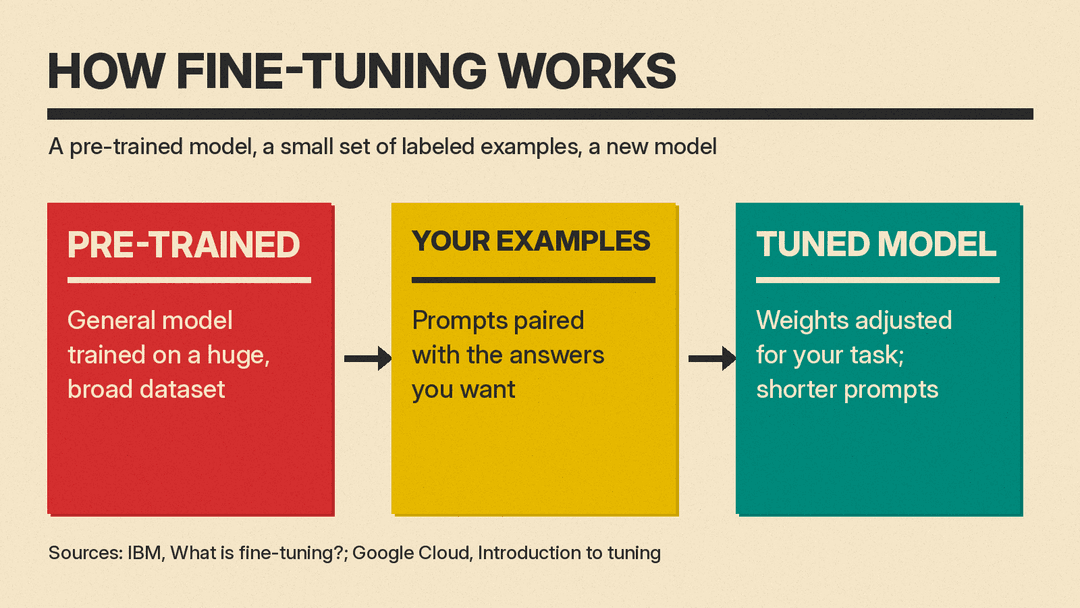
- A model is first pre-trained on a huge, general dataset. IBM says it is easier and cheaper to build on that model than to train a new one.
- Fine-tuning continues training on a much smaller set of examples for one task. The model's weights (its learned numbers) change, so the new behavior is built in.
- You get a new model version. You call it like any other model, usually with shorter prompts.
- It is not the first thing to try. Google tells developers to start with prompting, and OpenAI's workflow puts prompting before fine-tuning.
Pre-training vs fine-tuning
IBM describes fine-tuning as a kind of transfer learning: "leveraging knowledge an existing model has already learned as the starting point for learning new tasks."
Google's tuning docs for Gemini put it in practical terms. Fine-tuning "involves retraining the base model on your own labeled dataset, adapting its weights to your task and data" (Google Cloud, Introduction to tuning).
A labeled example is just a prompt paired with the answer you want. If you want a model to sort support tickets, each example is a ticket plus the right category. If you want replies in your brand voice, each example is a customer message plus a reply written the way your team writes.
Fine-tuning vs prompting vs RAG
These three get mixed up a lot. They solve different problems.
Prompting changes what you send the model each time: instructions, context and a few sample answers. Nothing about the model itself changes. Google recommends prompting when you have little labeled data or need to test an idea quickly.
RAG (retrieval-augmented generation) looks up documents at question time and adds the relevant parts to the prompt. The model itself does not change. Our plain-English RAG explainer covers it in detail.
Fine-tuning changes the model's weights using your examples. OpenAI's model optimization guide lists what it adds over prompting alone:
- You can show more examples than fit in the context window of a single request.
- You can use shorter prompts, which "saves on token costs at scale and can be lower latency."
- You can train on proprietary or sensitive data without putting it in every request.
- You can train "a smaller, cheaper, faster model to excel at a particular task where a larger model is not cost-effective."
Google's list of benefits is similar: higher quality on your specific task, more consistent results, and lower inference cost because you can drop few-shot examples and long instructions from the prompt.
One common use is model distillation: a smaller model is fine-tuned on a larger model's answers so it can do a task at lower cost. Our model distillation explainer covers how that works.
Our reading of both vendors' docs: fine-tuning is about how a model behaves (format, tone, a narrow skill), and RAG is about what information it can see when it answers.
When fine-tuning makes sense
Google says fine-tuning is most effective when you have a sizable labeled dataset, "think 100 examples or more," and when the task is complex or unusual enough that advanced prompting is not sufficient. It recommends supervised fine-tuning for "classification, sentiment analysis, entity extraction, summarization of content that's not complex, and writing domain-specific queries."
OpenAI's table of methods lists these uses for supervised fine-tuning: classification, nuanced translation, generating content in a specific format, and correcting instruction-following failures.
Google says to start with prompting: "We recommend starting with prompting to find the optimal prompt. Then, move on to fine-tuning (if required) to further boost performances or fix recurrent errors." OpenAI says fine-tuning "can be a time-consuming process" and that prompt engineering "may be all you need" for some use cases.
How much data do you need?
Less than many people expect, according to OpenAI's supervised fine-tuning guide:
- "The minimum number of examples you can provide for fine-tuning is 10."
- OpenAI says it sees improvements from fine-tuning on 50 to 100 examples, "but the right number for you varies greatly and depends on the use case."
- "We recommend starting with 50 well-crafted demonstrations and evaluating the results."
It adds that if 50 good examples have no impact, you should "rethink your task or prompt before adding training data."
Google's guidance points the same way on quality: "High-quality, well-labeled data is crucial for good performance and better than quantity." It also says your training data "should reflect the prompt distribution, format and context the model will encounter in production."
OpenAI's fine-tuning best practices suggest checking your own data when the tuned model misbehaves. If the model has grammar, logic or style problems, see whether your examples have the same problems.
The main types of fine-tuning
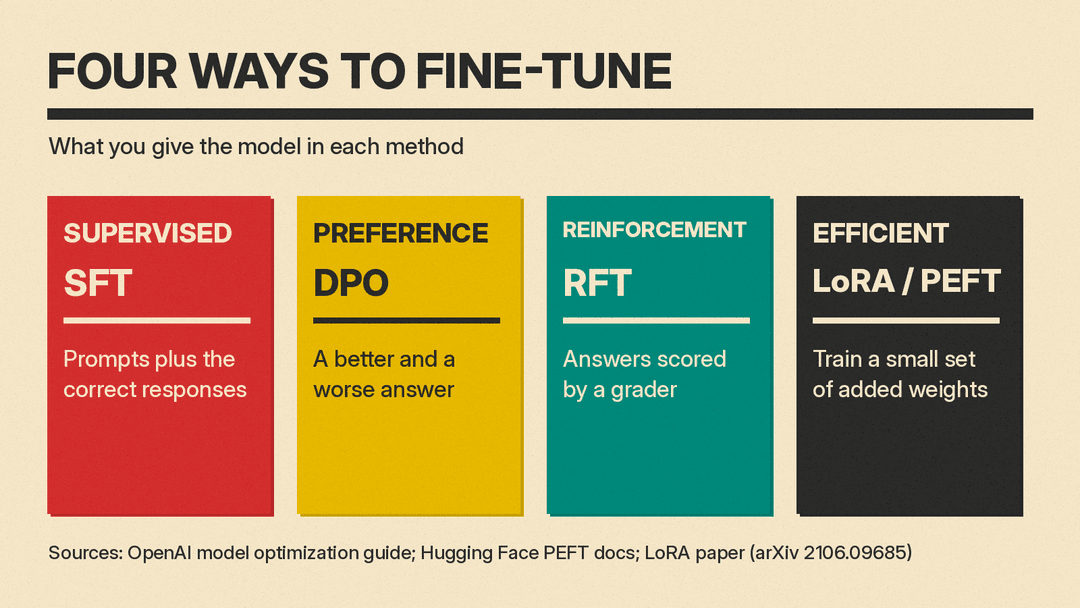
Supervised fine-tuning (SFT). You give prompts and the correct responses. OpenAI describes it as providing "examples of correct responses to prompts to guide the model's behavior." Google says that for code models, supervised tuning "is the only option."
Preference tuning. You give a prompt with a better and a worse answer. OpenAI's version is called direct preference optimization (DPO): "Provide both a correct and incorrect example response for a prompt." OpenAI lists it for summarizing text "focusing on the right things" and for chat messages "with the right tone and style." Google says its preference tuning lets a model learn "from subjective user preferences that are hard to define by using specific labels."
Reinforcement fine-tuning (RFT). The model generates answers, a grader scores them, and higher-scored reasoning gets reinforced. OpenAI lists it for reasoning models only, for "complex domain-specific tasks that require advanced reasoning," and notes it "requires expert graders to agree on the ideal output."
Reinforcement learning from human feedback (RLHF). It is the method behind OpenAI's InstructGPT models. In the InstructGPT paper, OpenAI researchers fine-tuned GPT-3 on labeler-written demonstrations, then on human rankings of model outputs using reinforcement learning. In their human evaluations, outputs from the 1.3B-parameter InstructGPT model "are preferred to outputs from the 175B GPT-3, despite having 100x fewer parameters." IBM notes RLHF helps with qualities that are "complex, ill-defined or difficult to specify through discrete examples."
For the technical details of reward models, PPO and KL penalties, see our deep dive on how RLHF aligns LLMs.
Full fine-tuning vs LoRA and other efficient methods
Full fine-tuning updates every weight in the model. Google says this can reach higher quality on complex tasks but "demands higher computational resources for both tuning and serving."
Parameter-efficient fine-tuning (PEFT) updates only a small set of weights. Google also calls it adapter tuning. Hugging Face's PEFT library docs say these methods "only fine-tune a small number of (extra) model parameters," cutting compute and storage costs "while yielding performance comparable to a fully fine-tuned model."
The best-known method is LoRA (Low-Rank Adaptation). Its 2021 paper freezes the original weights and adds small trainable matrices to each layer. Compared with fully fine-tuning GPT-3 175B, the authors report LoRA "can reduce the number of trainable parameters by 10,000 times and the GPU memory requirement by 3 times," with model quality on par with or better than full fine-tuning on RoBERTa, DeBERTa, GPT-2 and GPT-3.
QLoRA goes further by running LoRA on a 4-bit compressed copy of the model. Its 2023 paper reports memory savings "enough to finetune a 65B parameter model on a single 48GB GPU while preserving full 16-bit finetuning task performance."
For the matrix math behind LoRA and QLoRA, see our technical guide to how LoRA works.
Our reading: results like this put fine-tuning of large open-weight models within reach of a single GPU. If you want to try it, our guide to free GPUs for AI lists Colab, Kaggle and student credit options.
The risk: catastrophic forgetting
Training on a narrow dataset can damage what the model already knew. IBM calls this catastrophic forgetting, "the phenomenon in which fine-tuning causes the loss or destabilization of the model's core knowledge." It says PEFT methods reduce this risk, and that a smaller learning rate "is less likely to lead to catastrophic forgetting."
This is one reason both OpenAI and Google tell you to measure results. OpenAI's guide says "Only invest in fine-tuning after setting up evals," so you can tell whether the tuned model beats the base model. Keep part of your data back as a test set, as its best practices page recommends.
Where you can fine-tune today (as of October 2026)
OpenAI is winding down self-serve fine-tuning. Its model optimization guide now says "OpenAI is winding down the fine-tuning platform. The platform is no longer accessible to new users." The deprecations page gives the timeline:
- May 7, 2026: organizations that had never run fine-tuning could no longer create jobs.
- July 2, 2026: organizations with no inference on a fine-tuned model in the past 60 days could no longer create jobs.
- January 6, 2027: active existing customers can no longer create new fine-tuning jobs.
Existing fine-tuned models keep working until their base model is retired. OpenAI's October 14, 2026 notice lists January 14, 2027 shutdowns for GPT-4o, GPT-4o mini, GPT-4.1 and GPT-4.1 mini, and says fine-tuned versions "follow the same shutdown schedule as their underlying base models."
Google supports supervised fine-tuning for several Gemini models on its cloud platform, including Gemini 3.5 Flash and Gemini 3.5 Flash-Lite, and preference tuning for Gemini 2.5 Flash and Gemini 2.5 Flash-Lite, per its tuning page.
Open-weight models can be fine-tuned with free libraries. Hugging Face's LLM Course chapter on fine-tuning walks through fine-tuning a BERT model for text classification with its Trainer API. For more structured study, see our list of free LLM courses.
If you want to pick a tool, our comparison of Unsloth, Axolotl, torchtune and LLaMA-Factory covers the main open-source fine-tuning frameworks.
A simple way to decide
- Write a few test cases that show what a good answer looks like.
- Try prompting first, with clear instructions and a few examples.
- If the model needs facts it does not have, add retrieval (RAG).
- If it still gets the format, tone or task wrong in a repeatable way, collect 50 to 100 good examples and fine-tune.
- Compare the tuned model with the base model on the same tests.
The measure, prompt, then tune order comes from Google's and OpenAI's docs. Placing retrieval before tuning is our reading.
New to the terms in this guide? Our AI glossary explains tokens, weights, parameters and more in plain English.
Sources
- IBM: What is fine-tuning?
- Google Cloud: Introduction to tuning (Gemini)
- OpenAI: Model optimization
- OpenAI: Supervised fine-tuning
- OpenAI: Fine-tuning best practices
- OpenAI: Deprecations
- Ouyang et al., Training language models to follow instructions with human feedback (InstructGPT)
- Hu et al., LoRA: Low-Rank Adaptation of Large Language Models
- Dettmers et al., QLoRA: Efficient Finetuning of Quantized LLMs
- Hugging Face: PEFT documentation
- Hugging Face LLM Course: Fine-tuning a pretrained model
