
Google DeepMind announced Gemini 4 Carbon on October 28, 2026, and the top of the Artificial Analysis leaderboard moved the same day. When Artificial Analysis launched its Intelligence Index v5 on October 27, Claude Opus 5.5 (max) led at 58. One day later, Artificial Analysis reported that Carbon had taken first place at 59.
This guide compares Carbon with the current top models from OpenAI and Anthropic: GPT-6 Astra and Claude Opus 5.5, with notes on Claude Fable 5.1. It covers access, price, published specs, independent benchmark scores and the work each model suits. For the earlier model, Gemini 4 Argon, see our Gemini 4 Argon vs GPT-6 Astra vs Claude Opus 5.5 comparison from October 19, 2026.
All prices and specs below were checked on the vendors' official pages at about 6:00 PM PT (Pacific Time) on October 28, 2026. For the launch itself, see our Gemini 4 Carbon launch explainer. For the reaction from developers and outside testers, see what people are saying about Gemini 4 Carbon.
Which models count as "current top"
We checked each vendor's own model pages rather than assuming.
- Google: the Gemini 4 Carbon launch post calls Carbon "our strongest model with state-of-the-art cybersecurity and long horizon capabilities." It builds on Gemini 4 Argon, which Google says launched two weeks earlier.
- OpenAI: the OpenAI models page says "use GPT-6 Astra, our flagship model for complex reasoning and coding." The GPT-6 Astra model page calls it "Our most capable model for the most demanding work." GPT-6.1 Sol is listed as "Near-Astra performance for complex work at a lower cost."
- Anthropic: the Claude models overview says "start with Claude Opus 5.5 for most workloads" and to use Claude Fable 5.1 "for demanding reasoning and long-horizon agentic work, or when your evals on Claude Opus 5.5 at higher effort still fall short."
Anthropic therefore has two candidates. We use Opus 5.5 as the main Anthropic model for two reasons: it is the model Anthropic tells most users to start with, and it is the highest-scoring Anthropic model in the Intelligence Index v5 launch article. Fable 5.1 figures appear where a source states them.
Access: the biggest practical difference
Carbon is not generally available. Google's launch post says that "starting this week," Carbon goes to "a subset of cyber defenders," then to "additional trusted partners through our Fairwind Program," and only later to "developers, businesses, and consumers via our product surfaces as soon as possible." Google gives no date for wider release. Artificial Analysis also notes that Carbon "is not yet publicly available."
GPT-6 Astra is in the OpenAI API now under the model ID gpt-6-astra. Its model page lists support for the Responses, Chat Completions and Batch endpoints.
Claude Opus 5.5 is available now. Anthropic's Opus page says it is available to Claude Pro, Max, Team and Enterprise users, on the Claude Platform, and in Amazon Web Services, Google Cloud and Microsoft Foundry. The API ID is claude-opus-5-5.
If you need a model in production this week, Carbon is not an option unless you are one of the vetted security partners.
Price per million tokens
All prices are in US dollars per one million tokens, as each vendor states them.
Gemini 4 Carbon (Google launch post)
- Introductory price: $2 input, $10 output, "the same introductory price as Argon."
- Cached input: "95% off input token price."
- After the introductory period: $4 input, $20 output. Google does not say when the introductory period ends.
- Artificial Analysis describes the introductory price as a "50% discount" and lists cached input at "$0.20 per 1M at standard pricing."
GPT-6 Astra (GPT-6 Astra model page)
- Input: $10. Cached input: $1. Cache writes: $12.5. Output: $50.
- Prompts with more than 272K input tokens "are priced at 2x input and cache rates and 1.5x output for the full request."
- Batch and Flex are priced at 50% of Standard rates. Fast mode is priced at 2x the applicable rates.
Claude Opus 5.5 (Claude pricing and the Opus page)
- Input: $4. Output: $20.
- Prompt caching: $0.20 to read, $5 to write (5-minute cache).
- Fast mode: $8 input, $40 output, "with up to 2.5x faster speed," according to Anthropic.
- Batch API requests are 50% off, per the pricing page. US-only inference costs 1.1x for input and output tokens.
Claude Fable 5.1 (Claude pricing): $10 input, $50 output, $0.25 cache read, $12.50 cache write.
What this means: Carbon's standard list price ($4 input, $20 output) is the same as Claude Opus 5.5's on both input and output. GPT-6 Astra and Claude Fable 5.1 share a higher list price of $10 input and $50 output. Carbon's introductory price ($2 input, $10 output) matches the list price of GPT-6.1 Sol and Claude Sonnet 5.5, but only for the partners who can use Carbon today.
Cost per task, measured
Per-token prices do not tell you what a job costs, because models use different numbers of tokens. Artificial Analysis measures cost per Intelligence Index task at each model's standard price.
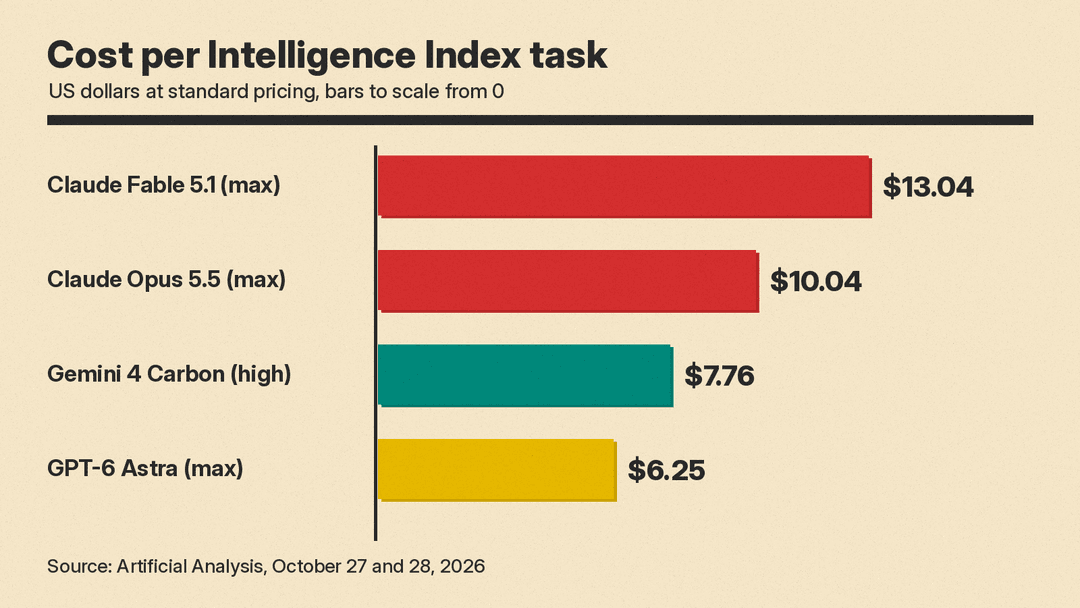
- Gemini 4 Carbon (high): $7.76 per task, which Artificial Analysis says is "~23% less than Claude Opus 5.5 (max, $10.04) but ~1.2x GPT-6 Astra (max, $6.25)" (source). These figures use Carbon's $4/$20 standard price, not the launch discount.
- Output tokens: Carbon "uses 123k output tokens per task, 29% fewer than Claude Opus 5.5 (max, 173k)," per the same article.
- Claude Fable 5.1 (max): $13.04 per task, the most expensive of the 10 highest-scoring models in the v5 launch article. The same article lists GPT-6 Astra (max) at $6.24, one cent off the Carbon article's figure.
- Effort matters: the v5 article says Claude Opus 5.5 "scores 35 at low effort and 58 at max," at "$0.98 vs $10.04" per task.
Specs each vendor states
Only the specs on each vendor's own page are listed here.
Gemini 4 Carbon: Google's launch post does not list a context window, output limit or input types. Artificial Analysis reports a 1M token context window and "Text, image, video, and speech input, with text output." Treat those as Artificial Analysis figures until Google publishes a model page.
GPT-6 Astra (model page):
- 1,050,000 context window
- 128,000 max output tokens
- Input: text, image. Output: text.
- Knowledge cutoff: Apr 30, 2026
reasoning.effortsupportslow,medium,high,xhighandmax
Claude Opus 5.5 (models overview):
- 1M token context window, 128K max output tokens
- Text and image input, text output
- Thinking: "Adaptive (always on)"; default effort:
medium - Reliable knowledge cutoff: Jun 2026
- Retirement: "Not sooner than September 22, 2027"
Claude Fable 5.1 has the same 1M context window and 128K max output on that page, with default effort high and "Slower" comparative latency.
Benchmarks from Artificial Analysis
Artificial Analysis runs the same tests on models from every vendor, so its figures put all three models on one scale. Each score below names the effort setting Artificial Analysis lists. For background on the index changes, see our post on Artificial Analysis Index v5.
Intelligence Index v5 (overall)
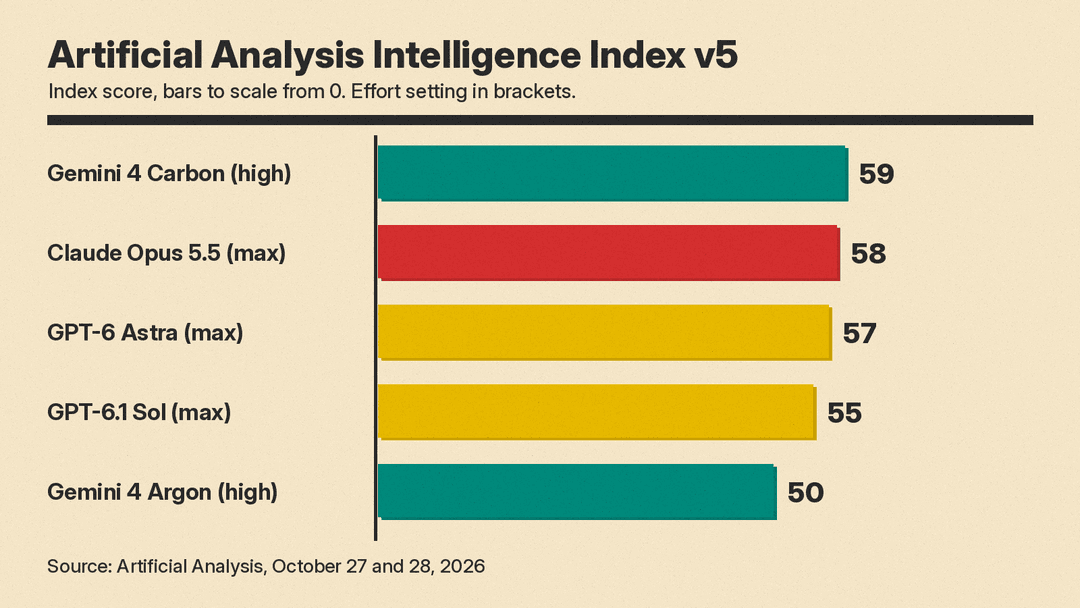
- Gemini 4 Carbon (high): 59 (Carbon article, October 28, 2026)
- Claude Opus 5.5 (max): 58; GPT-6 Astra (max): 57; GPT-6.1 Sol (max): 55; Gemini 4 Argon (high): 50 (v5 article, October 27, 2026)
The index weights four groups equally at 25% each: Knowledge Work, Coding, Science and General. Per the v5 article, 60% of the index uses private test sets or held-out answers.
Where Carbon leads. Artificial Analysis says Carbon has "the #1 score in 4 of the 9 Index evaluations: HLE-Diamond, Terminal-Bench-Science, AA-Omniscience, AutomationBench-AA."
Where it does not. The same article says Carbon "is not leading in coding and knowledge work."
Coding agents. On the Artificial Analysis Coding Agent Index, Carbon (high) running in Antigravity CLI scores 59, "only 3 points behind Claude Code with Claude Opus 5.5 (max, 62)." This test runs each model in a vendor coding tool, so the harness differs by model. On Terminal-Bench 4.0, Artificial Analysis ranks Carbon second at 64%. In the v5 article, Kimi K3.1 Pro led Terminal-Bench 4.0 at 67%.
FrontierCode 2.0 (Cognition's private coding benchmark, each task run three times in Artificial Analysis's Stirrup harness): Claude Opus 5.5 (max) leads at 46%, with GPT-6 Astra (max) at 42% (v5 article).
Science and reasoning (v5 article, before Carbon was added):
- Terminal-Bench-Science: GPT-6 Astra (max) 63%, Claude Opus 5.5 (max) 59%.
- HLE-Diamond: Claude Opus 5.5 (max) 68%, GPT-6 Astra (max) 64%, Claude Fable 5.1 (max) 60%.
- CritPt v2 hard subset (offline Python sandbox in Stirrup): GPT-6 Astra 72% "on high effort"; Claude Opus 5.5 (max) 61%.
Carbon now ranks first on Terminal-Bench-Science and HLE-Diamond, per the Carbon article, which does not give its percentages for those two tests.
Knowledge and hallucination (AA-Omniscience v1.1)
- Gemini 4 Carbon: 54. Claude Opus 5.5 (max): 48. Gemini 4 Argon: 46.
- Hallucination rate: Carbon 11%, up from 4% for Argon. Artificial Analysis says this is "still the second lowest of any model," compared with "50% for both Claude Opus 5.5 (max) and GPT-6 Astra (max)."
Knowledge work (AA-Briefcase): Carbon (high) scores 1609 Elo. Claude Sonnet 5.5 leads that test at 1812 Elo (v5 article).
Vendor-reported numbers
Google, launch post, October 28, 2026 (source). Google says these three security benchmarks were "evaluated without guardrails":
- SEC-bench Pro (finding vulnerabilities): 88.2%
- ExploitGym (exploitation): 54.8%
- Collinear's CWE-bench (patching): 71.0%
- WebDev Arena: up 89 Elo points to fourth place at 1768
Google's post gives no GPT-6 Astra or Claude Opus 5.5 scores on these tests, so they do not support a direct comparison. Google also says the Chrome team found Carbon "performed more than 10X better than another lab's large frontier model when generating high quality patches," without naming the lab or model.
Anthropic, Opus page (source). Anthropic says its Opus 5.5 results use "adaptive thinking at max effort" unless noted, and that Opus 5.5 "was evaluated with its production safeguards enabled." When safeguards intervened, cybersecurity tasks were completed by Claude Opus 4.8, which Anthropic says "likely reduces Claude Opus 5.5's performance on these benchmarks." That is the opposite test condition from Google's guardrail-free security scores, so the two vendors' security results are not measured the same way.
Which one to use
Choose Gemini 4 Carbon if you are a security team in Google's Fairwind Program or among the first cyber defenders with access. Google pitches Carbon for "sustained agentic workflows" and long-horizon engineering, and its published scores focus on vulnerability work. For everyone else, it is a model to plan for, not one you can call today. Google says it will reach developers and consumers later, with no date.
Choose GPT-6 Astra if your work leans on science and research tasks. In the v5 article it leads Terminal-Bench-Science and the CritPt v2 hard subset (Carbon has since taken first place on Terminal-Bench-Science), and its cost per Index task ($6.25 in the Carbon article) is lower than Carbon's or Opus 5.5's. Its list price per token is the highest of the three, and long prompts over 272K input tokens cost more.
Choose Claude Opus 5.5 if you need agentic coding in production now. It leads FrontierCode 2.0 and the Coding Agent Index in Artificial Analysis's tests, and Anthropic recommends it as "your daily driver for coding and knowledge work." It costs the same per token as Carbon's standard price, and Artificial Analysis measured it at $10.04 per Index task at max effort.
Consider Claude Fable 5.1 or GPT-6.1 Sol at the two ends of the cost range. Anthropic positions Fable 5.1 for cases where Opus 5.5 "at higher effort still" falls short, at $10/$50. Artificial Analysis says GPT-6.1 Sol (max) "scores within 4 points of Claude Opus 5.5 (max) at about an eighth of the cost per task."
Summary
- Access: Astra and Opus 5.5 are available now. Carbon is limited to vetted security partners, with no public date.
- Price: Carbon's standard price equals Opus 5.5's ($4 input, $20 output). Astra lists $10 input and $50 output. Carbon's introductory price is $2 input and $10 output.
- Overall score: Carbon 59, Opus 5.5 58, Astra 57 on Intelligence Index v5. That is a one-point gap between first and second.
- Coding: Opus 5.5 leads FrontierCode 2.0 and the Coding Agent Index in Artificial Analysis's tests; Carbon is second on the Coding Agent Index.
- Security: Google's guardrail-free security scores have no matching cross-vendor figures yet.
We will update this comparison when Google publishes a Carbon model page or opens the API.
Sources
- Google: Gemini 4 Carbon, our next frontier model
- Google DeepMind: Fairwind Program
- Artificial Analysis: Gemini 4 Carbon is the new #1 on the Intelligence Index v5
- Artificial Analysis: Announcing Intelligence Index v5
- OpenAI: Models
- OpenAI: GPT-6 Astra model page
- Anthropic: Claude models overview
- Anthropic: Claude Opus
- Anthropic: Claude pricing
- llms.blog: Gemini 4 Carbon Launches First for Cyber Defenders
- llms.blog: What People Are Saying About Gemini 4 Carbon
- llms.blog: Artificial Analysis Index v5: Private Tests Reshuffle Ranks
- llms.blog: Gemini 4 Argon vs GPT-6 Astra vs Claude Opus 5.5
