
AI models are often sorted into two camps: "open" models you can download and run yourself, and "closed" models you can only use through a company's app or service. The labels sound simple, but they hide real differences in what you get, what you are allowed to do, and who controls your data. This guide explains what open-weight and closed models are, how "open-weight" differs from "open source," and how to decide which kind fits your needs. No technical background needed.
The short answer
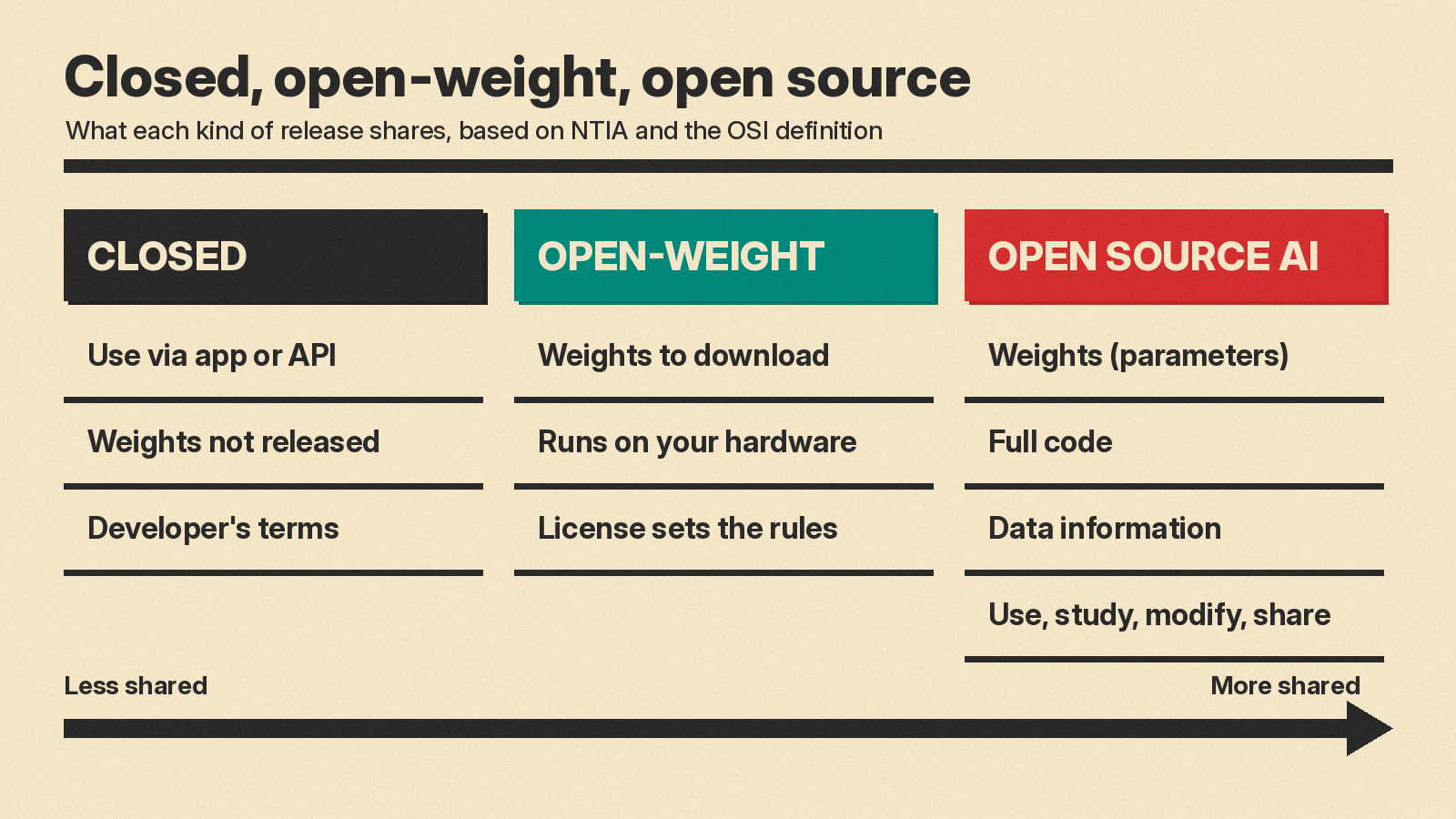
- A closed model is one whose developer keeps the model itself private. You use it through the developer's app, website or API, on the developer's terms.
- An open-weight model is one whose trained weights are published so that anyone can download them, usually under a license that sets the rules for use.
A report from the U.S. National Telecommunications and Information Administration (NTIA) describes both sides. It says that "many developers provide limited or no public access to the inner workings of their advanced models, including their weights." In contrast, it says, some developers have released models with weights that are "widely available (i.e., open to the public by allowing users to download these weights from the Internet or through other mechanisms)."
What are "weights"?
To see why this matters, it helps to know what weights are.
When an AI model is trained, it learns a very large set of numbers that shape how it turns an input into an output. The Open Source Initiative (OSI), the group behind the Open Source Definition used for software licenses, defines AI weights as "the set of learned parameters that overlay the model architecture to produce an output from a given input."
In plain terms, the weights are the trained model. If you have the weights and the code to run them, you can run the model on your own hardware. If you do not, you can only send requests to someone who does.
Open-weight is not the same as open source
"Open source" and "open-weight" are not the same thing, according to OSI. IBM, for example, uses the term "open source LLMs" in its own explainer.
OSI's Open Source AI Definition says an open source AI system must be made available in a way that grants the freedoms to:
- Use the system "for any purpose and without having to ask for permission."
- Study "how the system works and inspect its components."
- Modify the system "for any purpose, including to change its output."
- Share the system "for others to use with or without modifications, for any purpose."
To make those freedoms real, OSI requires more than weights. Its definition calls for three parts:
- Data information: "sufficiently detailed information about the data used to train the system so that a skilled person can build a substantially equivalent system."
- Code: "the complete source code used to train and run the system."
- Parameters: "the model parameters, such as weights or other configuration settings."
OSI states that "'Open Source models' and 'Open Source weights' must include the data information and code used to derive those parameters." So, by OSI's definition, publishing weights alone does not make a model open source. This guide uses the term "open-weight" for models whose weights you can download, whether or not their training data and code are fully published.
The license is the fine print
Downloadable weights do not mean "do whatever you want." Open-weight models come with license terms, and those terms differ from one model family to another.
Google's Gemma Terms of Use is one example. It says users "must not use any of the Gemma Services" for the restricted uses in Google's Prohibited Use Policy, and that anyone who redistributes Gemma or a model built from it "must include the use restrictions" in their own agreement and give recipients a copy of the terms. The same document says that "Google claims no rights in Outputs you generate using Gemma."
Closed models have terms as well. IBM's guide to open source LLMs notes that a proprietary model's "license may restrict how the LLM can be used."
Before you build anything that matters on a model, read its license or terms of service. The label "open" alone does not tell you what is allowed.
Who releases open-weight models?
Open-weight models are not only from small labs. The NTIA report names "Meta, Google, Microsoft, Stability AI, Mistral, the Allen Institute for AI, and EleutherAI" as developers that have released models with widely available weights, "though not always their most advanced models." Google's Gemma is one open-weight family. For more examples, see our guide to the best open-weight models.
That last point from NTIA is worth remembering: a company can release some models openly and keep others closed. "Open" and "closed" often describe a specific model, not a whole company.
Why people choose open-weight models
Control over data
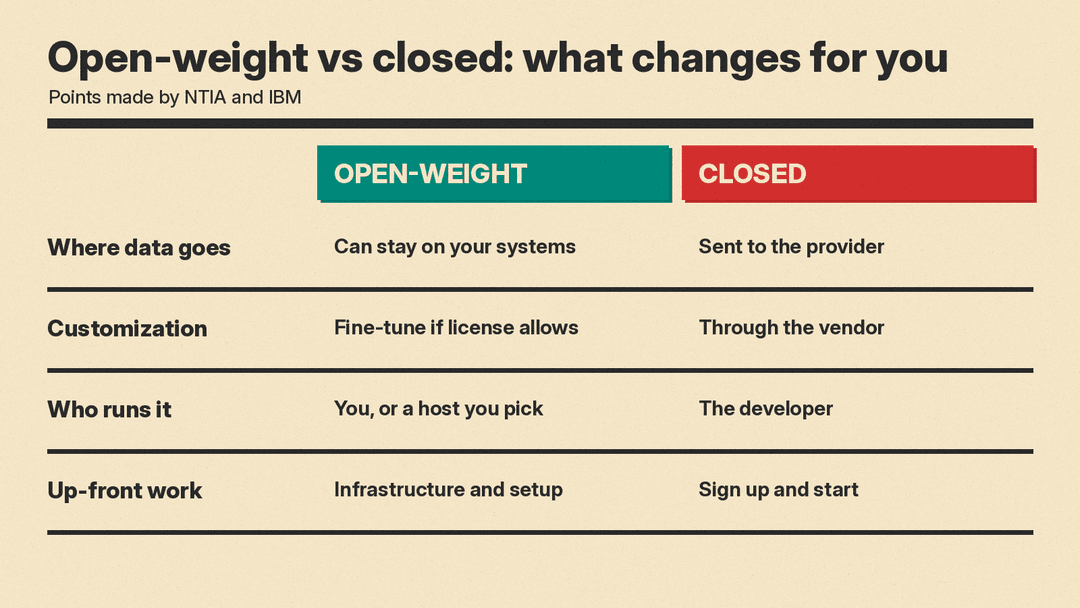
NTIA says open models "enable users to leverage models without sharing data with third parties, increasing confidentiality and data protection." IBM makes a similar point: running an open model within your own infrastructure, "whether in the cloud or on premises," gives organizations "full control over their data and means sensitive information stays within their network."
Customization
IBM notes that open models allow fine-tuning, where a model is trained further on your own data, and that making similar changes to a proprietary model "entails working with a vendor and costs time and money."
Less reliance on one company
According to IBM's guide, a proprietary model means an organization "must rely on a single provider," while an open one lets it use "community contributions, multiple service providers and possibly internal teams." NTIA adds a market-level view: open foundation models "decentralize AI market control from a few large AI developers" and widen the range of people, "including less resourced actors," who take part in AI research.
Transparency
IBM says that being able to inspect code and see how a model works can give an enterprise "more trust" and help with audits and compliance. How much you can actually inspect depends on how much the developer publishes, which brings us back to the open-weight versus open source distinction.
Why people choose closed models
With a closed model, you sign up, open an app or connect to an API, and the developer runs the model for you.
The costs of running a model yourself are real. IBM says open models avoid licensing fees but that "the cost of operating an LLM does include the cloud or on-premises infrastructure costs, and they typically involve a significant initial rollout cost." With a closed model, those costs and that work sit with the provider.
The safety debate
Open weights also raise policy questions. NTIA writes that making the weights of certain models widely available "could also engender harms and risks to national security, equity, safety, privacy, or civil rights through affirmative misuse, failures of effective oversight, or lack of clear accountability mechanisms."
NTIA's own conclusion was cautious. It says "current evidence is not sufficient to definitively determine either that restrictions on such open weight models are warranted, or that restrictions will never be appropriate in the future," and recommends that the government "actively monitor a portfolio of risks."
How to decide
Ask yourself a few questions:
- Where must your data stay? If you cannot send data to an outside company, an open-weight model on infrastructure you control is one way to keep it in-house.
- Do you need to customize the model? If you want to fine-tune on your own material, check whether the model and its license allow it.
- Who will run it? Running a model yourself means paying for hardware or cloud services and having someone to set it up and maintain it. A closed service handles that for you.
- What does the license allow? Read the terms for both kinds. Look for use restrictions, rules for sharing modified versions and any limits on commercial use.
- How much do you need to see inside? If audits or research require knowing the training data and code, check whether the release meets a definition like OSI's, not just whether the weights are downloadable.
There is no single right answer. You can also use both: a closed chat assistant for everyday work and an open-weight model for tasks where control or privacy matters most.
Quick glossary
- Weights (parameters): the learned numbers that make up a trained model.
- Closed (proprietary) model: a model whose weights are not released; you use it through the developer's service.
- Open-weight model: a model whose weights are published for download, under a license.
- Open source AI (OSI definition): a system released with the freedoms to use, study, modify and share it, including data information, code and parameters.
- Fine-tuning: training an existing model further on your own data.
- License or terms of use: the legal rules for how a model may be used and shared.
The bottom line
The real difference between open-weight and closed models is who holds the weights. With a closed model, the developer keeps them and you use the model on its terms. With an open-weight model, you can download and run it yourself, under a license that still sets rules. "Open-weight" is also not the same as "open source": OSI's definition requires the code and data information behind the weights, too. Choose based on where your data must stay, how much control and customization you need, who will run the model and what the license allows.
