
Anthropic, Google and OpenAI each sell a model they pitch for long, demanding technical work: Anthropic's Claude Fable 5.2 (November 9, 2026), Google's Gemini 4 Carbon (October 28, 2026) and OpenAI's GPT-6 Astra, which OpenAI announced on September 3, 2026, according to NBC News.
This guide compares them on price, size limits, access and test scores. Most scores below come from one source: the benchmark table in Anthropic's Fable 5.2 launch post of November 9, 2026, which lists all three models side by side. That keeps the numbers comparable, but it also means the table was published by one of the three competitors. Prices and limits come from each vendor's own pages, checked on November 11, 2026 (PST).
Quick answers
- Coding: In Anthropic's table, Fable 5.2 leads on FrontierCode 2.0 and FrontierSWE v2 as of November 9, 2026. GPT-6 Astra is second on both.
- Business workflows: Gemini 4 Carbon leads on AutomationBench in the same table as of November 9, 2026.
- Computer use: Fable 5.2 leads on OSWorld 2.1 in the table, with Carbon second and Astra third.
- Lowest API price right now: Gemini 4 Carbon, at its introductory rate through November 30, 2026.
- Highest API price per token: GPT-6 Astra, at $10 input and $50 output per million tokens.
- Consumer apps: Fable is in paid Claude plans and Astra is in paid ChatGPT plans. Carbon is rolling out to Google AI Ultra subscribers in the Gemini app, per Google.
What is each model?
Claude Fable 5.2
Anthropic says Claude Fable 5.2 and Claude Mythos 5.2 "are the same underlying model." Fable carries cybersecurity and biology safeguards, which Anthropic says "allows us to make it available to all users." Mythos goes only to organizations that pass Anthropic's verification programs.
Anthropic does not position Fable as its everyday model. The launch post says: "For most coding and knowledge tasks, we recommend that users start with Claude Opus 5.5, our strongest daily driver." Fable is the step up for what Anthropic calls "the most ambitious, open-ended technical work."
The Fable 5.2 model page describes it as built "For demanding reasoning and long-horizon agentic work." Its model ID is claude-fable-5-2.
Gemini 4 Carbon
Google calls Gemini 4 Carbon "our strongest model with state-of-the-art cybersecurity and long horizon capabilities" in its launch post. The same post says Carbon builds on Gemini 4 Argon, "which was launched two weeks ago."
Google's Gemini API models page describes Carbon as "Our strongest reasoning model, built for complex software engineering, multimodal knowledge work, scientific reasoning, and cybersecurity defense." Its model code is gemini-4-carbon.
GPT-6 Astra
OpenAI's model page calls GPT-6 Astra "our most capable model for the most demanding work" and lists uses as "complex reasoning, coding, computer use, research, and document creation." Its model ID is gpt-6-astra. OpenAI's own launch post calls it "the world's most intelligent and aligned model," a vendor claim.
How much does each model cost?
All prices are per million tokens for the developer API. Tokens are the small text pieces a model reads and writes.
Claude Fable 5.2 (Anthropic model page):
- Input: $8
- Output: $40
- Cache read: $0.20
- Fast mode (from the launch post): $16 input and $80 output. Anthropic says fast mode "speeds up token generation by up to 2.5 times."
- Batch API: 50% discount on input and output.
Gemini 4 Carbon (Gemini API pricing page):
- Input: $2.00 through November 30, 2026, then $4.00 starting December 1, 2026.
- Output, including thinking tokens: $10.00 through November 30, 2026, then $20.00 starting December 1, 2026.
- Context caching: $0.10 through November 30, 2026, then $0.20.
- The page says Carbon "is not available on the Free tier."
GPT-6 Astra (OpenAI model page):
- Input: $10
- Cached input: $1
- Output: $50
- OpenAI says: "Prompts with more than 272K input tokens are priced at 2x input and cache rates and 1.5x output for the full request."
- Batch and Flex are "priced at 50% of Standard rates," and fast mode "is priced at 2x the applicable rates."
Per-token price is only part of the cost. A model that uses fewer tokens to finish a task can cost less per task. Anthropic says that on FrontierCode 2.0, Fable 5.2 at High effort scored "about the same as Opus 5.5's best score (45.3% vs. 45.5%) for roughly half the cost per task, and ahead of GPT-6 Astra's best score (42.8%) at about the same cost." That is Anthropic's measurement, not an independent one.
How much can each model read and write?
- Claude Fable 5.2: 1M token context window and 128K max output tokens, per Anthropic. Reliable knowledge cutoff: Jun 2026.
- Gemini 4 Carbon: "Context 1M tokens" and "Max output 65K / 1M tokens," per Google's models page. The page does not explain the two output figures. The pricing page describes "long-decode generation up to 1M tokens."
- GPT-6 Astra: "1,050,000 context window," "Maximum input tokens: 922,000" and "128,000 max output tokens," per OpenAI. Knowledge cutoff: Apr 30, 2026.
How do they score on benchmarks?
These numbers come from the table in Anthropic's Fable 5.2 launch post, published November 9, 2026. Anthropic's notes say: "Scores for Fable 5.2, Fable 5.1, and Opus 5.5 show results with safeguards on unless otherwise noted. All scores show each model's highest-available effort unless otherwise noted." The post does not name the test harness for each score. For method, it points to the Claude Fable 5.2 and Claude Mythos 5.2 System Card.
Scores are listed as Fable 5.2, then GPT-6 Astra, then Gemini 4 Carbon.
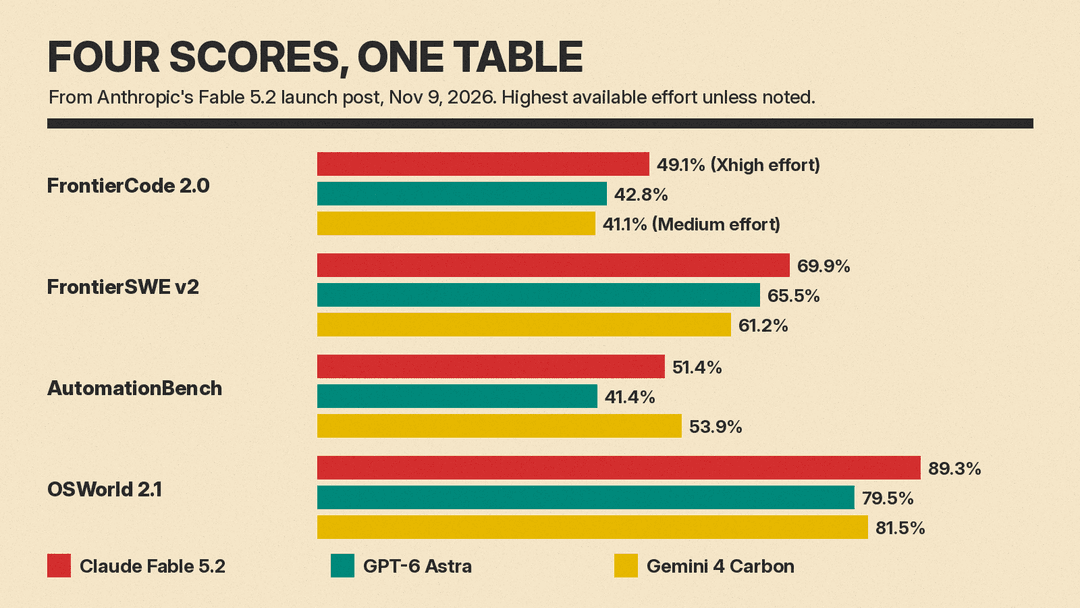
- FrontierCode 2.0 (agentic coding): 49.1% at Xhigh effort; 42.8%; 41.1% at Medium effort.
- FrontierSWE v2 (agentic coding): 69.9%; 65.5%; 61.2%.
- AutomationBench (business workflows): 51.4%; 41.4%; 53.9%.
- Terminal-Bench-Science 0.1 (agentic scientific research): 74.6%; 68.1%; 64.8%.
- OSWorld 2.1, offline set, partial (computer use): 89.3%; 79.5%; 81.5%.
- AA-Briefcase v1.1 (knowledge work): 66.1% rubric and 1785 Elo; 52.0% rubric and 1569 Elo; 61.8% rubric and 1611 Elo.
- Chartography, no tools (reading charts): 73.4%; 71.0%; 72.5%.
- RoboDojo Sim (robotics): 64.9%; 29.8%; no score listed for Carbon. Anthropic says this test "was run internally."
- Humanity's Last Exam, with tools (expert reasoning): 74.2%; 57.2%; no score listed for Carbon.
Two details matter when you read this list. First, on FrontierCode 2.0 the table marks Fable at Xhigh effort and Carbon at Medium effort, so those two scores are not at the same setting. Second, the table also includes Claude Opus 5.5, which scores 1800 Elo on AA-Briefcase, above Fable 5.2's 1785. Among the three models in this guide, Fable has the highest AA-Briefcase score.
Where does each model lead?
In Anthropic's table, as of November 9, 2026:
- Fable 5.2 leads on FrontierCode 2.0, FrontierSWE v2, Terminal-Bench-Science 0.1, OSWorld 2.1, AA-Briefcase v1.1 and Chartography among these three models. Carbon has no score listed on RoboDojo Sim or Humanity's Last Exam. On both, Fable is above Astra.
- Gemini 4 Carbon leads on AutomationBench, at 53.9% against Fable's 51.4%. It is second on OSWorld 2.1, AA-Briefcase and Chartography.
- GPT-6 Astra is second on FrontierCode 2.0, FrontierSWE v2 and Terminal-Bench-Science 0.1, and third on the other shared tests.
Google and OpenAI publish their own numbers, with different tests and settings. Google's Carbon launch post of October 28, 2026 reports 88.2% on SEC-bench Pro, 54.8% on ExploitGym and 71.0% on CWE-bench, "evaluated without guardrails." Those numbers are not in Anthropic's table, so this guide does not set them against Fable or Astra.
Artificial Analysis, an independent testing group, runs its own versions of some of these tests. On its Intelligence Index, checked on November 11, 2026, Fable 5.2 at Max effort scores 65, Gemini 4 Carbon at High effort scores 60 and GPT-6 Astra at Max effort scores 57. Its own runs do not always match Anthropic's table: on its AutomationBench-AA test, Carbon scores 77.8%, Fable 76.4% and Astra 68.5%.
How can you use each one?
Claude Fable 5.2. Anthropic says Fable 5.2 "is available today on all platforms, including Amazon Web Services, Google Cloud, and Microsoft Azure." In the Claude apps, the Claude pricing page lists:
- Free: no Fable.
- Pro: "Fable, paid with usage credits."
- Max and Ultra: Fable at "50% of weekly limits."
Gemini 4 Carbon. Google's launch post said Carbon would go first to "a subset of cyber defenders" through its Fairwind Program, with wider release to "developers, businesses, and consumers via our product surfaces as soon as possible." As of November 11, 2026, the Gemini API models page lists gemini-4-carbon and the pricing page lists paid-tier rates. Google's November 10 post says Carbon is now available through the API to all paying developers and enterprises, and is rolling out to all Google AI Ultra subscribers in the Gemini app, AI Mode in Search and Google Antigravity.
GPT-6 Astra. OpenAI's launch post said Astra would roll out "to all ChatGPT Plus, Pro, Business, and Enterprise users, as well as through the OpenAI API, Microsoft Azure, and AWS Bedrock." The model page lists the Amazon Bedrock ID openai.gpt-6-astra.
Which one should you pick?
- You write code with an agent and want the highest scores in this table: Fable 5.2. Anthropic itself suggests starting with Opus 5.5 and moving up to Fable when a task needs it.
- You automate business workflows, or you want the lowest API price this month: Gemini 4 Carbon, on the Gemini API paid tier. Plan for the higher rate from December 1, 2026.
- You already use ChatGPT or the OpenAI API, or you need computer use inside OpenAI's tools: GPT-6 Astra. Watch the higher rate for prompts above 272K input tokens.
- You pay for a consumer app, not the API: compare plans, not token prices. Fable needs a paid Claude plan, Astra needs a paid ChatGPT plan, and Carbon in the Gemini app needs Google AI Ultra.
For the earlier matchup with Claude Opus 5.5, see our Gemini 4 Carbon vs GPT-6 Astra vs Claude Opus 5.5 comparison. For launch details, see our posts on Claude Fable 5.2 and Mythos 5.2 and GPT-6 Astra.
Caveats
- The main score list comes from Anthropic, which makes one of the three models. Artificial Analysis scores, from its own runs, are the independent check.
- Anthropic's post does not name the harness for each score. It refers readers to its system card.
- Effort settings differ on some rows, as marked.
- Carbon's prices change on December 1, 2026.
- Prices, plans and access were checked on November 11, 2026 (PST) and can change.
Sources
- Anthropic: Claude Fable 5.2 and Mythos 5.2 (launch post and benchmark table), checked on November 11, 2026
- Anthropic: Claude Fable 5.2 model overview, checked on November 11, 2026
- Claude: Plans and pricing, checked on November 11, 2026
- Google: Gemini 4 Carbon launch post, checked on November 11, 2026
- Google: Gemini API models, checked on November 11, 2026
- Google: Gemini API pricing, checked on November 11, 2026
- OpenAI: GPT-6 Astra model page, checked on November 11, 2026
- OpenAI: GPT-6 Astra launch post, checked on November 11, 2026
- NBC News: OpenAI debuts GPT-6 Astra, checked on November 11, 2026
- Google: Gemini 4 Carbon is now available (November 10, 2026), checked on November 11, 2026
- Artificial Analysis: AI model comparison and Intelligence Index, checked on November 11, 2026
