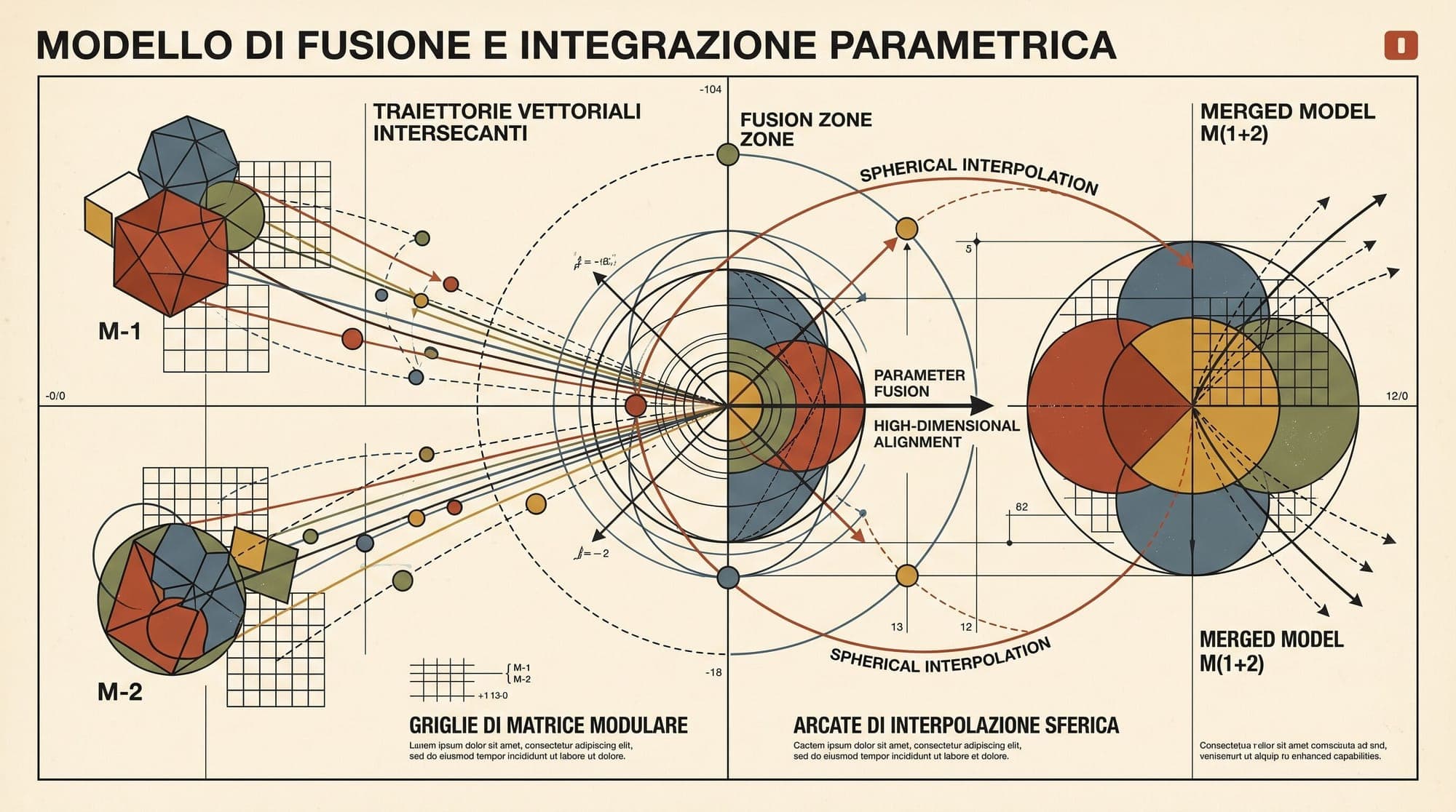
Model Merging and Task Arithmetic: Mathematical Foundations, Task Vectors, TIES-Merging, DARE, and Spherical Linear Interpolation (SLERP)
Model Merging and Task Arithmetic: Mathematical Foundations, Task Vectors, TIES-Merging, DARE, and Spherical Linear Interpolation (SLERP) Model merging enables the combination of multiple specialized large language models into a unified checkpoint without retraining, backpropagation, or access to the original training datasets. Rather than running costly multi-task supervised fine-tuning across disparate domains, practitioners can directly manipulate parameter tensors in weight space to fuse ca
1 min