
Mistral Large 4 is now a model you can download. On October 29, 2026, Hugging Face published a launch post for the weights, nicknamed "Le Chonk," with day-one support in Transformers, vLLM and llama.cpp. When Mistral first announced the model, llms.blog covered the specs and the wait for the weights. That wait is over. This post covers what was released, the license terms, and what hardware it takes to run.
What was released
According to Hugging Face, Mistral Large 4 is a multimodal, multilingual Mixture-of-Experts model. It takes text and images as input and writes text. Hugging Face lists about 1 trillion total parameters, about 49 billion active per token, and a 1 million token context window. The official repository is named mistralai/Mistral-Large-4-1T-A52B. The model card explains the gap between the two numbers: about 49 billion parameters are active per token, or 52 billion if you count the embeddings and output layers.
Mistral ships two official variants, both in the Mistral Large 4 collection:
- FP8, the main checkpoint, used for fine-tuning and for the 8-GPU server recipe.
- NVFP4, a smaller 4-bit format that Hugging Face says needs NVIDIA Blackwell GPUs in vLLM.
The community made GGUF files, the format that llama.cpp and similar local apps read. Hugging Face says Unsloth and the llama.cpp team made GGUFs. The llama.cpp team lists IQ2_XXS, Q2_K, Q4_K_M, NVFP4, Q8_0 and BF16 versions.
The license is open weight, with a limit
The weights use the Mistral Ecosystem Open-Weight License. Hugging Face describes it as "an MIT derivative that establishes limitations for model-as-a-service offerings." The model card says the license covers both commercial and non-commercial use, but operating a model-as-a-service business requires a separate commercial license from Mistral. This is not a plain MIT or Apache 2.0 release, so "open weight" is the right label here, not "open source." Our explainer on open-weight vs closed AI models covers what that difference means for users.
How the model works
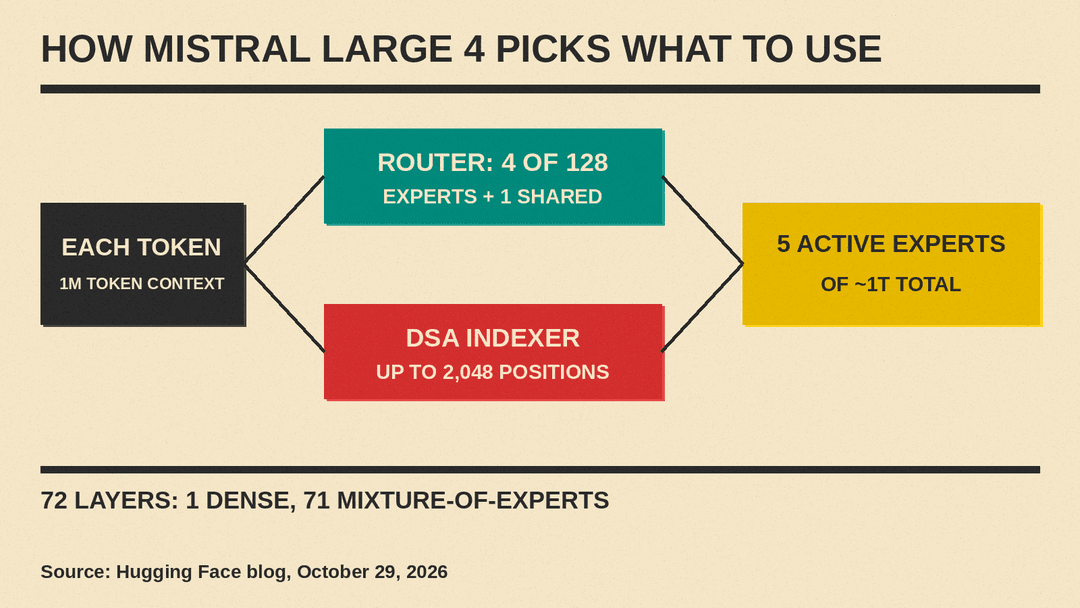
Hugging Face describes two kinds of sparsity. The first is the expert pool. The text decoder has 72 layers. The first layer is dense, and the other 71 use MoE blocks with 128 experts. A router picks 4 experts for each token, and 1 shared expert always runs, so 5 experts are active per token. This is why a model with about 1 trillion parameters uses only a small part of them for each word.
The second kind is in attention. The model combines Multi-head Latent Attention (MLA), which keeps a compressed memory of earlier tokens, with a DeepSeek Sparse Attention (DSA) indexer. Hugging Face says the indexer picks up to 2,048 earlier positions for each query, and that GLM 5.3 also uses this approach.
Images go through a 1.6 billion parameter Pixtral vision encoder with 30 layers. Hugging Face also says the model can use low, medium or high reasoning effort. The default is high, and reasoning cannot be turned off.
Benchmarks, as reported
All numbers below come from the Hugging Face post. We did not test them. As of October 29, 2026, Hugging Face says the model ranks fifth among open weights models on the Artificial Analysis Intelligence Index. Mistral's model card puts it another way: a score of 26 on version 5 of that index, the highest among western open-weight models, with the leading Chinese open-weight models scoring higher.
- Coding: 61.7% on DeepSWE v1.1, 59.4% on SWE-Atlas-QnA, 28.3% on Terminal-Bench 4, and a Coding Agent Index score of 49.8%. Hugging Face says this places it ahead of DeepSeek V4 Pro 0813 and Qwen3.8 Max. Mistral's model card gives a lower Coding Agent Index score of 48% and calls it effectively tied with GLM-5.3.
- Knowledge work: 59.9% on AutomationBench and 1,393 Elo on AA-Briefcase.
- Security: 82% on the Artificial Analysis Cyber Index task that asks a model to reproduce a real vulnerability and then patch it, and 93% of 40 Cybench challenges.
- Prompt injection: 93.3% attack resistance on Lakera's B3 benchmark.
Security is the main pitch. Mistral reports that several closed frontier models score near zero on the reproduce-and-patch test because they refuse the work. Hugging Face argues that open weights help defenders, because a team keeps control of the model during an incident and does not depend on an API provider's filters. It also says the model still declines harmful requests, with a higher average refusal rate on cyber prompts from JailbreakBench, StrongREJECT and AgentHarm than any other open weight model.
What it takes to run
This is a data center model first. Hugging Face's numbers show what "local" means at this size:
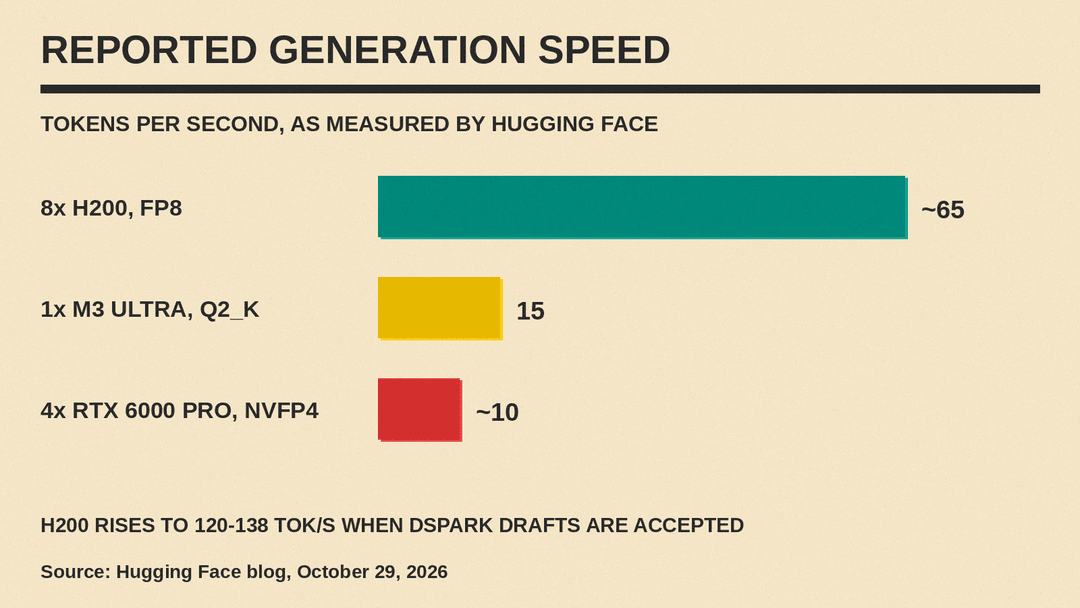
- One Apple Silicon Ultra with 512 GB of unified memory can run the 2-bit quants. On a single M3 Ultra with Q2_K, Hugging Face measured about 90 tokens per second for prefill and 15 tokens per second for generation. Hugging Face says the other quants need distributed inference, and that the model can also run across multiple NVIDIA or AMD cards.
- On 4 RTX 6000 Pro cards, the NVFP4 version ran at 32K context, with about 10 tokens per second of generation. The IQ2_XXS quant reached 800K context. Generation ran at 30 tokens per second with short prompts and dropped to 3 tokens per second at long context.
- On Hugging Face Inference Endpoints, a ready recipe uses 8 NVIDIA H200 GPUs with the FP8 weights in vLLM. It serves up to 131K tokens of context and 16 requests at a time. A single request generated about 65 tokens per second, and 120 to 138 tokens per second on chat prompts when the built-in DSpark draft head's guesses were accepted.
Fine-tuning is supported on day one through TRL. Hugging Face's example trains a LoRA adapter on the FP8 variant on a node of 8 B300 GPUs. The model is also available through Hugging Face Inference Providers for people who want to try it without any hardware.
Why it matters
Mistral Large 4 is a roughly 1 trillion parameter model with downloadable weights, and Hugging Face ranks it fifth among open weights models. For teams that need to keep data and tools in-house, it adds a self-hosted option with strong reported coding and security scores. The limits are real. Very few people can run it at home, running it as a hosted service needs a separate commercial license, and the benchmark figures above are as reported in the Hugging Face post. Independent tests in the coming weeks will show whether the coding and security numbers hold up.
