
Mistral has released Timestral, its first family of time-series foundation models, with open weights on Hugging Face. The four models have 5M, 28M, 123M and 209M parameters, run on a CPU, and forecast numeric data such as sensor readings, sales volumes or server metrics without task-specific training. Mistral says the largest one ranks first among pretrained, zero-shot models on the three main public forecasting benchmarks.
The weights are free to download, but not free for everyone to use. The license excludes any company whose monthly revenue is above $20 million, which covers many of the industrial and financial users Mistral names as the target market.
What Timestral does
Timestral does not generate text. It reads a history of numbers and returns a probabilistic forecast: 21 quantiles per time step, from the 1st to the 99th percentile, so a user sees a range of likely values and not just one line. According to the model card, it accepts up to 32,768 historical time steps and forecasts up to 1,024 steps in one forward pass. Longer horizons are forecast block by block, with each block's median fed back as context.
It handles several related series at once (Mistral's example is a pump's vibration, temperature and pressure) and takes two kinds of side information. Past-only covariates are known only for the history. Known-future covariates, such as a production schedule, a holiday calendar or a weather forecast, are visible across the forecast window. Categorical inputs such as day of week or machine state are supported too.
The 209M model is a patch-based transformer with 24 layers and an embedding dimension of 768, reading 32 time steps per patch. The GitHub repository lists the fp32 weights at 21 MB for the 5M model and 837 MB for the 209M model.
How it was trained
Mistral says most of the training data was synthetic. It first generated single series with trends, seasonality and varied noise, then combined them into multivariate series with nonlinear dependencies. Pretraining used purely synthetic data at a context of 8,192 steps. Post-training used a mix of real and synthetic data with a context four times longer.
Two design choices get the most attention in the announcement. The first, which Mistral calls Decoupled Horizon Forecasting, keeps the full history in the sequence and uses separate learned tokens to produce the forecast, so every observed value serves as both a training target and context. The second is an attention scheme in which covariates can pass information to targets but never read them, which prevents a target's own future values from leaking into its forecast. A technical report is listed as coming soon.
The benchmark lead is real but narrow
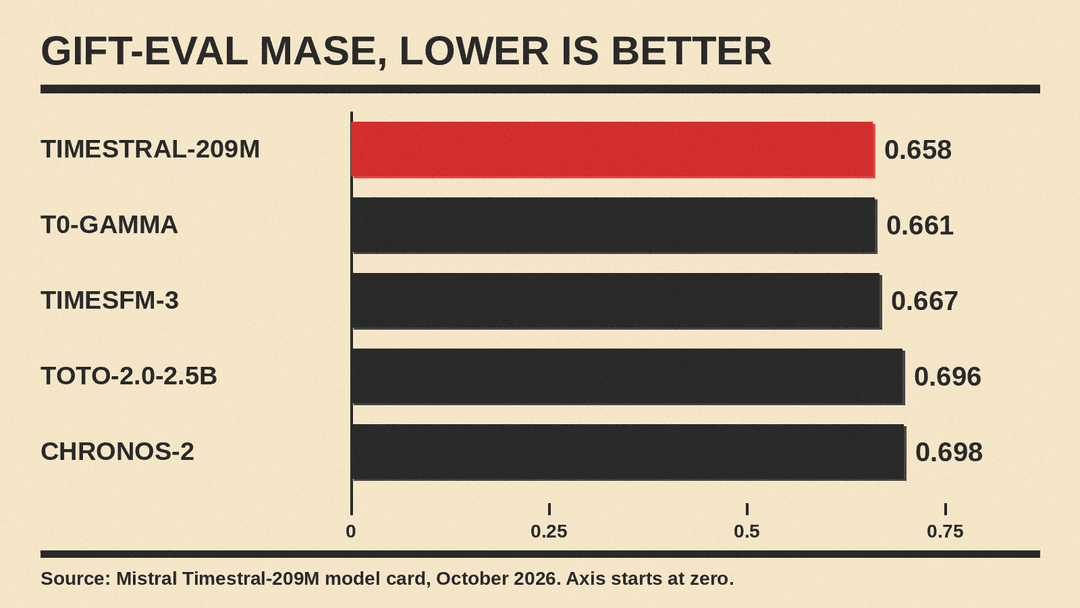
All figures below come from Mistral's model card. Mistral says the results were submitted to the GIFT-Eval and TIME leaderboards, but they are its own runs.
- GIFT-Eval MASE (lower is better): Timestral-209M scores 0.658, against 0.661 for t0-gamma, 0.667 for TimesFM-3, 0.696 for Toto-2.0-2.5B and 0.698 for Chronos-2.
- TIME MASE (lower is better): 0.626, against 0.637 for t0-gamma and 0.640 for TimesFM-3.
- fev-bench SQL skill score (higher is better): 50.39, against 49.42 for t0-gamma and 48.99 for TimesFM-3.
On GIFT-Eval the gap to the next model is 0.003, under half a percent. That is enough to top a leaderboard, but small enough that most teams will not see it on their own data. The stronger claim is about size. Mistral says the 28M model beats Chronos-2, which it describes as about four times larger, on GIFT-Eval and TIME. The card supports that: 0.678 against 0.698 on GIFT-Eval MASE, and 0.638 against 0.662 on TIME.
Small enough for a CPU
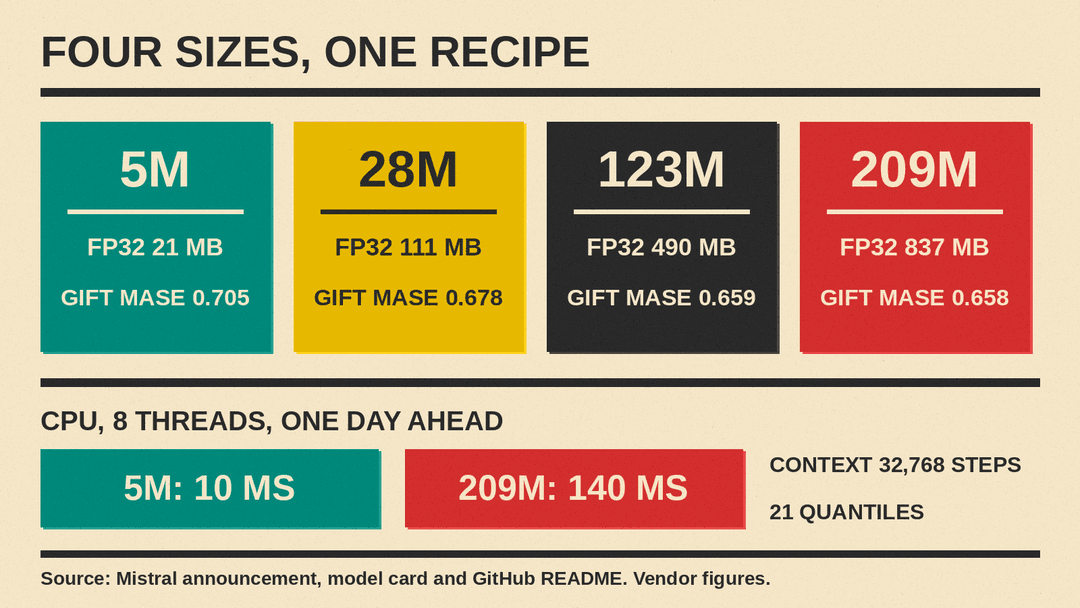
Mistral says Timestral needs no GPU at inference. On a server CPU with 8 threads, forecasting one day ahead from three weeks of 15-minute data takes 10 ms with the 5M model and 140 ms with the 209M model. It says the 28M model is five times faster than the 209M model, and the 123M model comes within 0.2% of the 209M score at three quarters of its latency. Those are vendor timings on unspecified hardware.
That matters for where forecasting actually runs: inside monitoring pipelines, on premises, and often next to thousands of sensor streams. Mistral pitches Timestral for that setting, including air-gapped deployments, and as an anomaly detector that can hand off to its language-model agents for root-cause analysis. Fine-tuning on private data goes through its Mistral Forge training service.
The license catch
The inference code is Apache 2.0. The weights are not. They ship under a Modified MIT license that adds one condition: you may not exercise any rights under it if the global consolidated monthly revenue of your company, or your employer, exceeded $20 million in the preceding month. The restriction extends to derivatives and fine-tunes, including ones made by third parties. Companies above the line must request a commercial license, which Mistral may grant "at its sole discretion," or use Mistral's hosted services. Mistral has not published a license for its much larger Mistral Large 4 yet either.
That cuts against the use cases in Mistral's own announcement. A plant operator with thousands of assets or a bank forecasting flows across thousands of accounts is likely to be over $20 million a month. For them, Timestral is a sales lead with a free trial on public data, not a drop-in open model. For startups, researchers and smaller firms, it is a competitive forecaster they can run on a laptop. Meta's Muse Spark Open, released the same day, also came with revenue conditions, so readers should check the license file before treating "open weights" as permission to deploy. Our roundup of reactions to Timestral covers how Hacker News and X users responded to the license and the benchmark margins.
