
"Open-source LLM" usually means a model whose weights you can download and run yourself. In October 2026 that list is long. This guide sorts the open-weight models worth your time by what you want to do and what hardware you have, using each lab's own model card as of October 19, 2026.
A note on words: almost none of these are open source in the strict software sense. They are open-weight models. Some use standard licenses like Apache 2.0 or MIT. Others use a custom license written by the lab. Check the license section below before you ship anything commercial.
Quick picks
- Strongest open models overall: GLM-5.3 and Kimi K3.
- Best open model for coding agents on a budget: DeepSeek V4.1-Flash-1017.
- Biggest Apache 2.0 model on this list: Reflection Beam 1.0.
- Best US multimodal open model: Meta Muse Spark Open.
- Best for one server or a big workstation: NVIDIA Nemotron 3.5 Super VL and GLM-5.3-Flash.
- Best for a laptop or desktop GPU: Qwen3.8-27B and Gemma 4.
- Best for on-device agents: LFM2.5-24B-A2B.
- Best for a phone, with vision: MiniCPM-V 4.7.
How we picked
We looked at recent open-weight releases with high download and like counts on Hugging Face, then read each model card. Every specification below comes from that card or from our earlier coverage, which links the primary source.
Two cautions apply to the whole list. First, benchmark numbers in model cards are run by the lab that made the model. None of them are independent replications. Second, "total parameters" sets how much memory you need, and "active parameters" sets how much compute each token costs. A mixture-of-experts (MoE) model with 500B total and 23B active still needs room for all 500B.
One shared yardstick helps. In the comparison table on Meta's Muse Spark Open model card, the Artificial Analysis Intelligence Index puts GLM 5.3 at 45, Kimi K3 at 44, Qwen3.8-2.4T-A95B at 40 and Muse Spark Open at 39, as we reported in our Muse Spark Open coverage.
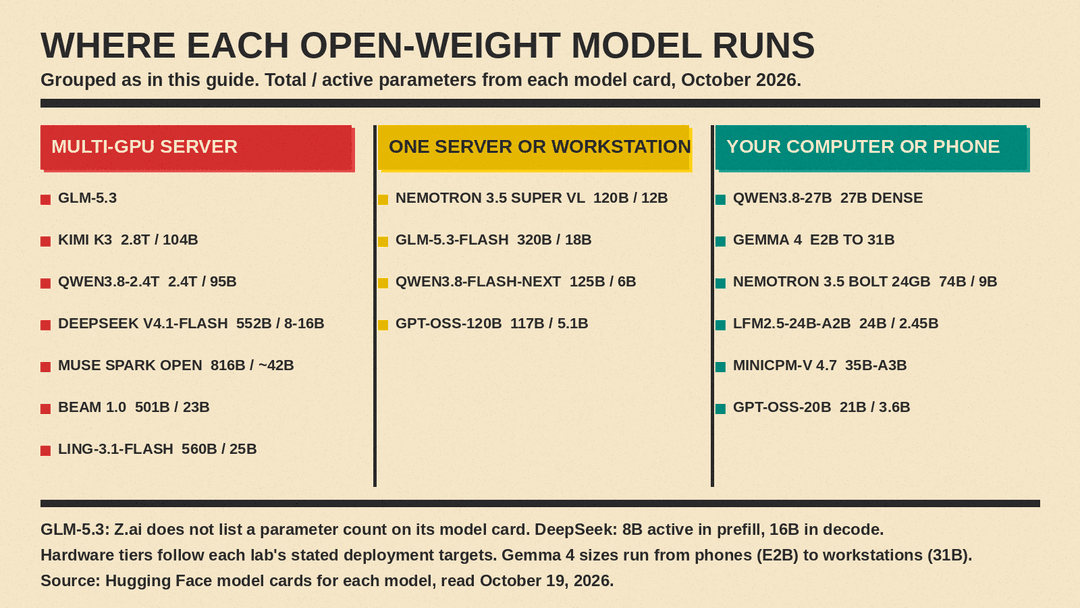
Frontier-class open models (multi-GPU servers)
These are the largest open models. You run them on a multi-GPU cluster or use them through a hosting provider. Meta, for example, lists API access to Muse Spark Open through providers including OpenRouter and Together AI.
GLM-5.3 (Z.ai)
Z.ai says GLM-5.3 uses the same base model as GLM-5.2 and that every gain comes from post-training. The lab calls it "the most capable open-weights model for coding" and reports a 50% gain over GLM-5.2 on its in-house Z.ai Code Bench. On the public tests in its card, it scores 88.2 on Terminal Bench 2.1 and 66.9 on DeepSWE v1.1. You can set the thinking budget with a reasoning_effort setting of low, high or max. It uses a custom GLM-5.3 license.
Pick it if you want a top open coding model and can host or rent a large deployment.
Kimi K3 (Moonshot AI)
Moonshot describes Kimi K3 as "the world's first open 3T-class model." It has 2.8T total parameters with 104B active, activates 16 of 896 experts per token, reads text, images and video, and supports a 1M-token context window. In Z.ai's own GLM-5.3 table, Kimi K3 scores 88.3 on Terminal Bench 2.1 and 67.5 on DeepSWE v1.1, just above GLM-5.3 on both. It ships under the Kimi K3 License.
Pick it if you need long-horizon coding and knowledge work with native vision in one open model.
Qwen3.8-2.4T-A95B (Alibaba)
This is the downloadable version of Alibaba's Qwen3.8-Max flagship: 2.4T total parameters, 95B active. Alibaba says it is the first time it has released a Max-class model as open weights. The open checkpoint is text only, with thinking always on. Vision input and a non-thinking mode stay on the hosted Qwen3.8-Max. It uses a custom Qwen3.8-Max License. Our Qwen3.8 explainer sorts out the whole family.
Pick it if you already build on Qwen and want the largest model in that family under your own control.
DeepSeek V4.1-Flash-1017 (DeepSeek)
DeepSeek calls the October 17 release a minor update to V4.1-Flash with gains in reasoning, coding, agentic tasks and vision, plus shorter outputs. The base V4.1-Flash model card describes a multimodal MoE with 552B backbone parameters and up to 1M tokens of context. It activates 8B parameters per token during prefill and 16B during decode. DeepSeek's card shows 77.0 on DeepSWE v1.1, against 74.0 for Anthropic's Opus 5. The license is MIT. More detail is in our DeepSeek V4.1-Flash-1017 report.
Pick it if you run many coding-agent tasks and care about cost per task.
Meta Muse Spark Open (Meta)
Muse Spark Open has 816B total parameters, about 42B active, and a 1M-token context window. It accepts text, images, audio and video and produces text. Meta calls it "the most capable US open-weight model to date," and says it runs "on your desktop" with two Apple M5 Ultra Mac Studios and MLX. That is about a terabyte of memory across two machines. The BF16 weights are about 1.5 TB. The Hugging Face repo is gated: you submit an access request before you can download. The license is a custom Meta license with attribution and revenue conditions.
Pick it if you need audio and video input in an open model, or you prefer a US lab.
Reflection Beam 1.0 (Reflection)
Beam 1.0 has 501.3B total parameters and 23.4B active, a 1M-token context window, and text-only input and output. Reflection says it was developed predominantly for English and reaches comparable quality to leading open models with about 3x fewer reasoning tokens. It ships in BF16, FP8 and NVFP4 under Apache 2.0.
Pick it if you want a large text model under Apache 2.0. It is the largest model on this list with that license.
Ling-3.1-flash (inclusionAI)
Ant Group's inclusionAI lab released Ling-3.1-flash with 560B total parameters, 25B active per token and a 1M-token context window, under MIT. The lab says it works well inside agent tools such as Claude Code, Kilo Code and Qwen Code.
Pick it if you want another large MIT-licensed model for agent and software work.
Mid-size open models (one GPU server or a big workstation)
NVIDIA Nemotron 3.5 Super VL
Nemotron 3.5 Super VL has 120B total parameters and 12B active, takes text, images and video, and supports up to 1M tokens of context. NVIDIA lists 4x H100 or 2x GB200 for the BF16 weights and points to an NVFP4 version for DGX Spark. NVIDIA says the Nemotron family comes with open weights, training data and recipes. It uses the OpenMDW-1.1 license.
Pick it if you need document and video understanding on a single multi-GPU node, or you want to fine-tune with NVIDIA's published training data.
GLM-5.3-Flash (Z.ai)
GLM-5.3-Flash is the first natively multimodal model in the GLM-5 series, with 320B total and 18B active parameters. Z.ai says it beats GLM-5.2 across benchmarks at one-tenth the price. It is MIT licensed and supports SGLang, vLLM and Transformers.
Pick it if GLM-5.3 is too large for you and you want image input.
Qwen3.8-Flash-Next (Alibaba)
Alibaba describes Flash-Next as an experimental preview of the architecture that will underpin Qwen 4. It has 125B parameters with 6B activated, plus 51B of n-gram embeddings and a 4B multi-token prediction module. It handles 262,144 tokens natively, extendable to 1M. It uses the Qwen Community license.
Pick it if you want to test the next Qwen architecture early.
gpt-oss-120b (OpenAI)
OpenAI's gpt-oss-120b dates from August 2025, and Hugging Face still showed more than 3 million downloads in the past month as of October 19. It has 117B parameters with 5.1B active and fits on a single 80GB GPU such as an H100 or MI300X, thanks to MXFP4 quantization of its expert weights. It is Apache 2.0 and supports low, medium and high reasoning effort.
Pick it if you want a known, permissive model that fits one data center GPU.
Open models you can run on your own computer
If you are new to local models, start with our guide on how to run an AI model on your own laptop with Ollama, LM Studio or llama.cpp.
Qwen3.8-27B (Alibaba)
A 27B dense vision-language model that understands images and video, with thinking on by default and switchable per request. It handles 262,144 tokens natively, extendable to 1M. The license is Apache 2.0. Hugging Face showed more than 7 million downloads in the past month as of October 19.
Pick it if you want a dense all-round model with image and video understanding under Apache 2.0.
Gemma 4 (Google DeepMind)
Gemma 4 comes in five sizes: E2B, E4B, 12B, 26B A4B and 31B. All take text and images, and E2B, E4B and 12B also take audio. The small models have a 128K context window and the medium models 256K. Google says Gemma 4 supports more than 35 languages out of the box, was pre-trained on more than 140, and supports configurable thinking modes and function calling. Gemma 4 is released under Apache 2.0. The 31B instruction model had close to 9 million Hugging Face downloads in the past month as of October 19.
Pick it if you want a size for every device, from a phone (E2B, E4B) to a workstation (31B), under a permissive license.
NVIDIA Nemotron 3.5 Bolt 74B-A9B 24GB
NVIDIA built this version of Bolt to run everyday agent tasks locally. It has 74B total and 9B active parameters, and native 2-bit quantization, which NVIDIA's card says uses quantization-aware training, packs it into 24GB of memory. It reads text, images and video and supports up to 256K tokens. NVIDIA's card lists vLLM on Ampere (A100), Hopper (H100-80GB) or Blackwell GPUs for deployment. It uses the OpenMDW-1.1 license.
Pick it if you have one of the supported NVIDIA GPUs and want a large model inside a 24GB memory budget.
LFM2.5-24B-A2B (Liquid AI)
Liquid AI's largest LFM2.5 model has 24.0B total and 2.45B active parameters, a 131,072-token context window and text-only input. It always reasons before it answers. Liquid AI reports 184 tokens per second on an Apple M5 Max and a LiveClaw agent score of 48.09 against 38.19 for Qwen3.6-35B-A3B. It uses Liquid AI's LFM 1.0 license.
Pick it if you want a fast local agent model and speed per token matters more than raw size.
MiniCPM-V 4.7 35B-A3B (OpenBMB)
The first MoE model in the MiniCPM-V series handles single images, multiple images and video. OpenBMB reports more than 13 tokens per second using 3 GB of memory on an iPhone 17 Pro Max and supports iOS, Android and HarmonyOS. It is Apache 2.0. See our MiniCPM-V 4.7 explainer for setup.
Pick it if you need vision on a phone without sending images to a server.
gpt-oss-20b (OpenAI)
The smaller gpt-oss model has 21B parameters with 3.6B active and runs within 16GB of memory, according to OpenAI. It is Apache 2.0.
Pick it if you have a 16GB machine and want a reasoning model with a clean license.
Licenses at a glance
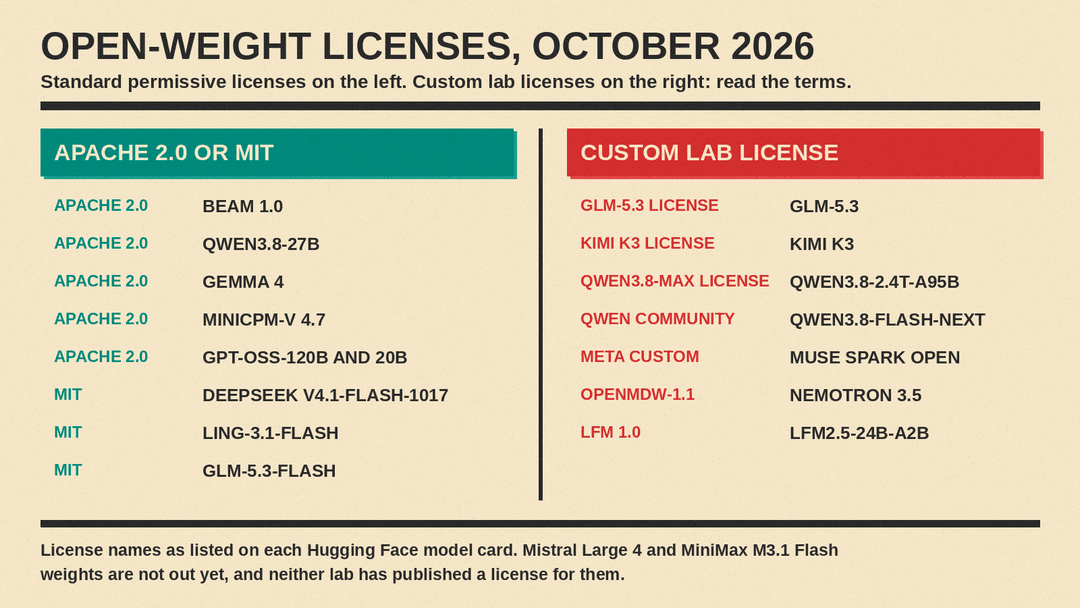
Standard permissive licenses (Apache 2.0 or MIT):
- Apache 2.0: Reflection Beam 1.0, Qwen3.8-27B, Gemma 4, MiniCPM-V 4.7, gpt-oss-120b and gpt-oss-20b.
- MIT: DeepSeek V4.1-Flash-1017, Ling-3.1-flash and GLM-5.3-Flash.
Custom lab licenses (read the terms before commercial use):
- GLM-5.3 license, Kimi K3 License, Qwen3.8-Max License (Qwen3.8-2.4T-A95B), Qwen Community license (Qwen3.8-Flash-Next), Meta's Muse Spark Open license, NVIDIA OpenMDW-1.1 (Nemotron 3.5) and Liquid AI's LFM 1.0 license.
Coming soon
- Mistral Large 4. Mistral said the open weights would follow the October 6 API preview "by the end of the month." A Hugging Face upcoming-release page lists October 31, 2026, and Mistral has not published a license yet. Our Mistral Large 4 explainer has the details.
- MiniMax M3.1 Flash. MiniMax launched it on its API on October 19 and says "model weights will be released later." See our MiniMax M3.1 Flash explainer.
How to choose
- Start with your hardware. Total parameters set the memory floor. On one consumer GPU or a laptop, look at Qwen3.8-27B, Gemma 4, LFM2.5-24B-A2B and gpt-oss-20b. On one server, look at Nemotron 3.5 Super VL, GLM-5.3-Flash and gpt-oss-120b.
- Then check the license. If you cannot do a legal review, stay with Apache 2.0 or MIT.
- Then test on your own tasks. Vendor benchmarks are a starting point. Run 20 to 50 of your real prompts through two or three candidates before you commit.
- Use a host before you buy hardware. Most frontier-class open models are available from API providers, so you can test them before you plan a deployment.
Sources
- GLM-5.3 model card (Hugging Face)
- GLM-5.3-Flash model card (Hugging Face)
- Kimi K3 model card (Hugging Face)
- Qwen3.8-2.4T-A95B model card (Hugging Face)
- Qwen3.8-27B model card (Hugging Face)
- Qwen3.8-Flash-Next model card (Hugging Face)
- DeepSeek V4.1-Flash-1017 model card (Hugging Face)
- DeepSeek V4.1-Flash model card (Hugging Face)
- Meta Muse Spark Open on Hugging Face
- Hugging Face: Welcome Muse Spark Open
- Reflection Beam 1.0 model card (Hugging Face)
- Ling-3.1-flash model card (Hugging Face)
- NVIDIA Nemotron 3.5 Super VL BF16 model card (Hugging Face)
- NVIDIA Nemotron 3.5 Bolt 74B-A9B 24GB model card (Hugging Face)
- gpt-oss-120b model card (Hugging Face)
- Gemma 4 31B instruction model card (Hugging Face)
- LFM2.5-24B-A2B model card (Hugging Face)
- MiniCPM-V 4.7 35B-A3B model card (Hugging Face)
- gpt-oss-20b model card (Hugging Face)
- Meta: Introducing Muse Spark Open
- Mistral: Mistral Large 4 announcement (October 6, 2026)
- Mistral Large 4 upcoming-release page (Hugging Face)
- MiniMax: M3.1 Flash launch post
