
MiniMax has put a name on Space Bunny. MiniMax says the anonymous model that developers had been testing was an early version of MiniMax M3.1 Flash, which MiniMax officially rolled out on October 19. MiniMax says the anonymous version processed more than 200 trillion tokens before the reveal. The release lands two days after DeepSeek's V4.1-Flash-1017 update, and its list price matches DeepSeek's off-peak rate.
The short version: M3.1 Flash is a 1M-context coding and agent model, with text, image and video input. It costs $0.15 per million input tokens and $0.60 per million output tokens, and it is available now through MiniMax's API. MiniMax says the weights will come later.
The reveal
On X, Together AI posted a teaser that read "Who is Space Bunny?" with the line "Something's hopping onto Together AI." A few hours later, MiniMax's official account posted "Welcome back. Space Bunny." and "MiniMax-M3.1-Flash is coming." The blog post with the full launch followed the same day. MiniMax's API docs now list MiniMax-M3.1-Flash as the latest M-series model, with MiniMax-M3 still available.
What MiniMax claims
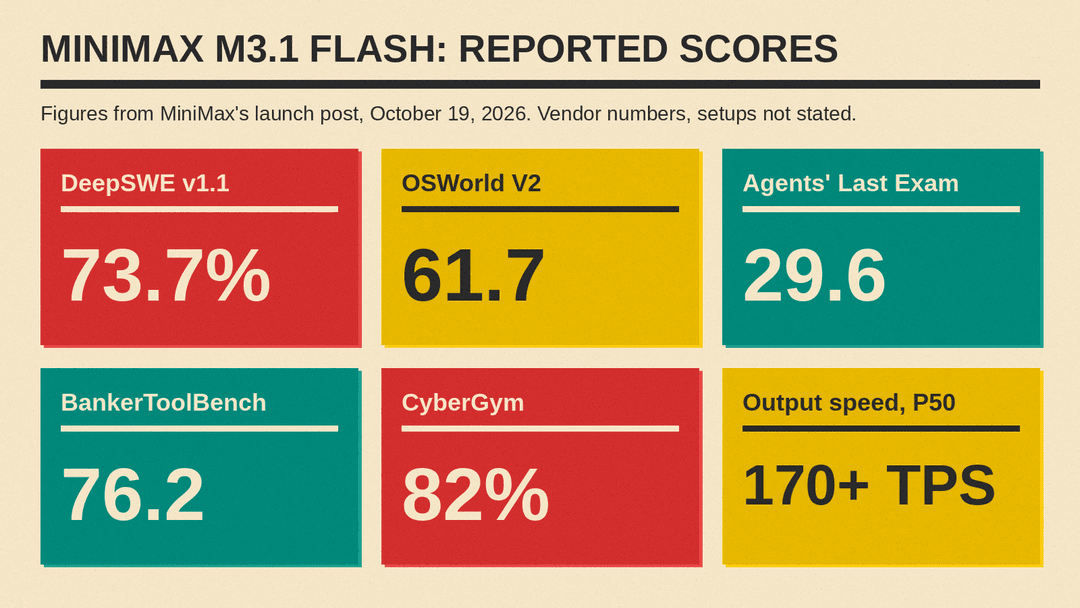
All figures below come from MiniMax's own launch post. They are vendor numbers.
- DeepSWE v1.1: 73.7%.
- OSWorld V2 (computer use across apps): 61.7.
- Agents' Last Exam (ALE): 29.6. MiniMax says the model ranks first among Chinese models on both OSWorld V2 and ALE.
- BankerToolBench: 76.2.
- CyberGym (vulnerability discovery): 82%.
- AutomationBench-AA: MiniMax says it "ranks among the top performers" but gives no score.
MiniMax also says online inference is nearly three times faster than before, with output speeds of 200+ tokens per second and a median (P50) of 170+. For agentic tasks, it says overall usage cost is 70% lower than the predecessor model.
One caution on comparisons. DeepSeek's model card for V4.1-Flash-1017 lists 77.0 on DeepSWE v1.1 and 35.4 on Agents' Last Exam, both higher than MiniMax's figures. DeepSeek says it ran DeepSWE with the Mini-SWE-V2 harness. MiniMax's post does not name its harness or setup, so the two vendors' tables may not be measuring the same thing. That also makes MiniMax's "first among Chinese models" claim on ALE hard to check against DeepSeek's self-reported score. For more on the DeepSeek release, see our DeepSeek V4.1-Flash-1017 breakdown.
Pricing against DeepSeek
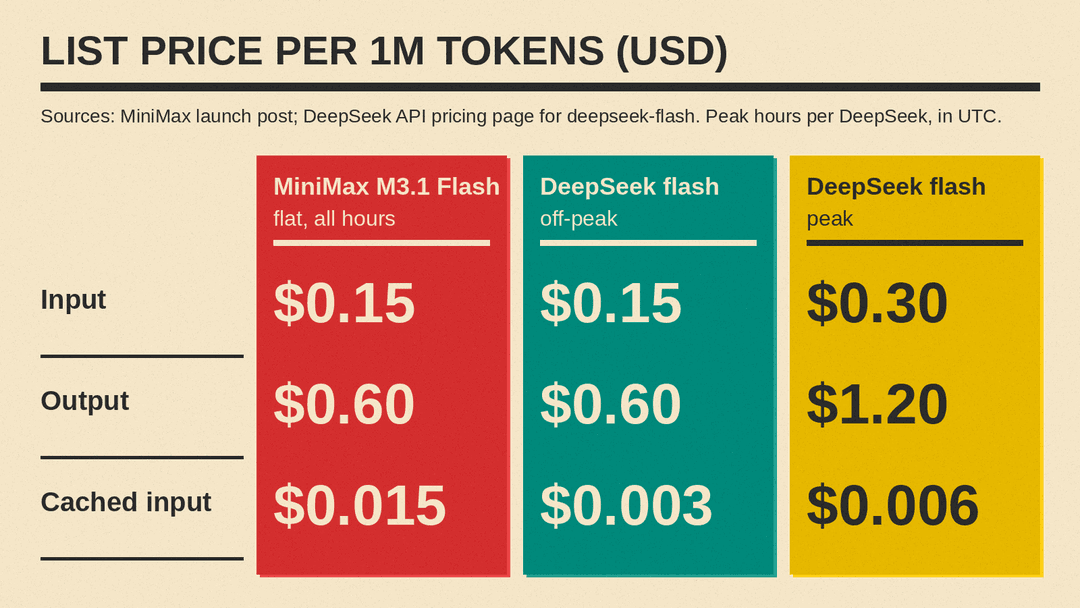
MiniMax lists a flat price for M3.1 Flash: $0.15 input, $0.60 output and $0.015 cached input, per million tokens. For comparison, MiniMax's pricing page lists MiniMax-M3 at $0.30 input, $1.20 output and $0.06 cached input for requests up to 512K input tokens.
DeepSeek's pricing page for deepseek-flash, which now serves V4.1-Flash-1017, has two rates:
- Off-peak: $0.15 input (cache miss), $0.60 output, $0.003 cached input.
- Peak: $0.30 input (cache miss), $1.20 output, $0.006 cached input.
DeepSeek lists peak hours as 01:00 to 04:00 and 06:00 to 10:00 UTC, Monday through Friday. So MiniMax matches DeepSeek's off-peak list price at all hours, but DeepSeek's cached input is cheaper at either rate. For agent workloads that resend long contexts, the cache price can matter more than the headline rate. Our LLM API pricing comparison covers the wider market.
Thinking is always on
The docs add a detail that the launch post does not. M3.1 Flash always reasons before it answers, and thinking cannot be turned off. A request that sends thinking disabled, or effort set to "none", returns a 400 error. Instead, developers set an effort level of low, medium, high, xhigh or max. If the field is omitted, the default is max. MiniMax says higher levels produce more output tokens at higher latency, so teams that care about cost should set effort explicitly rather than accept the default.
The API accepts both Anthropic-style and OpenAI-style requests, and MiniMax recommends the Anthropic-compatible endpoint.
Weights and availability
M3.1 Flash is available through the MiniMax API, MiniMax's M Plan subscription and its MiniMax Code app. The launch post says "Model weights will be released later," and the docs describe the model as "An ultra-efficient open-weight model for everyday work." As of 4:50 AM PDT on October 19, MiniMax's Hugging Face organization did not list an M3.1 Flash repository. MiniMax also says a Pro model "will also arrive later."
Why it matters
Before DeepSeek's October 17 update, the major Chinese model makers had gone almost a month without a new frontier release, Caixin reported. Caixin also noted that Zhipu, Alibaba's Qwen, StepFun, Xiaomi MiMo and DeepSeek have all framed recent launches around the Pareto frontier of performance and cost. M3.1 Flash follows the same pattern: a Flash model aimed at coding and agent work, with a low list price.
The open questions are practical. MiniMax has not said when the weights ship or under what license. Its benchmark table uses its own setups. And with thinking always on, real per-task cost depends on how many tokens the model spends at each effort level. Independent tests over the next few weeks will show whether the 70% cost cut holds outside MiniMax's own numbers.
Sources
- MiniMax: MiniMax M3.1 Flash: Redefining Agent Performance and Cost
- MiniMax API docs: Model Invocation
- MiniMax API docs: Pricing Overview
- MiniMax on X: "Welcome back. Space Bunny."
- Together AI on X: "Who is Space Bunny?"
- DeepSeek-V4.1-Flash-1017 model card on Hugging Face
- DeepSeek API docs: Models and Pricing
- MiniMaxAI on Hugging Face
- Caixin: DeepSeek releases new model (Chinese)
