
The standard defense against the AI book flood has always been that the books are bad. Machine-written novels are sloppy, repetitive and forgettable, so the argument goes, and paying readers will filter them out. Two large studies published in 2026 confirm the first half of that sentence and quietly demolish the second. AI books do sell worse per title. They are also restructuring the marketplace anyway, and the mechanism is arithmetic rather than taste.
What is actually in the catalog
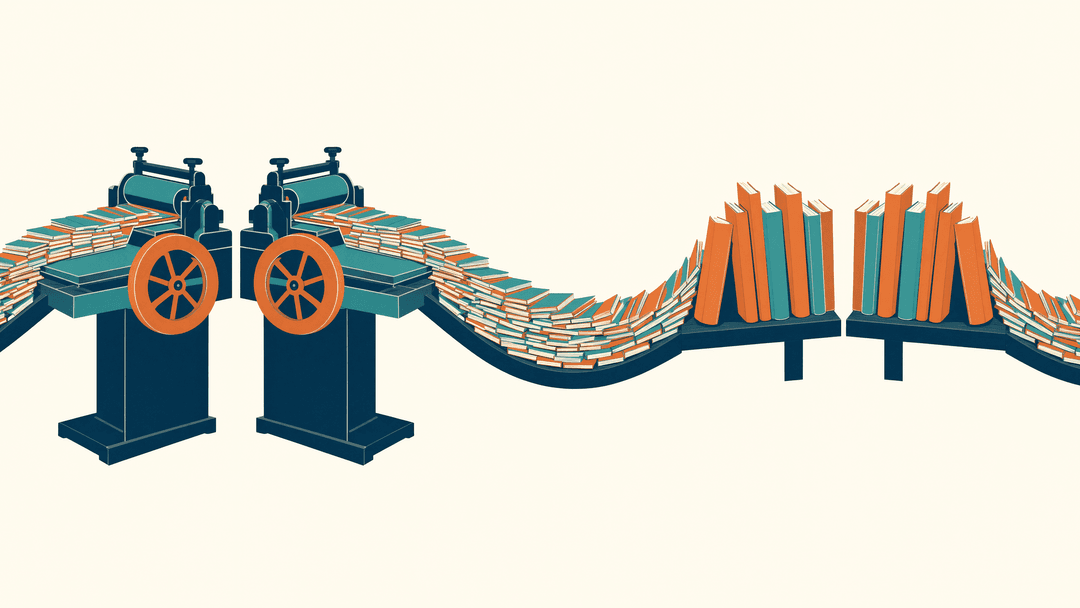
The clearest measurement comes from a team at Stony Brook, Columbia Law and Michigan (Chakrabarty, Liu, Ginsburg and Dhillon), who ran full-text AI detection across 14,419 randomly sampled self-published genre-fiction ebooks released on Amazon between January 2023 and March 2026, then matched each title to daily sales through a proprietary panel maintained by one of the Big Five publishers. That panel tracks roughly 500,000 Amazon ASINs and covers about 95 percent of daily ebook unit volume. None of the books disclosed anything about AI use, so the detection is the only signal anyone had.
The results, in three bands (arXiv 2607.20349):
- Books with more than 25 percent detected AI text make up 20.0 percent of the sample catalog but earn only 12.1 percent of sales and 11.3 percent of revenue.
- Books with light AI text (1 to 25 percent) make up 17.1 percent of books and roughly 16 percent of sales and revenue, about proportionate.
- Books with no detected AI text hold 62.9 percent of the catalog and 71.7 percent of sales and 72.5 percent of revenue.
A parallel NBER working paper by Imke Reimers and Joel Waldfogel (w34777) sampled some 60,000 Amazon titles and detected AI from 1,000-word previews rather than full texts. It put detected AI incidence at roughly 30 percent of new releases in 2023, about 45 percent in 2024, and more than 60 percent during 2025, with monthly release counts having roughly tripled since 2022, eclipsing 300,000 in late 2025. Preview detection overstates "fully AI-written" and no store publishes its own count, so treat the shares as estimates. What the two studies agree on is direction and scale: AI text is now a majority-adjacent feature of the self-publishing catalog.
The underlying volume numbers are not disputed because they do not depend on detection. Bowker's ISBN data, reported by Publishers Weekly, counts 4.17 million titles registered in the US in 2025, up 32.5 percent year over year, of which about 3.5 million were self-published, a 38.7 percent single-year jump and roughly 84 percent of all output.
Dilution, not displacement
The per-title sales record of AI books is genuinely poor. The problem is the denominator. Between January 2023 and March 2026 the cumulative catalog in the Chakrabarty sample grew 38.3-fold and the number of books selling in a given quarter grew 19.2-fold, while quarterly units grew 7.3-fold and quarterly revenue 8.9-fold. The market added selling books about twice as fast as it added revenue. Revenue per selling book therefore fell almost mechanically, and it fell for everyone.
Comparing launch-window cohorts (90 days post-release, fixed), revenue per book declined in six of eight genre clusters across all books and in seven of eight when the sample was restricted to books with no detected AI text. The exception proves the pattern: in Fantasy/Supernatural/Horror, the cluster AI reached latest and least, revenue per no-AI book rose 35 percent between the 2023 and 2025 cohorts. Where AI exposure was low, human authors kept their economics. Where it was high, they did not.
Top ranks show the same squeeze. The share of new entrants into weekly Top-25 lists that carry substantial AI text rose from near zero in early 2023 to 31 percent, while the retention of no-AI books in those slots dipped to a trough near 28 percent before recovering to about 62. No-AI books still hold 73 percent of the top 5 percent of sellers. But churn at the top is now supplied disproportionately by machine text, and holding rank is no proof of durability.
Where Kindle Unlimited fits
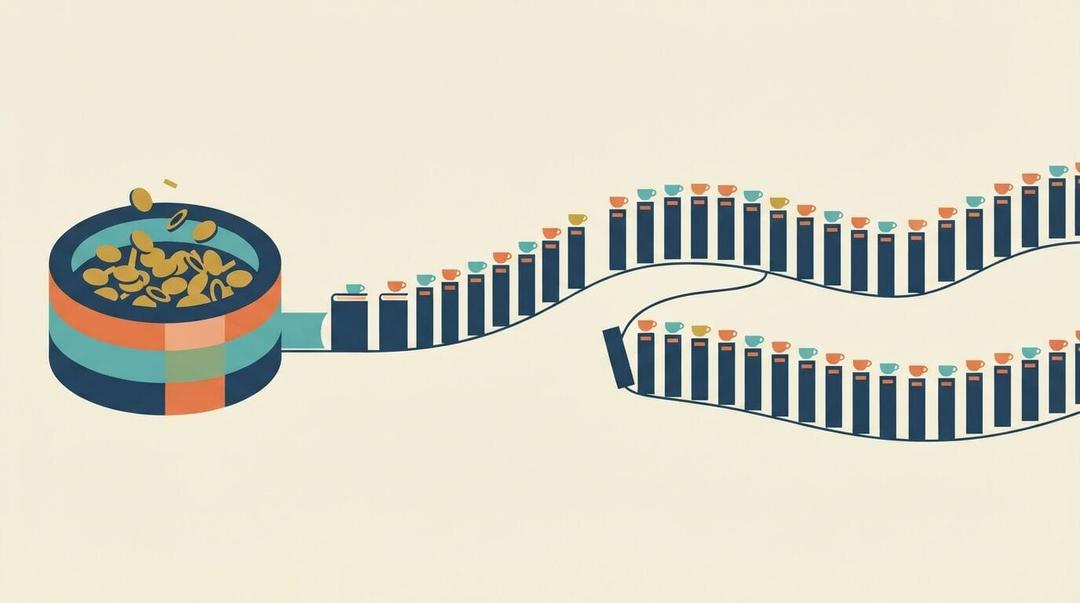
The dilution is sharpest in genres with heavy Kindle Unlimited availability. KU pays authors from a single monthly pool divided by total pages read worldwide. Amazon's disclosed KDP Select Global Fund for October 2026 was $67.7 million, and tracker sites put the 2026 US per-page rate between $0.0042 and $0.0055 (Written Word Media; the fund has paid out about $3.5 billion cumulatively since 2014). Because the pool is fixed and payouts are a claim on it, every cheap-to-produce title competing for page reads transfers money directly: an AI-generated novel that nobody would buy at $4.99 still earns fractions of a cent when skimmed, and that money comes out of the same fund. In high-KU genres, the revenue-share lead of no-AI books is 8.4 percentage points smaller than in low-KU genres (arXiv 2607.20349). Worked example: a fully read 300-page KU title earns about $1.35 at $0.0045 per page, versus roughly $3.49 for one direct $4.99 sale at the 70 percent royalty. Thin per-unit returns, but volume changes what thin means.
The farms still print money
Marketwide dilution and individual failure are not contradictions, because the distribution inside the AI band is brutally skewed. Among 385 author identities that released a substantial-AI book and then released more, 287 increased monthly output after adoption, and the top quartile produced 60.5 percent of those books. The most prolific identities reached dozens of titles per year. The single highest-revenue byline in the sample generated $1.7 million in gross consumer revenue across eight titles. The top 15 individual substantial-AI books each cleared $220,000, the best reaching $643,000 on 80,431 sales. These are gross figures before platform commissions, and pen-name splitting means the totals likely understate what one operator earns.
The reported anecdotes match the arithmetic. The New York Times detailed "Coral Hart," a byline credited with more than 200 romance novels across 21 pen names in a single year and roughly 50,000 copies sold, and the romance industry's open turn to Claude-class models. Hachette canceled the horror novel Shy Girl in March 2026 after an independent analysis found it largely AI-generated. Meanwhile a mainstream hit is exactly what the farm playbook aims at: rank is the scarce asset, and dozens of lottery tickets per account is the strategy.
Amazon's answer is capacity caps, not content bans
Amazon has banned nothing. Its AI disclosure rule, in place since September 2023, requires publishers to declare AI-generated text, images and translations at upload, and heavy human editing afterward does not change AI-generated into AI-assisted. The declaration is private: as of mid-2026 no AI label appears on any product page. Enforcement is removal of undisclosed titles, aimed at volume accounts.
The real lever has been throughput limits. Amazon first capped new titles at three per day in 2023, later operated under a limit of ten per format per week, and on September 21, 2026 cut it to two new titles per format per week per account, resetting Sunday at 00:00 UTC, an 80 percent reduction that industry outlets (The Bookseller, Publishing Perspectives-adjacent trade blogs) read as a direct answer to AI flood accounts. Existing books are untouched. For a coach publishing one authority book a year, nothing changed. For an operator whose unit economics depend on forty titles a month, the business model is over, at least on this platform.
Why the numbers matter in court
This is where the flood research stops being trivia. In the consolidated copyright litigation (In re OpenAI, MDL 3143, S.D.N.Y.), the Authors Guild's output-infringement claims survived dismissal in October 2025, cross-motions for summary judgment were filed in September 2026, and unredacted briefs that month disclosed OpenAI's use of books from what its own employees called a sketchy Russian website. A ruling could land in spring 2027. The fair-use fight has long centered on whether training harms the market for authors' works. Kadrey v. Meta's Judge Chhabria singled out market dilution, erosion through a flood of substitutable works, as a theory that could decide the question even while finding the evidence absent in that case. The arXiv study is, as of now, the most direct empirical answer to what that evidence would look like: catalog up 38-fold, revenue up 9-fold, per-book income down for the human authors who never touched a model.
The read
AI books lost the quality contest and are winning the volume contest anyway. Detection shares of 20 to 60 percent, revenue dilution in most genres, and a two-title weekly cap are the three facts a rational self-publisher should price in: the shelf is bigger, the fund is not, and platform leniency ended the moment the charts got ugly. For readers, nothing visible changed, which is the point. The disclosure box Amazon created in 2023 informs Amazon, not you.
Sources
- Chakrabarty, Liu, Ginsburg, Dhillon, "Generative AI floods and dilutes the market for books," arXiv 2607.20349: https://arxiv.org/abs/2607.20349
- Reimers & Waldfogel, "AI and the Quantity and Usage of Creative Products," NBER Working Paper 34777: https://www.nber.org/papers/w34777
- The Decoder summary of the Chakrabarty et al. study: https://the-decoder.com/ai-generated-books-are-flooding-amazon-and-tanking-sales-for-human-authors
- Publishers Weekly, "Book Output Topped Four Million in 2025" (Bowker ISBN data): https://www.publishersweekly.com/pw/by-topic/industry-news/publisher-news/article/99943-book-output-topped-4-million-in-2025.html
- NYT, horror novel "Shy Girl" canceled over AI use: https://www.nytimes.com/2026-03-19/books/shy-girl-book-ai.html
- NYT, "The New Fabio Is Claude" (romance industry and AI): https://www.nytimes.com/2026-02-08/business/ai-claude-romance-books.html
- The Bookseller, "Amazon reduces weekly KDP uploads from 10 to two per format": https://www.thebookseller.com/news/amazon-reduces-weekly-kdp-uploads-from-10-to-two-per-format
- Self Publishing Advice, "Amazon Cuts KDP Weekly Upload Limit" (policy timeline): https://selfpublishingadvice.org/amazon-cuts-kdp-weekly-upload-limit
- BlurbBio, KDP AI disclosure timeline (Sep 2023 rule, three-a-day cap): https://app.blurbbio.com/blog/ai-in-publishing-2026
- Written Word Media, KDP Global Fund and per-page rate tracker: https://www.writtenwordmedia.com/kdp-global-fund-payouts
- BookSpace, KDP Select economics explainer (page rate vs direct sale): https://bookspace.com/glossary/kdp-select
- Authors Guild v. OpenAI case page (MDL 3143 status): https://authorsguild.org/advocacy/artificial-intelligence/authors-guild-v-openai
- AI Lawsuit Tracker, Authors Guild v. OpenAI docket summary: https://ailawsuittracker.com/cases/authors-guild-v-openai
