
Meta released the weights for Muse Spark Open on October 15, a natively multimodal mixture-of-experts model with 816B total parameters, about 42B active per token and a 1M-token context window. Meta calls it "the most capable US open-weight model to date." Its own model card also shows it trailing the strongest Chinese open models on several coding and overall scores, and it ships under a custom license with attribution and revenue conditions.
This is the full-size model in the Muse series. Muse Glimmer, released in August, is the small dense member of the family and shares the same tokenizer and vocabulary. Meta's most capable model, Muse Wonder, is not open-weight. Our Muse Wonder explainer covers its API and subscription pricing.
What is in the checkpoint
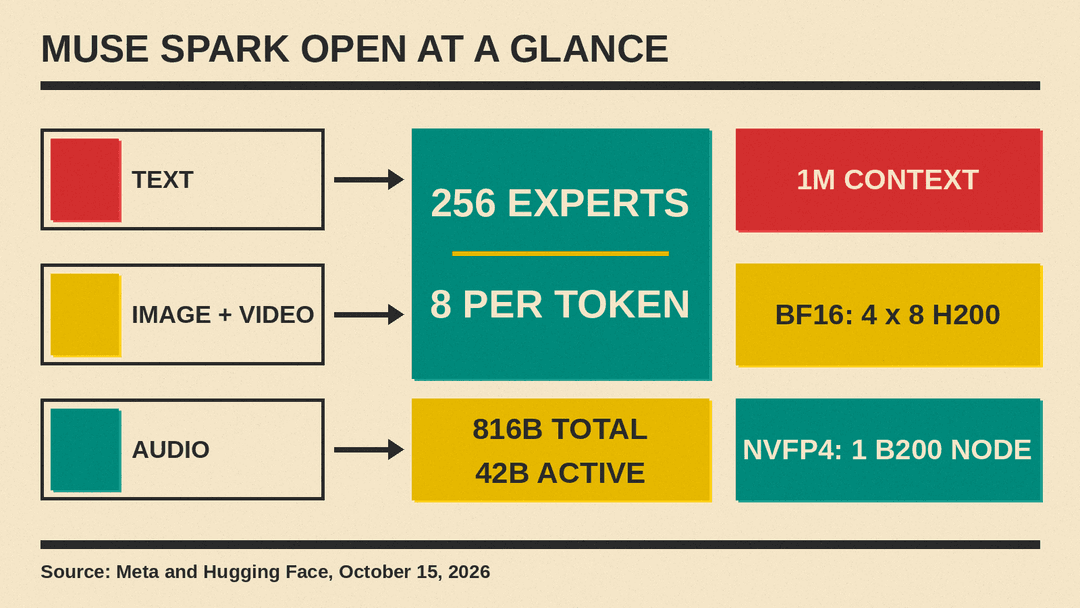
According to the Hugging Face launch post, the language model has 62 layers, a hidden size of 8192, and grouped-query attention with 128 query heads and 16 key-value heads. Each layer replaces Glimmer's dense feed-forward block with an MoE block of 256 experts, of which a router selects 8 per token. The experts hold about 97% of the parameters.
The model accepts text, images, audio and video and produces text. Images and video frames go through a 1.8B-parameter perception encoder. Audio is tokenized at one token every 80 ms, or 12.5 tokens per second. Reasoning cannot be switched off. The processor exposes four effort levels (low, medium, high, xhigh), which map to integer values of 16, 64, 256 and 512, with xhigh as the default.
Two checkpoints are published: BF16 and NVFP4. Hugging Face puts the BF16 safetensors at about 1.5 TB. In Transformers, BF16 runs across 4 nodes of 8 H200 GPUs, while NVFP4 fits on a single B200 node. The KV cache is relatively small for the size: Hugging Face calculates about 250 KB per token in BF16, or about 266 GB for a full 1M-token context.
The "desktop" claim
Meta's announcement says the model runs "on your desktop" using two Apple M5 Ultra Mac Studios with MLX. Meta says each machine gives the GPU up to 512 GB of unified memory, so two of them can hold the full model. That is a real local path for a model of this class, but it is a two-machine setup with about a terabyte of memory, not a single workstation GPU. Our M5 Ultra Mac Studio guide covers prices and when the 512GB option ships. Quantization lowers the floor: Hugging Face reports that a 3-bit oQ3e quant takes about 344 GB and ran on a single 512 GB M3 Ultra. Discussion on r/LocalLLaMA has focused on that gap.
For hosted use, Meta lists API access through Baseten, Fireworks AI, Groq, Modal, Nebius, OpenRouter and Together AI, and weight downloads through Amazon SageMaker AI, Google Cloud Model Garden, Hugging Face and Microsoft Foundry. Supported engines include SGLang, vLLM, TensorRT-LLM, Transformers, MLX, llama.cpp and Unsloth.
How it scores, by Meta's numbers
All figures below come from Meta's model card, run at xhigh effort. None are independent replications.
- Artificial Analysis Intelligence Index: 39, against 45 for GLM 5.3, 44 for Kimi K3 and 40 for Qwen3.8-2.4T-A95B.
- Agentic tool use is the strongest area. Muse Spark Open scores 89.2 on MCP-Atlas, ahead of every model in Meta's table, and 61.8 on JobBench, narrowly ahead of GLM 5.3 at 61.4.
- Coding is weaker. On Terminal-Bench 2.1 it scores 76.4, against 85.0 for Kimi K3, 83.9 for GLM 5.3 and 80.1 for Reflection's Beam. On DeepSWE 1.1 it scores 60, against 68 for Kimi K3 and 67 for GLM 5.3.
- On GPQA Diamond it scores 89.0, below Qwen3.8 and Kimi K3 at 93.5.
- On the StrongREJECT v2 adaptive attack benchmark, where lower is better, Meta reports 0.5, against 62.9 to 86.4 for the other models listed.
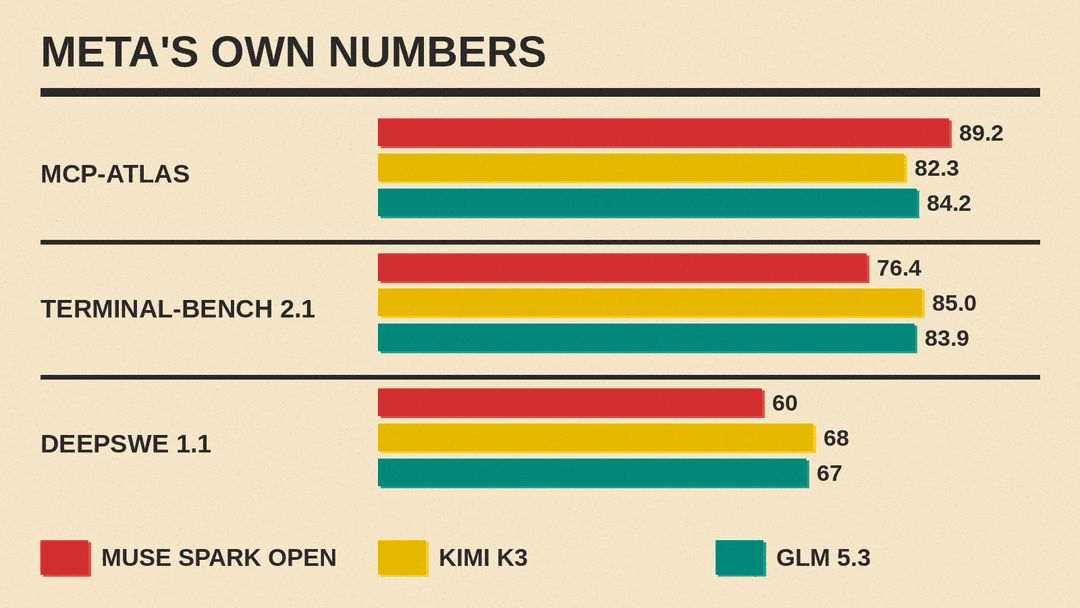
The pattern is a model that leads on tool use and safety refusals but sits a few points behind the current Chinese leaders on coding, which is the use case Meta says it was trained for.
License terms
The Muse Model License is permissive in form. It grants rights to use, modify, fine-tune, distill, merge, distribute and sell the software. It adds three conditions:
- Products that use the model or any derivative must prominently display "Built with Muse Spark Open." The license defines derivatives broadly, including models trained or distilled using the model's outputs.
- A company that offers models through an API ("Model as a Service") and has more than $20 million in gross revenue over any 12-month period must notify Meta and sign a separate agreement. Internal use, research, and use inside a company's own non-API product are exempt.
- Use must follow an attached usage policy, which among other things excludes military applications and users under 18.
Access on Hugging Face is gated behind a form that collects name, date of birth, country and affiliation. The license is less restrictive than past Llama terms for most developers, but it is not Apache 2.0 or MIT, which is what Reflection's Beam and DeepSeek's recent Flash checkpoints use.
Why it matters
Muse Spark Open puts a US lab back in the large open-weight tier that Chinese labs have held for most of 2026. It also brings native audio and video input at a scale few open models offer. Meta's own table, however, does not show it leading that tier overall, and the hardware floor rules out most local setups. The key test is independent evaluation on coding and long-horizon agent tasks. Meta says a full safety evaluation report is coming "soon." For Mistral's 1.05 trillion parameter open-weight model, whose weights are not out yet, see our Mistral Large 4 explainer.
