
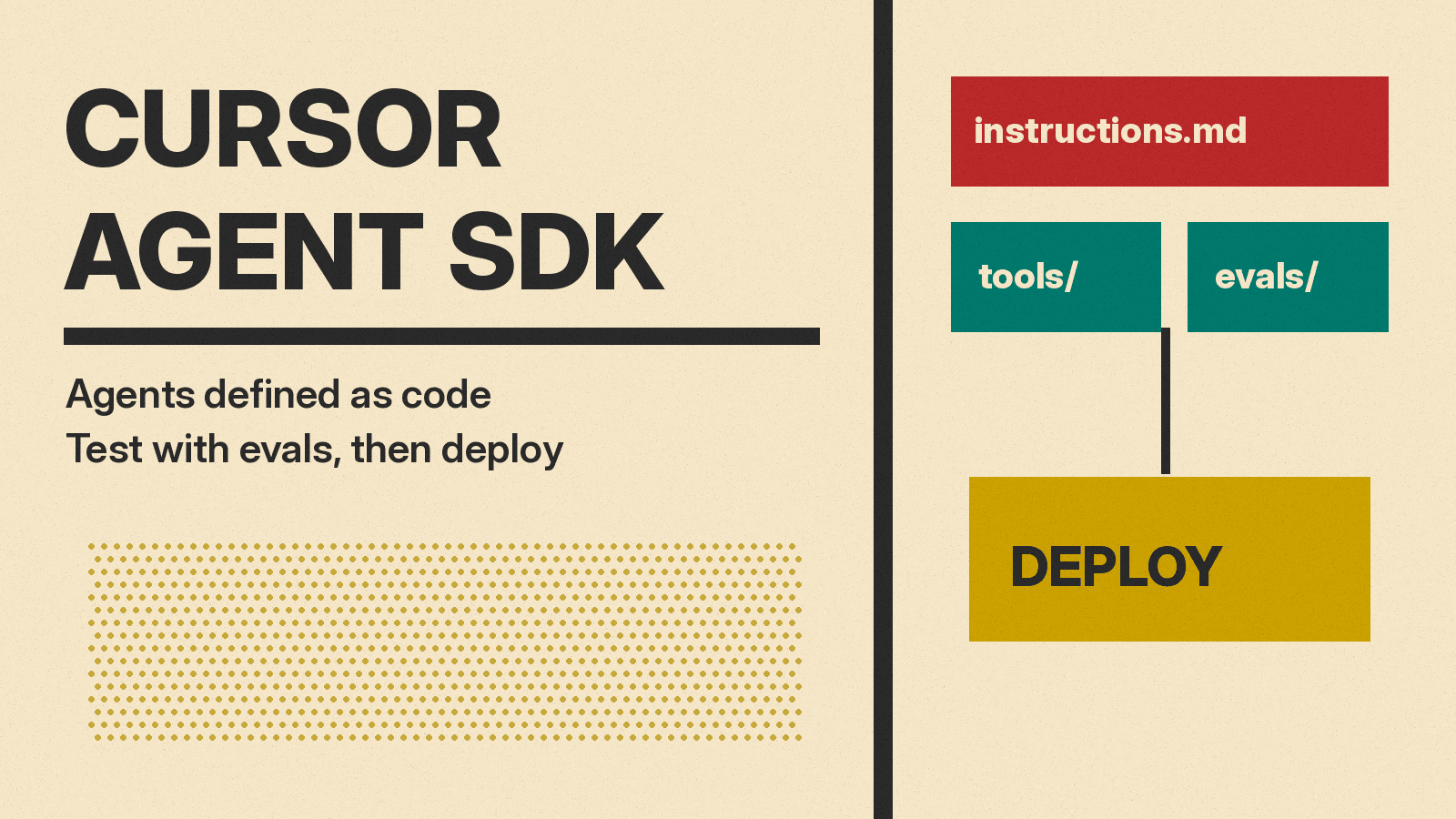
Cursor has released the Agent SDK, the framework it says it uses to build its own managed agents such as Bugbot, Security Reviewer and Rollouts. It lets a team write an agent as a small code project, test it with evals, and run it on Cursor's servers or its own. Cursor announced it on October 20, 2026 as "generally available today," and the Agent SDK changelog lists version 0.3.0 on October 23 as the "GA Release."
Cursor's pitch: until now, building an agent tailored to a team has generally meant adopting a product designed around someone else's workflow or starting from scratch. With the Agent SDK, the team writes the instructions, tools and evals as files it can version and review, and Cursor runs the model loop that calls them.
What an agent looks like
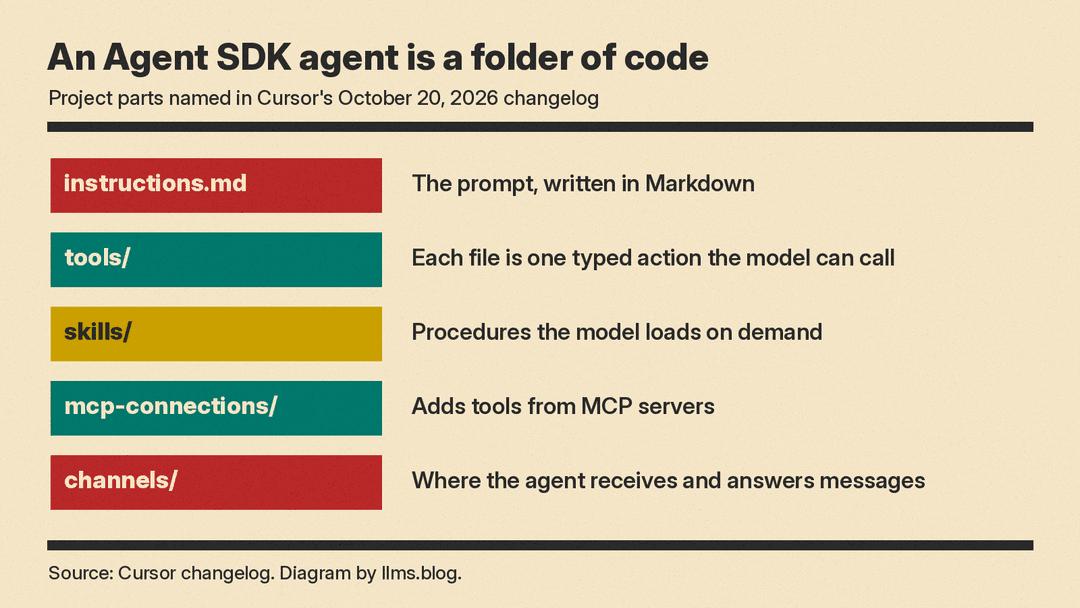
Per Cursor's changelog entry, an agent is a folder:
instructions.mdis the prompt.- Each file in
tools/is one typed action the model can call. skills/holds procedures the model loads on demand.mcp-connections/adds tools from MCP servers.channels/defines where the agent receives and answers messages.
The launch post says prompts are written in Markdown and tools are TypeScript functions. Because it is all code, changes go through the same version control and review as the rest of a codebase. Agents can also hand a task to another specialized agent, or split a job among subagents that work in parallel.
What wakes an agent
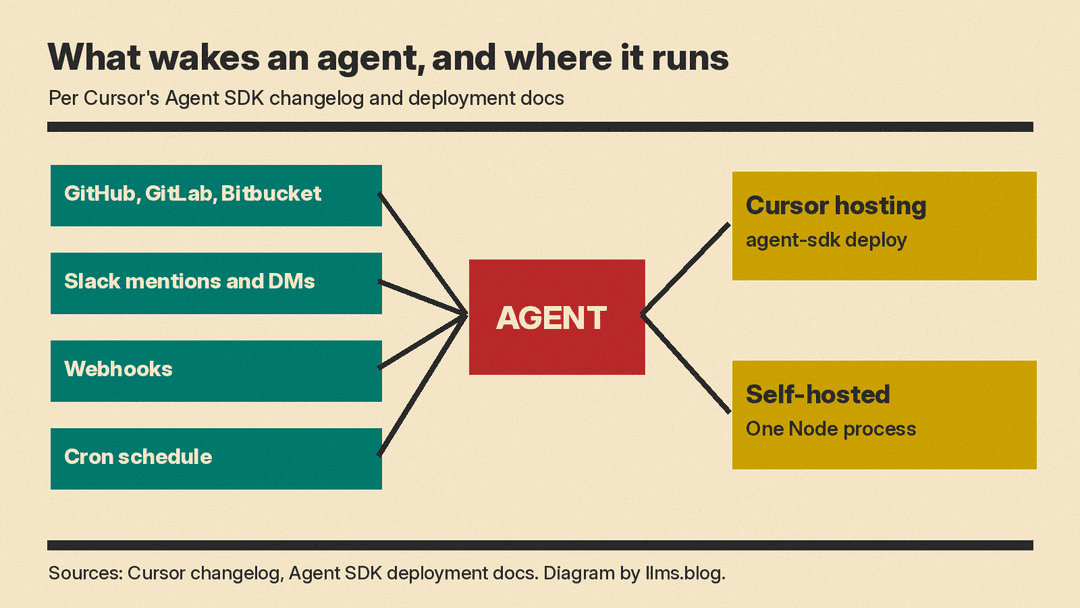
The changelog says agents wake on pull request, comment and CI events from GitHub, GitLab and Bitbucket; on mentions and DMs in Slack; on webhooks from any provider; and on a cron schedule. GitHub events come through the team's Cursor account, so no public webhook URL is needed. Each conversation keeps its own session, and a follow-up on the same pull request or Slack thread resumes that session.
To start, the changelog says to run agent-sdk init, then agent-sdk dev for a local playground. The --template flag starts from a security reviewer, an owners-policy approver, a pull request autofixer, or a Linear or Jira triager. One naming detail: the launch post and changelog use the npm package @cursor/agent-sdk, while the current Agent SDK docs install @grok/agent-sdk and note that the package was @cursor/bdk before. Check the docs for the current name before you install.
Evals and event replay
The launch post says the Agent SDK supports evals and event replay out of the box. Per the evals docs, an eval sends a fixed input to the real agent and checks which tools ran and what the answer looks like. A code review eval can pass only if the agent calls an inspection tool and does not call the approve tool. Evals can also check the shape of a reply against a schema, or use a model as a judge when correctness depends on meaning.
The agent-sdk github replay command turns a real pull request into webhook payloads, so a team can test a GitHub agent without waiting for a push, and save those payloads as fixtures. The docs warn that evals run real tools, so any tool that writes should check whether it is in an eval session first.
Cursor says this gives "assurances that critical workflows execute the way you expect." For a different team's approach to AI code review, see the AI-first review loop on the Claude Code team.
Where it runs
Per the deployment docs, agent-sdk deploy builds a pushed Git ref, so uncommitted changes do not ship, and prints the agent's URL. Secrets are set per deployment, and the agent must list every outside host it calls; a team's egress policy can block hosts at deploy time. Sessions and the agent's stored key-value data and files survive restarts and redeploys.
The docs list two limits. Managed hosting is not available under Privacy Mode (Legacy): deploys, hosted sessions and eval runs all refuse. Self-hosting needs Node 22.13 or newer, "never Bun," and the docs say to put TLS or an authenticating proxy in front of the server. The launch post says each agent runs as a single Node process that can be packaged in a container.
What it costs
Cursor's Agent SDK launch post, changelog and docs pages that we read do not list a separate price for the SDK or for managed hosting. The closest published rule is in the Cursor TypeScript SDK docs, for the SDK harness the Agent SDK is built on: SDK runs "follow the same pricing, request pools, and Privacy Mode rules as runs from the IDE and Cloud Agents," with spend shown under an SDK tag. Cursor's Cloud Agents docs say that work uses your plan's usage "at the selected model's rate." Service account keys bill the team that owns them, and user keys bill that user's plan. Treat this as a guide, not a quote, until Cursor publishes Agent SDK pricing.
Who should look at it
The docs comparison is direct. Cursor Automations fit a job that is a prompt plus a schedule or event trigger. The Agent SDK is for teams that want code around model judgment that they can version, review, test and improve over time. Cursor gives one example: an internal team built a reviewer that checks every pull request against its knowledge base of past lessons "in about a day." The PGA Tour is named as a customer.
For a solo developer choosing a coding assistant, this changes little; our Cursor vs Claude Code vs Codex comparison still covers that choice. For teams weighing agent frameworks, the Agent SDK now competes with options like OpenAI's Agents API and Claude's Agent SDK.
