
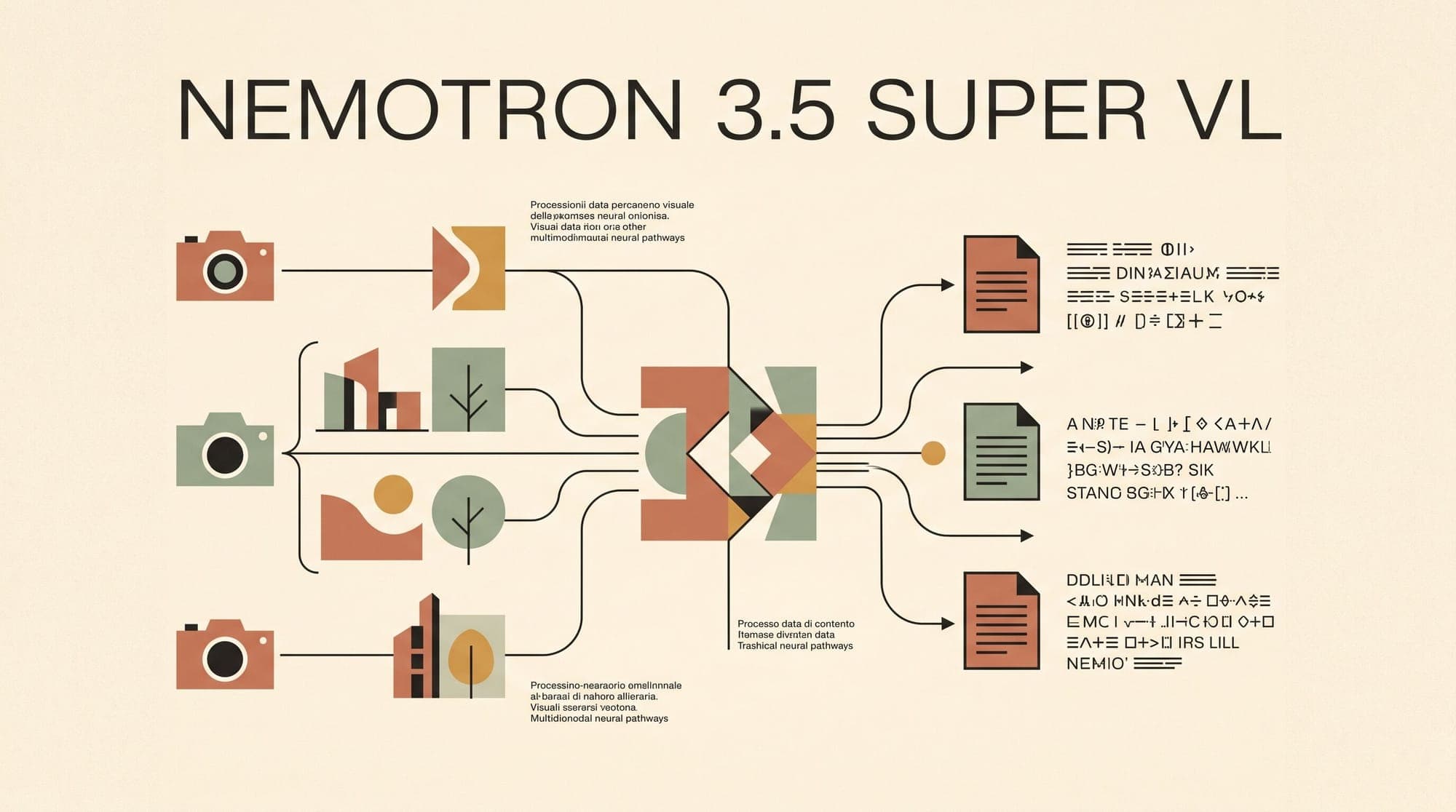
NVIDIA has released Nemotron 3.5 Super VL, an open-weights vision-language model designed for complex agentic workflows. The model features a 120-billion-parameter mixture-of-experts (MoE) architecture that activates 12 billion parameters per token, paired with a context window supporting up to 1 million tokens.
The release is available on Hugging Face in full-precision BF16 reference weights and quantized NVFP4 formats under the OpenMDW-1.1 license, which permits commercial deployment, fine-tuning, and redistribution.
Architecture and Inference Efficiency
Nemotron 3.5 Super VL combines interleaved Mamba-2 state space layers, sparse Mixture-of-Experts routing, and attention mechanisms with a C-RADIO vision encoder and a multimodal connector. This architecture unifies reasoning, code generation, tool calling, and optical character recognition across images, tables, charts, and video inputs into a single model, removing the need for separate vision adapters or distinct text-only routing layers.
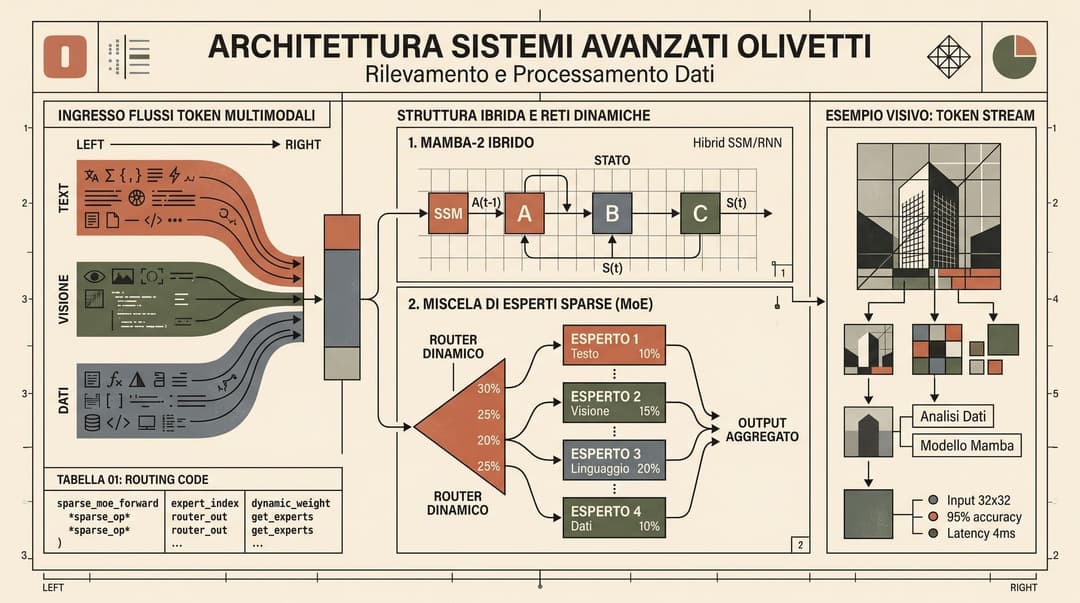
To optimize inference latency and hardware utilization, NVIDIA integrated native Multi-Token Prediction (MTP) for speculative decoding, LiLiCorr speculative decoding algorithms, and context reuse. On a single GPU, the model achieves up to 5x higher throughput compared to other open-weight models in its parameter tier, exceeding 600 output tokens per second on agentic evaluation workloads hosted on Baseten endpoints.
Standard full-precision BF16 deployment requires four NVIDIA H100 GPUs or two GB200 systems, while the quantized NVFP4 release enables execution on workstations such as NVIDIA DGX Spark.
Benchmark Performance
Across standardized evaluations, Nemotron 3.5 Super VL demonstrates competitive marks in reasoning, multimodal extraction, and software engineering benchmarks:
- GPQA-Diamond: 89.52%
- LiveCodeBench v6: 88.22%
- BrowseComp: 78.0%
- SWE-bench Verified: 71.10%
- SWE-bench Pro: 51.78%
- GraphWalks: 89.71%
- MathVision: 78.16%
- MMLongBench-Doc: 62.82%
- IFBench: 70.86%
- Video-MME v2: 32.85%
The model supports configurable reasoning via its chat template, allowing developers to enable or disable explicit thinking traces depending on task latency budgets.
Post-Training and Enterprise Implementations
Alongside the model weights, NVIDIA released open training datasets covering agentic tool calling, financial reasoning trajectories, instruction following, and 45 specialized vision-language datasets. Developers can customize the model using NVIDIA NeMo for supervised fine-tuning (SFT), low-rank adaptation (LoRA), and reinforcement learning (RL).
Several enterprise teams reported production benchmarks following domain-specific post-training:
- Scale AI: Post-trained Nemotron 3.5 Super VL for automated vendor credit processing at Skydance Corporation, reporting a 40x reduction in inference cost and a 5x drop in latency.
- Ramp: Applied the model to parse unstructured receipt images into structured JSON schema, reporting a 10x latency improvement and up to 50% higher throughput.
- AI21: Fine-tuned the model for threat intelligence and cybersecurity vulnerability triage at Alice, achieving a 40% gain in extraction accuracy.
Availability
The model weights, usage cookbooks, and evaluation recipes are available on Hugging Face, NVIDIA NIM, and GitHub via NeMo Gym.
