
DeepSeek has replaced the model behind its deepseek-flash API name with DeepSeek-V4.1-Flash-1017, an update the company itself labels "minor." The model card tells a different story: the new checkpoint improves on its predecessor in every benchmark DeepSeek reports, and on several coding and agent tests it posts higher scores than Claude Opus 5 and GPT-5.6 Sol. The weights are public under the MIT license, and the release ships alongside a new paid Search and Fetch API built on DeepSeek's in-house search engine.
The model went live on October 17. Coverage has kept building through the weekend, with SiliconANGLE among the outlets writing it up on October 18, as developers and resellers notice that their existing integrations have already switched over.
What changed
The update lands a little over five weeks after the original V4.1-Flash, which DeepSeek launched in September as the smallest model in a new architecture family, according to SiliconANGLE. DeepSeek says the 1017 checkpoint scores higher, finishes tasks faster and writes shorter outputs than the version it replaces, and it calls the combination a Pareto improvement in performance and cost.
The training change DeepSeek highlights is reinforcement learning with self-feedback, aimed at end-to-end project work. Its announcement shows the model building a 3D model of the Forbidden City, a browser racing game and a Portal 2 recreation in the Godot engine. The Decoder describes the method as using the model's own confidence scores or self-generated critiques as the reward signal, which removes the need for human raters or a separate reward model. DeepSeek's own page does not go into that level of detail.
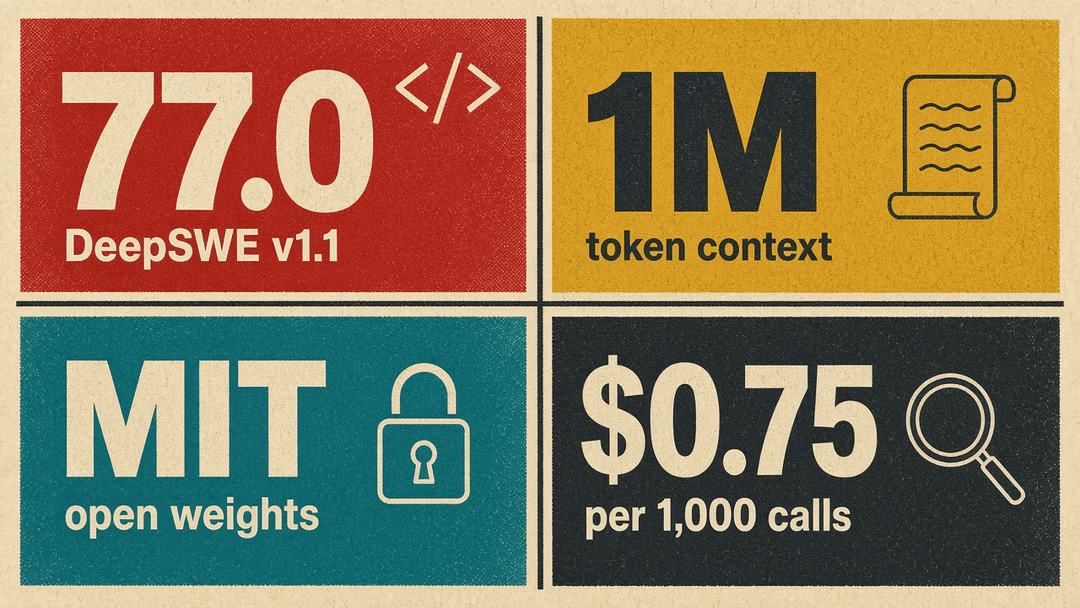
Per the model card, the recommended setup is a 1M token context window with max_tokens of at least 256K. The release does not include a Jinja chat template. Instead it ships a Python reference encoder and a new Rust toolkit, deepseek-recipe, that converts Messages, Chat Completions and Responses API requests into DeepSeek's prompt format.
The numbers
All figures below come from DeepSeek's own table. Independent evaluations have not been published yet.
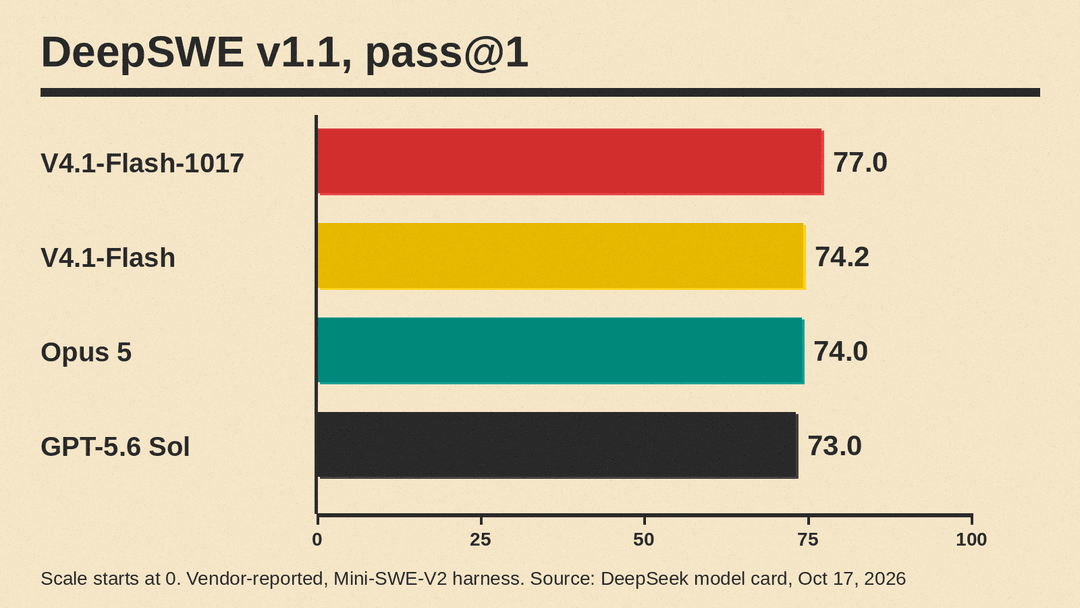
- DeepSWE v1.1: 77.0, up from 74.2. Opus 5 is listed at 74.0 and GPT-5.6 Sol at 73.0.
- Terminal-Bench 4.0: 42.3, up from 31.2. This is the largest jump in the table, though Opus 5 still leads at 51.8.
- Automation-Bench v1.0.6: 60.5, against 50.3 for Opus 5 and 45.8 for GPT-5.6 Sol.
- Agents' Last Exam: 35.4, ahead of every model in the comparison.
- HLE without tools: 42.6, up from 36.8, but well behind Opus 5 at 56.3.
- ProgramBench and NL2Repo-Bench: clear gains over the predecessor, but Opus 5 stays ahead on both, at 37.0 and 75.3.
The pattern is consistent. The Flash model leads on agentic task benchmarks and trails the largest closed models on hard reasoning and on whole-repository generation. DeepSeek ran Terminal-Bench with the Claude Code harness and DeepSWE with the Mini-SWE-V2 harness, so scores may shift under other harnesses.
Cost is where the release stands out. Reading DeepSeek's cost chart for DeepSWE, The Decoder reports that the new model hits 77.0 percent at an average of just under $0.20 per task, and clears 72 percent at about $0.10 in its low setting. The predecessor scored 74.2 percent at around $0.50. The same chart places GPT-6 Astra, Gemini 3.8 Flash and Claude Opus 5 between $2 and more than $10 per task. Shorter outputs account for much of that gap, since agent runs are billed by the token.
Search and Fetch
The second part of the announcement is a developer API for DeepSeek's search engine, which the company says already serves hundreds of millions of requests a day. Each endpoint is billed at $0.75 per 1,000 successful requests. Search and Fetch calls made through server-side tools in DeepSeek Harness, Claude Code and Codex are free for DeepSeek API users until billing starts on October 31 at 16:00 UTC. Our opinion piece argues that this pricing makes agent search a commodity.
Silent upgrades
DeepSeek did not add a new model name. The API docs say deepseek-flash now points to V4.1-Flash-1017. The legacy names deepseek-v4-flash and deepseek-v4-flash-vision-exp still work, but those models are retired: their requests now go to the new checkpoint at the Flash price. Tencent Cloud applied the same silent upgrade to its hosted DeepSeek endpoints at 10:00 Beijing time on October 17, with no change to model IDs or billing.
For most users that means a free improvement. For teams with evaluation suites, prompts tuned to output length, or agent pipelines that depend on specific behavior, it means the model under a fixed ID changed without any opt-in. Anyone who needs reproducibility should pin the open weights rather than rely on the hosted alias.
Why it matters
Open-weight models from Chinese labs already account for a large share of routed token volume. This release keeps that pressure on from the bottom of the price range. A permissively licensed model that DeepSeek says beats Opus 5 on DeepSWE at a fraction of the cost per task changes the default calculation for agent-heavy workloads, where token spend scales with every retry and tool call. The caveats still apply: these are vendor benchmarks, the gains are concentrated in agentic tests, and the frontier closed models keep a clear lead on reasoning. Independent results over the next few weeks will show whether the cost advantage holds outside DeepSeek's own harnesses. MiniMax has since answered with M3.1 Flash, priced at $0.15 per million input tokens.
Sources
- DeepSeek: DeepSeek-V4.1-Flash-1017 announcement
- Hugging Face: deepseek-ai/DeepSeek-V4.1-Flash-1017 model card
- DeepSeek API docs: model names
- The Decoder: Deepseek V4.1 Flash 1017 beats larger rivals in agentic tasks
- Tencent Cloud: silent upgrade notice
- SiliconANGLE: DeepSeek releases updated V4.1-Flash model
