
Ant Group's AI lab, inclusionAI, has put the full weights of Ling-3.1-flash on Hugging Face under an MIT license tag. It is a 560B-parameter mixture-of-experts model that activates 25B parameters per token. This explainer covers what the model is, what its own benchmark charts show, what it costs through an API, and what hardware you need to run it yourself.
What Ant released, and when
The inclusionAI organization page on Hugging Face describes the group as the home of Ant Group's artificial general intelligence work. The same lab has also published two MIT-licensed audio models; our Ming-3.0-audio explainer covers them.
According to AI Affairs, which cites reporting by Pandaily, Ant announced Ling-3.1-flash on September 30 with a two-week free API trial capped at 256K tokens of context. The team said it planned to publish the weights and open the full 1M-token window when the trial ended and the service moved to paid access. The free period closed on October 14, and the weights were published alongside that change. The Hugging Face API lists the repository as created on October 13.
Hugging Face lists the download as not gated, so there is no request form or approval step.
The architecture in plain terms
The model card calls Ling-3.1-flash a "hybrid-linear MoE." Two ideas are packed into that phrase.
First, it is a mixture-of-experts model. Each layer holds 512 small "expert" networks plus one shared expert, and a router sends each token to 8 of the 512. That is why only a fraction of the 560B parameters do work on any single token. The card gives that fraction as 25B active parameters.
Second, the attention layers are mixed. Of the 72 layers, 63 use Kimi Delta Attention (KDA), a linear attention design, and 9 use gated Multi-head Latent Attention (MLA), a form of full attention. That is a 7:1 ratio. The previous model, Ling-3.0-flash, used a 5:1 ratio and was far smaller, with 124B total and 5.1B active parameters. inclusionAI described that hybrid design as a way to improve long-context efficiency and compute cost.
The general idea is that full attention gets more expensive as the context grows, because each new token looks back at every earlier token. Linear attention layers carry a compressed running state instead. A small number of full attention layers keeps the model able to look up exact details from far back in the context.
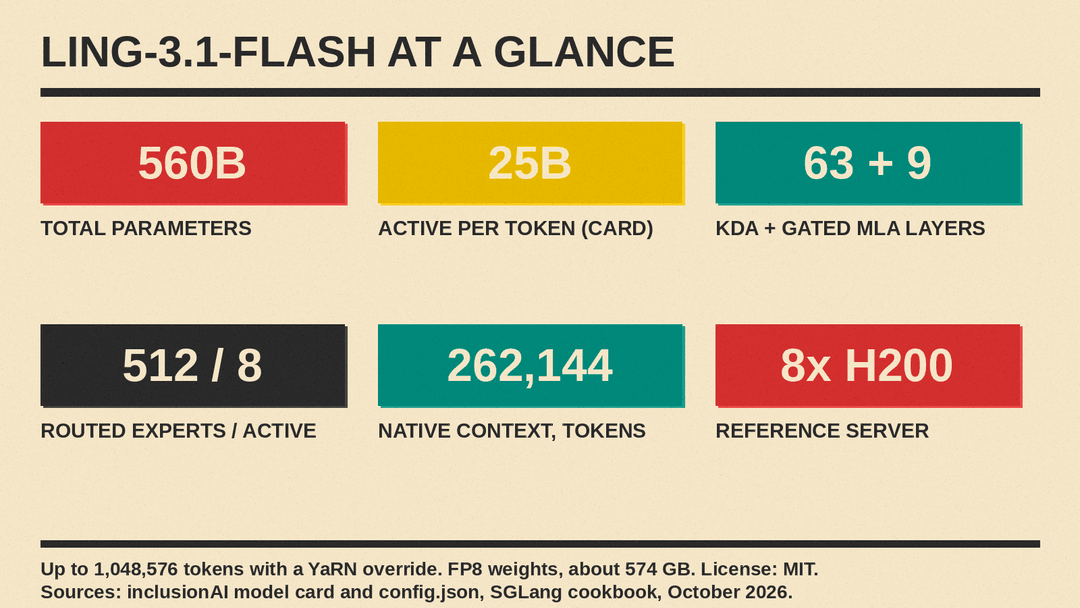
Other numbers from the card: 4 dense layers, 64 attention heads, a hidden size of 4,096 and a vocabulary of 157,184 tokens. The weights ship in FP8. The SGLang deployment guide describes them as FP8 E4M3 in 128 by 128 blocks, and the repository's 54 weight files add up to about 574 GB.
One discrepancy: the SGLang guide describes the model as having "about 17B active" parameters per token, while the model card says 25B. The card is inclusionAI's own document, so we use 25B, but the two figures do not match.
Context window: 1M on paper, 262K by default
The model card says Ling-3.1-flash has a 1M-token context window. The released config.json sets the maximum position embeddings to 262,144. The SGLang guide explains the gap: the checkpoint supports 262,144 tokens natively, and you can reach 1,048,576 tokens by adding a YaRN override, a method for extending a model's context window.
OpenRouter also lists a 262,144-token context. If you need the full million tokens, plan to self-host and test quality at that length yourself.
What the benchmarks show
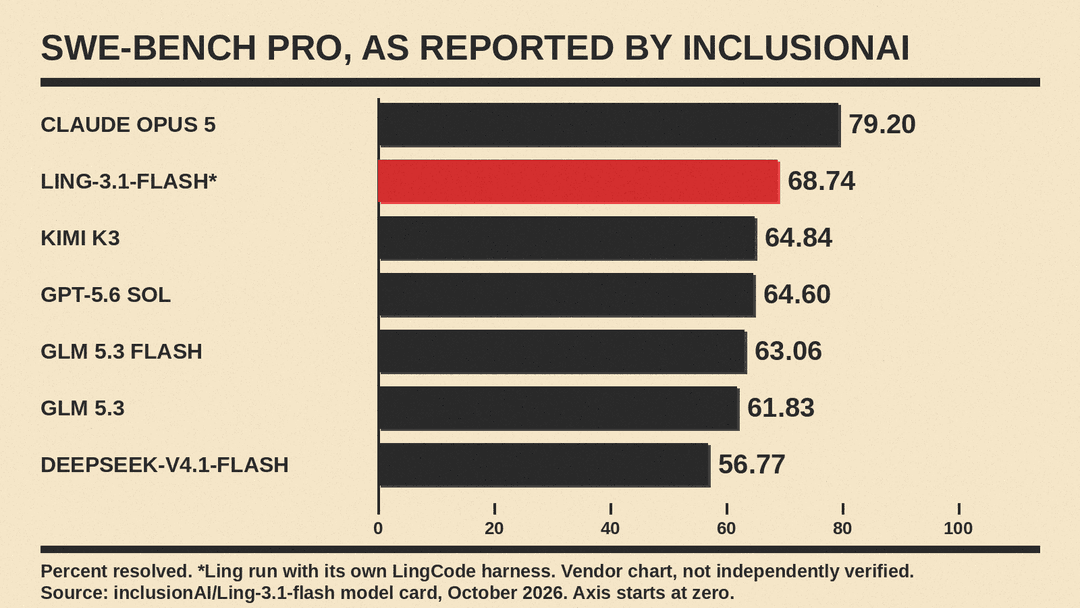
All scores below come from charts on inclusionAI's model card. None were independently verified at publication, and the Hugging Face API record marks the model's self-reported evaluation entries as unverified. The card compares Ling-3.1-flash with DeepSeek-V4.1-Flash, Kimi K3, GLM 5.3, GLM 5.3 flash, Claude Opus 5 and GPT-5.6 Sol.
Where Ling-3.1-flash scores highest in its own table:
- HealthBench Professional: 65.35, ahead of GPT-5.6 Sol at 60.76 and Claude Opus 5 at 59.8. The card notes this was evaluated in what it calls the AQ environment, and that Ling's healthcare capabilities can currently be used only in AQ.
- BrowseComp: 91.67, narrowly ahead of Kimi K3 at 91.20 and Claude Opus 5 at 90.80.
- FrontierSWE: 75.16, ahead of GLM 5.3 at 74.34 and Kimi K3 at 73.52. Claude Opus 5 and DeepSeek have no score listed.
Where it trails:
- SWE-bench Pro: 68.74, behind Claude Opus 5 at 79.20 but ahead of GPT-5.6 Sol at 64.60 and every other open model in the chart.
- Terminal-Bench 4.0: 46.03, behind Claude Opus 5 at 49.00 and ahead of the rest.
- GDPval-AA v2.1: 1,673, behind Claude Opus 5 at 1,708.
- Humanity's Last Exam (HLE): 37.44, the lowest score in the table. Claude Opus 5 posts 54.90.
- DeepSWE: 59.70, also the lowest in the table. DeepSeek-V4.1-Flash posts 74.20.
- Terminal-Bench 2.1: 81.18, the lowest in the table, against 90.60 for DeepSeek-V4.1-Flash.
Two caveats matter. First, the card says the SWE-bench Pro, Terminal-Bench 4.0, DeepSWE and SWE Atlas scores were produced with LingCode, a harness inclusionAI "extensively customized" from the open-source coding agent Pi. The rival models were not necessarily run in the same harness, so those comparisons are not like for like. Second, the evaluation entries are dated October 13. DeepSeek shipped an update, V4.1-Flash-1017, on October 17, so the DeepSeek column may not reflect its current model.
The overall picture from Ant's own numbers: a strong open model for agentic, search and office tasks that sits behind Claude Opus 5 on most coding and reasoning tests and does not lead the open-weight field on every coding benchmark.
LingCode and agent frameworks
The card describes LingCode as built for coding tasks that run for hours, involve hundreds of tool calls, and require repeated context compaction. inclusionAI says it is "considering" open-sourcing LingCode but has not done so. That matters because some of the headline coding scores depend on it.
The card also says the model works well in Claude Code, Kilo Code, Qwen Code, Hermes Agent and OpenClaw. It recommends a temperature of 1.0, top_p of 0.95, top_k of 20, and thinking mode switched on.
Price through an API
You do not need your own GPUs to try it. As of October 19, 2026, OpenRouter lists Ling-3.1-flash at $0.075 per million input tokens, $0.225 per million output tokens, and $0.015 per million cached input tokens. The model card also links to ModelScope.
What it takes to run yourself
This is not a laptop model. The FP8 weights alone are about 574 GB. inclusionAI's reference server is eight NVIDIA H200 GPUs (tensor and expert parallelism across 8), or four GB300 GPUs.
Notes from the SGLang guide, which is the recommended serving path:
- Use the dedicated Docker image,
lmsysorg/sglang:dev-ling-3.1-flash. The first launch spends about five extra minutes compiling kernels, so mount a persistent cache. - For single-user chat, a recipe that uses only tensor parallelism gives about 9 to 13% lower time per output token at batch size 1 on H200. At 16 to 32 concurrent requests, both recipes deliver about the same throughput.
- Built-in multi-token prediction for speculative decoding is supported. SGLang measured an average acceptance length of 2.61 tokens on random-token probes and 2.13 on real text.
- AMD MI325X and MI350X recipes are listed but unverified, and the published ROCm images need a manual fix before the model will start.
The model card also gives a vLLM recipe. It uses a separate vLLM branch, needs --trust-remote-code, and runs with a tensor-parallel size of 8.
The license fine print
The model card's metadata declares license: mit, and Hugging Face shows the MIT tag. The repository file list contains no separate LICENSE file, so the MIT terms rest on that metadata. If you plan a commercial deployment, keep a record of the card as published.
inclusionAI also links a training-content summary PDF from the card. The card says it covers training-content disclosure and does not replace the technical documentation, usage terms or license.
Why it matters
Ling-3.1-flash adds another large open model with a permissive license and a clear hybrid attention design, in the same wave as Mistral Large 4. Its vendor charts show strength on agent, search and office tasks rather than a clean sweep of coding benchmarks. For teams choosing an open model to self-host, it is worth a test on your own tasks, with two checks: whether your workload needs more than 262K tokens of context, and whether its coding results hold up without LingCode.
Sources
- inclusionAI/Ling-3.1-flash model card, Hugging Face
- Ling-3.1-flash config.json, Hugging Face
- Ling-3.1-flash repository files, Hugging Face
- Ling-3.1-flash model API record, Hugging Face
- inclusionAI organization page, Hugging Face
- Ling-3.0-flash model card, Hugging Face
- SGLang cookbook: Ling-3.1-flash
- Ling 3.1 Flash on OpenRouter
- AI Affairs: Ant Group publishes Ling-3.1-flash weights under an MIT licence
- DeepSeek: V4.1-Flash-1017 release note
