
The Nanbeige team has released Nanbeige4.3-33B, an open-weight model built for coding agents and office-style agent work. It ships under the Apache 2.0 license, next to a separate base model. According to the Hub's commit history, the repos were created on the evening of October 23, Pacific time, and the weights were uploaded on October 24.
The short version: the team says it is the strongest open agent model near 30 billion parameters, and its own table supports that on most rows. The numbers are self-reported. The license and the size are the parts you can check today.
What it is
The model card calls Nanbeige4.3-33B the "flagship teacher model" of the Nanbeige4.3 series. The plan, in the team's words, is to build "a high-capacity teacher agent first" and then distill its agent skills into smaller models. The card names a Nanbeige4.3-3B as an example of what comes next. No date is given.
Some basics from the files on the Hub:
- Size: about 33.1 billion parameters, stored in BF16, according to the Hub's safetensors count.
- Architecture: the config file lists a Llama-style architecture (
LlamaForCausalLM). - Context: up to 524,288 tokens (512K, as the card puts it).
- Languages: the card tags English and Chinese.
- Modes: thinking is on by default and can be turned off. A
preserve_thinkingsetting keeps earlier reasoning in multi-turn chats; the team recommends it for tool use and code agents, and off for general chat.
The benchmark claims
The card compares the model with Qwen3.8-27B, Muse-Glimmer-30B and Gemma4-31B, all at their highest thinking effort. The team says it used the same settings and harness for each model. Every number below comes from that table.
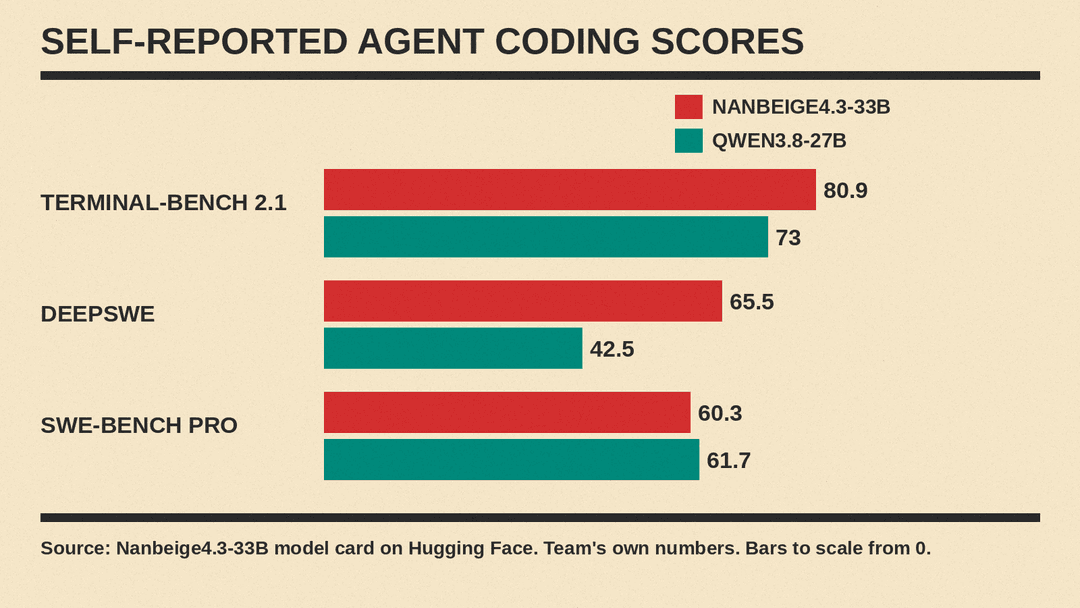
- Terminal-Bench 2.1: 80.9, against 73.0 for Qwen3.8-27B.
- Terminal-Bench 4.0: 23.8, against 6.3 for Qwen3.8-27B and 0.0 for Gemma4-31B.
- DeepSWE: 65.5, against 42.5 for Qwen3.8-27B.
- SWE-Bench Pro: 60.3, a little behind Qwen3.8-27B at 61.7.
- GDPval: 84.8, behind Qwen3.8-27B at 86.4.
- GPQA Diamond: 89.5, behind Gemma4-31B at 91.3.
- AIME 2026: 95.2, the top score in the table.
The footnotes matter. Some tests ran inside third-party agent harnesses, such as mini-swe-agent and Claude Code, and one, SWE-Atlas-QnA, is graded by GPT-6 Sol as a judge. The YC-bench row is reported in dollars, not a percentage. These are the team's own numbers, not independent results, so treat the table as a reason to test, not a result.
What it takes to run
The BF16 safetensors files in the repo total about 66 GB, before any working memory. The serving examples on the card for SGLang and vLLM split the model across four GPUs (--tp-size 4 and --tensor-parallel-size 4).
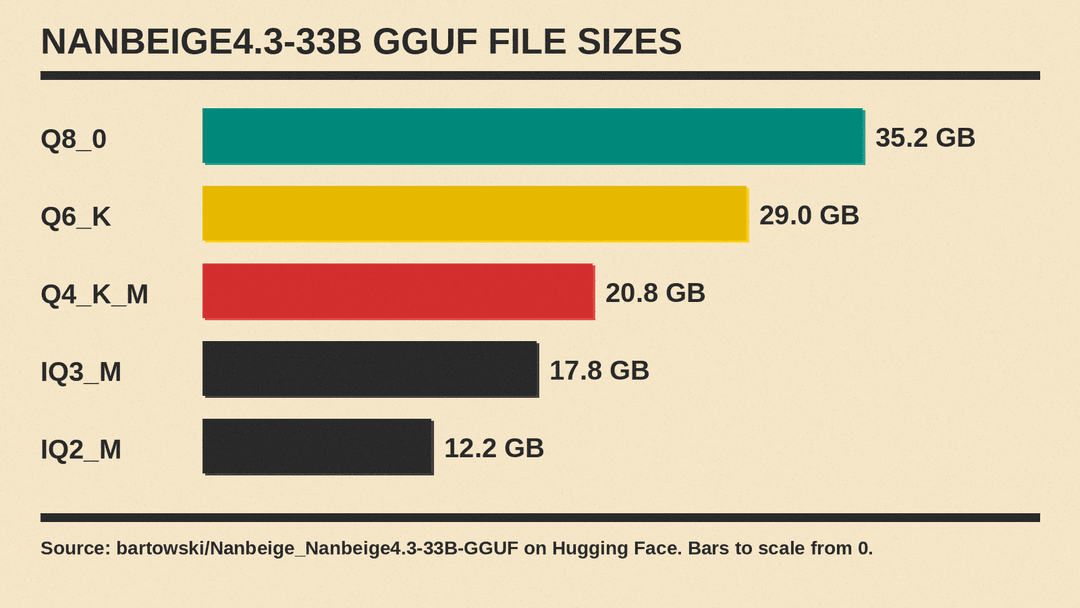
Community quantized copies appeared on the Hub on October 25. Uploader bartowski has a GGUF set in the GGUF format used by llama.cpp and apps such as LM Studio. File sizes in that repo:
- Q8_0: 35.2 GB.
- Q6_K: 29.0 GB.
- Q4_K_M: 20.8 GB.
- IQ3_M: 17.8 GB.
- IQ2_M: 12.2 GB.
For readers who are not sure which file to pick, bartowski's notes suggest Q4_K_M (20.79 GB), "usually a good mix of size and performance." If labels like Q4_K_M are new to you, our beginner guide to running a model on your laptop explains them, and why a bigger context window needs more memory.
Other community formats are already listed on the Hub, including MLX 4-bit for Apple Silicon and FP8 builds. These are third-party conversions, not files from the Nanbeige team.
Why it matters
Nanbeige picked Qwen3.8-27B and Gemma4-31B as its comparison points, so those are the models to test it against. Our Qwen3.8 explainer covers the 27B model and the rest of that family. A model in this range that leads on agent coding, even by its makers' count, gives people who run models on their own hardware another option to test for local coding agents.
The license is the other half. The Apache 2.0 license allows commercial use, changes and redistribution. Some recent open-weight releases use custom licenses instead, such as Mistral's Timestral, where commercial use comes with conditions.
What to watch: independent runs of Terminal-Bench and SWE-Bench Pro, real-world reports on how it behaves in long agent sessions, and whether the smaller distilled models the card promises arrive.
