
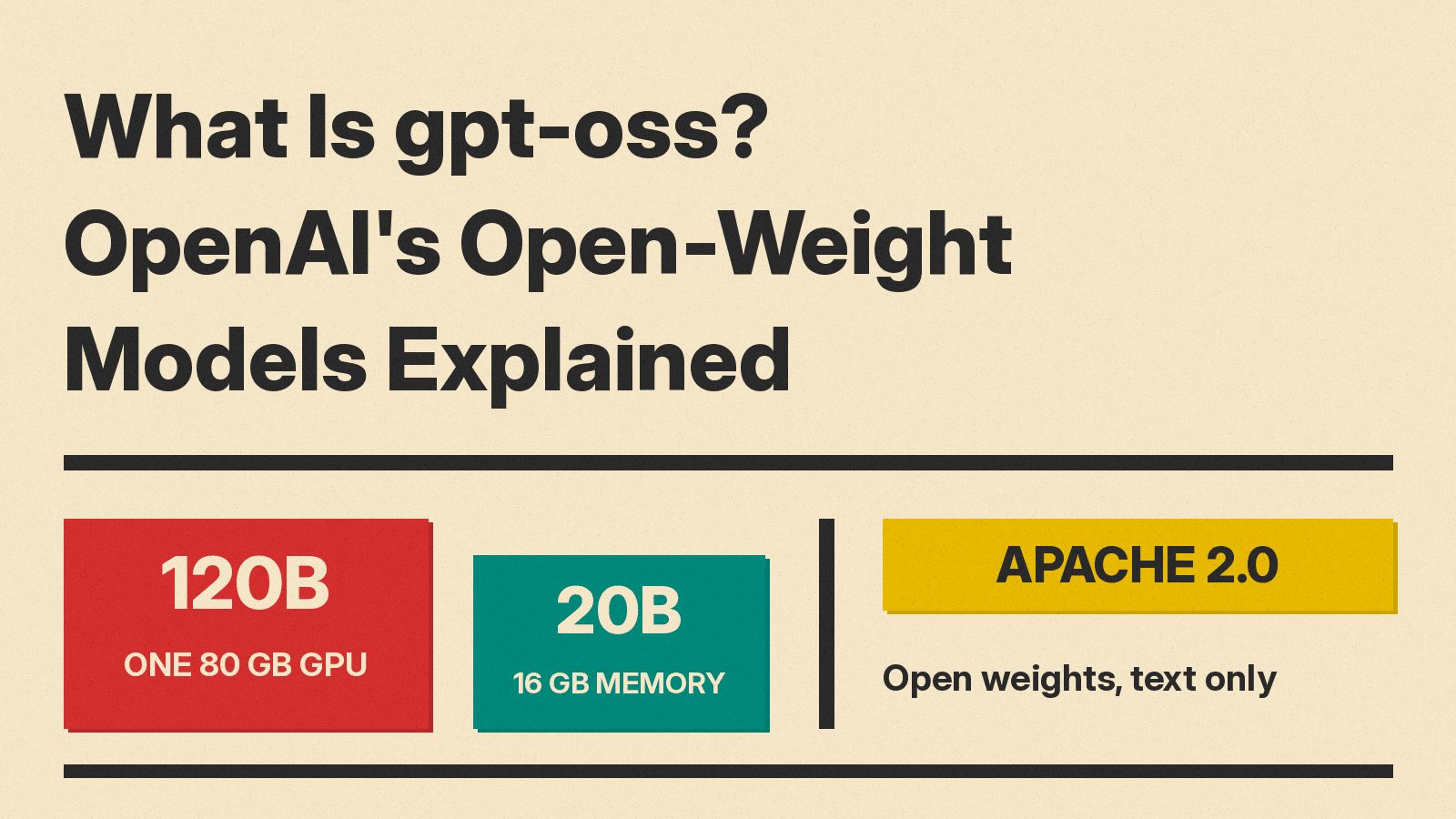
On August 5, 2025, OpenAI released two language models that anyone can download and run: gpt-oss-120b and gpt-oss-20b. The release stood out for two reasons. OpenAI had not put out open-weight language models since GPT-2, and OpenAI says the larger of the two comes close to its o4-mini model on core reasoning benchmarks while fitting on a single graphics processor. Here is what gpt-oss is, which models exist, how they are built, what license covers them, whether you can run one yourself, and what OpenAI says about safety.
What is gpt-oss?
gpt-oss is a family of open-weight language models from OpenAI, announced in the company's launch post on August 5, 2025.
"Open-weight" means OpenAI publishes the model's weights, which are the large sets of numbers that encode what the model learned during training. Anyone can download the weights, run the model on their own hardware, inspect them, and modify them. Closed models, like the ones behind ChatGPT, can only be reached through OpenAI's servers. If that distinction is new to you, open-weight vs closed AI models covers the tradeoffs in detail.
OpenAI says gpt-oss is its first open-weight language model since GPT-2. It had earlier released other open models, Whisper and CLIP, but those were not language models.
According to the launch post, the models were trained "using a mix of reinforcement learning and techniques informed by OpenAI's most advanced internal models, including o3 and other frontier systems." Reinforcement learning is a training method in which a model practices tasks and receives feedback signals about which outputs are better.
Which gpt-oss models exist?
As of November 9, 2026, the gpt-oss collection on OpenAI's Hugging Face organization lists two models, both released in August 2025. OpenAI's Hugging Face page shows no newer gpt-oss version as of that date. Hugging Face is a website that hosts model files.
gpt-oss-120b is the larger model. OpenAI says it "achieves near-parity with OpenAI o4-mini on core reasoning benchmarks, while running efficiently on a single 80 GB GPU." A GPU is a graphics processing unit, the type of chip typically used to run large models, and 80 GB of memory is data center hardware. The model card, which is Hugging Face's documentation page for a model, describes gpt-oss-120b as suited to "production, general purpose, high reasoning use cases that fit into a single 80GB GPU (like NVIDIA H100 or AMD MI300X)".
gpt-oss-20b is the smaller model. OpenAI says it "delivers similar results to OpenAI o3-mini on common benchmarks and can run on edge devices with just 16 GB of memory." Edge devices are machines outside a data center, such as a personal computer. The model card says gpt-oss-20b is "for lower latency, and local or specialized use cases".
A related family also exists: gpt-oss-safeguard-120b and gpt-oss-safeguard-20b. OpenAI describes them as "safety reasoning models built-upon gpt-oss", also under Apache 2.0, and its help center calls them a research preview. They classify text against safety policies that you write yourself, and OpenAI says they "are intended for safety use cases".
How is gpt-oss built?
Both models use a Transformer architecture with mixture-of-experts (MoE) design. In a mixture-of-experts model, the network contains many specialized sub-modules called experts, and only a few of them activate for each token, where a token is a chunk of text such as a word or part of a word. That keeps computation per token small even though the total parameter count is large. What is a mixture-of-experts model explains the idea in full.
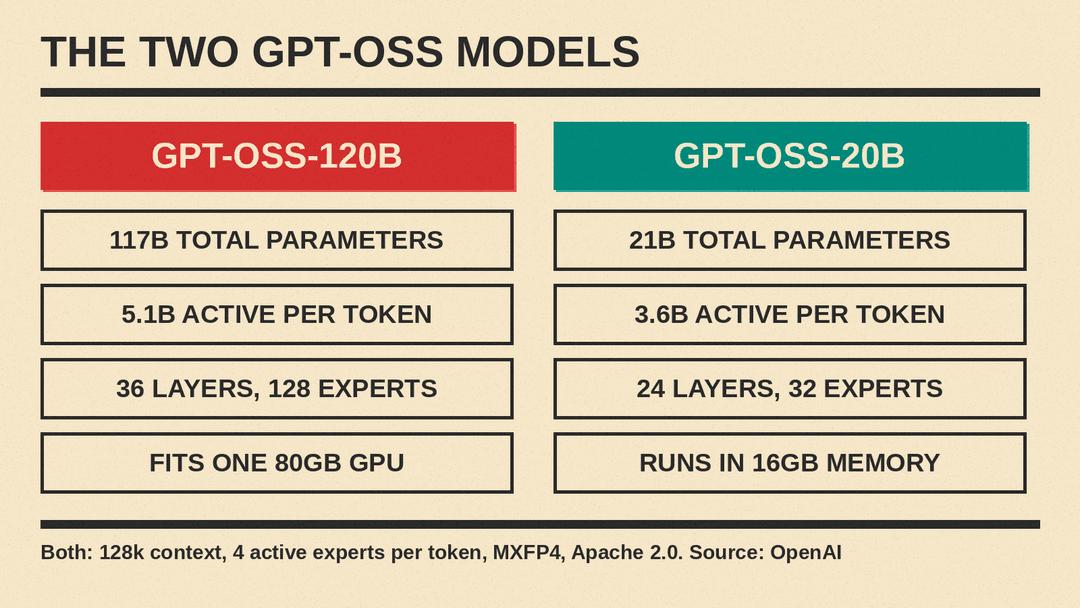
Per the launch post, the two models have these specifications:
- gpt-oss-120b: 36 layers, 117 billion total parameters, 5.1 billion active parameters per token, 128 total experts, 4 active experts per token, and a 128k context length.
- gpt-oss-20b: 24 layers, 21 billion total parameters, 3.6 billion active parameters per token, 32 total experts, 4 active experts per token, and a 128k context length.
Parameters are the individual numbers a model adjusts during training. Context length is how much text the model can consider at once, including your prompt and its reply, so 128k means roughly 128,000 tokens.
The training dataset was mostly English and text-only, focused on STEM (science, technology, engineering and math), coding and general knowledge. The tokenizer, named o200k_harmony, was also open-sourced. A tokenizer is the component that splits text into the tokens the model reads.
After pre-training, OpenAI post-trained the models with a supervised fine-tuning stage followed by a high-compute reinforcement learning stage, similar to o4-mini. Users can choose among three reasoning efforts: low, medium and high. The launch post says the effort level is set with one sentence in the system message, and the model card gives the example "Reasoning: high".
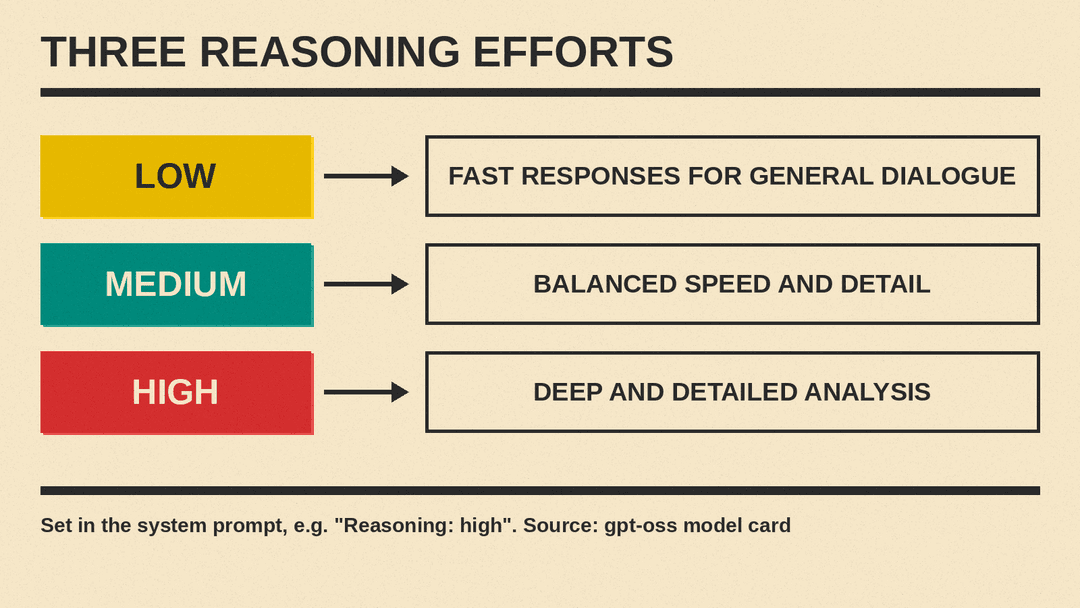
A system message is an instruction placed before a conversation that shapes how the model behaves, so this setting changes how much reasoning the model does before answering.
The weights are published natively quantized in MXFP4, a 4-bit format. Quantization stores each weight using fewer bits, which lowers memory requirements. OpenAI says this lets gpt-oss-120b run within 80GB of memory and gpt-oss-20b within 16GB.
What can gpt-oss do?
gpt-oss models generate and reason over text. Given their training focus, they are aimed at STEM questions, coding and general knowledge tasks. They support tool use, including web search, Python code execution, function calling and Structured Outputs. Function calling means the model can emit a structured request to run a program or service you provide. Structured Outputs means the model returns data in a strict format, such as JSON, instead of free-form prose. OpenAI says the models are compatible with its Responses API. That is about the request format: OpenAI's help center says the models are not served through the OpenAI API and are not available in ChatGPT.
One caveat concerns the chain of thought, which is the internal reasoning trace these models produce before answering. OpenAI did not put direct supervision on the chain of thought, and the launch post says developers "should not directly show CoTs to users" because they may contain hallucinated or harmful content. Hallucinated means false statements presented confidently.
gpt-oss is text-only. It does not accept images or other media as input. OpenAI says that for multimodal support and built-in tools, its API models "remain the best option".
How does gpt-oss compare with OpenAI's other models?
The practical difference is control. gpt-oss weights can be downloaded and run wherever you choose, so your data can stay on your own machines. ChatGPT and OpenAI's API models run on OpenAI's infrastructure. OpenAI does not host gpt-oss itself, so you run it yourself or through a third-party provider.
On quality, OpenAI positions gpt-oss-120b at near-parity with o4-mini on core reasoning benchmarks, and gpt-oss-20b at similar results to o3-mini on common benchmarks. Both are OpenAI's claims about specific benchmark sets rather than comparisons across the full model lineup.
On capability breadth, the comparison runs the other way. gpt-oss is text-only, while OpenAI says its API models "remain the best option" for multimodal support and built-in tools. The training lineage is connected: gpt-oss was trained with techniques informed by o3 and other frontier systems, and post-trained in a way similar to o4-mini.
What license does gpt-oss use?
Both gpt-oss models are released under Apache 2.0, a permissive open-source license. The model card calls it "ideal for experimentation, customization, and commercial deployment". The safeguard models use the same license.
The model repository also carries a short usage policy that says: "By using OpenAI gpt-oss-120b, you agree to comply with all applicable law."
The launch post also carries a medical disclaimer: "gpt-oss models do not replace a medical professional and are not intended for the diagnosis or treatment of disease".
Can you run gpt-oss on your own computer?
Possibly, depending on the model and your hardware. The weights are hosted on Hugging Face, quantized in MXFP4, which OpenAI says lets gpt-oss-120b run within 80GB of memory and gpt-oss-20b within 16GB. Memory is usually the limiting factor for local models, and how much memory to run an AI model locally explains how to estimate what you need.
The 80GB figure points to data center GPUs such as the NVIDIA H100 or AMD MI300X, so gpt-oss-120b is not a typical home setup. OpenAI says gpt-oss-20b runs on edge devices with 16GB of memory.
Software support is broad. The model card lists Transformers, vLLM, Ollama and LM Studio. The model card's Ollama example for the larger model is "ollama run gpt-oss:120b". If you are choosing between the two popular local apps, Ollama vs LM Studio compares them.
One technical requirement: the model card says the models must be used with the harmony response format "as it will not work correctly otherwise". Chat templates in the Transformers library apply it automatically.
Fine-tuning, which means further training a model on your own data, is also an option. The model card says gpt-oss-120b can be fine-tuned on a single H100 node, and gpt-oss-20b "can even be fine-tuned on consumer hardware".
If you would rather not manage hardware, the launch post lists partners including Azure, Hugging Face, vLLM, Ollama, llama.cpp, LM Studio, AWS, Fireworks, Together AI, Baseten, Databricks, Vercel, Cloudflare and OpenRouter, with hardware partners NVIDIA, AMD, Cerebras and Groq. Microsoft brought a GPU-optimized gpt-oss-20b to Windows through Foundry Local and AI Toolkit for VS Code. Early organizational partners included AI Sweden, Orange and Snowflake, for uses such as on-premises hosting and fine-tuning on specialized data.
Is gpt-oss safe?
OpenAI describes several safety measures in the launch post.
During pre-training, OpenAI filtered certain harmful CBRN data. CBRN stands for chemical, biological, radiological and nuclear.
OpenAI also tested misuse potential after download. It fine-tuned adversarial versions of gpt-oss-120b on biology and cybersecurity data, simulating what a malicious actor could do with open weights. OpenAI says these maliciously fine-tuned models "were unable to reach high capability levels" under its Preparedness Framework, the company's framework for rating risks from dangerous capabilities. The methodology was reviewed by three independent expert groups.
Alongside the release, OpenAI announced a Red Teaming Challenge with a $500,000 prize fund, to encourage researchers and developers to find new safety issues. Red teaming means deliberately probing a model for failures and abuses.
Two caveats matter for anyone building on gpt-oss. First, the chain-of-thought warning above: OpenAI did not directly supervise the reasoning traces and advises developers not to show them to users. Second, the repository's usage policy asks users to comply with all applicable law.
Who should use gpt-oss?
gpt-oss fits people who want an OpenAI-made model they can download, run on their own hardware, keep data on-premises, or fine-tune. That includes developers building products where data cannot leave their own infrastructure, students and hobbyists experimenting with a local model, and organizations that need a base model for specialized fine-tuning.
It is a weaker fit for people who need image or other media input, since gpt-oss is text-only, and for people who want the simplest possible setup. For those cases, ChatGPT and OpenAI's API models are the more direct path, and OpenAI says they "remain the best option" for multimodal support and built-in tools.
Frequently asked questions
Is gpt-oss free to use?
The weights are downloadable from Hugging Face under Apache 2.0, a permissive license, at no cost. A short usage policy requires compliance with applicable law. Your expenses come from your own side: hardware, or a hosting provider if you rent one. OpenAI's help center says the models are not available through the OpenAI API, so API pricing does not apply.
What is the difference between gpt-oss-120b and gpt-oss-20b?
Size and intended use. gpt-oss-120b has 117 billion total parameters with 5.1 billion active per token, and OpenAI says it achieves near-parity with o4-mini on core reasoning benchmarks while running on a single 80 GB GPU. gpt-oss-20b has 21 billion total parameters with 3.6 billion active per token, delivers similar results to o3-mini on common benchmarks according to OpenAI, and runs on edge devices with 16 GB of memory.
Can gpt-oss understand images?
No. gpt-oss is text-only and was trained on a text-only dataset. OpenAI says its API models "remain the best option" for multimodal support.
Is gpt-oss the same thing as ChatGPT?
No. ChatGPT is an application that runs OpenAI's hosted, closed models. gpt-oss is a set of downloadable model weights that you run yourself or through a third-party host, and that you can inspect, modify and fine-tune.
