
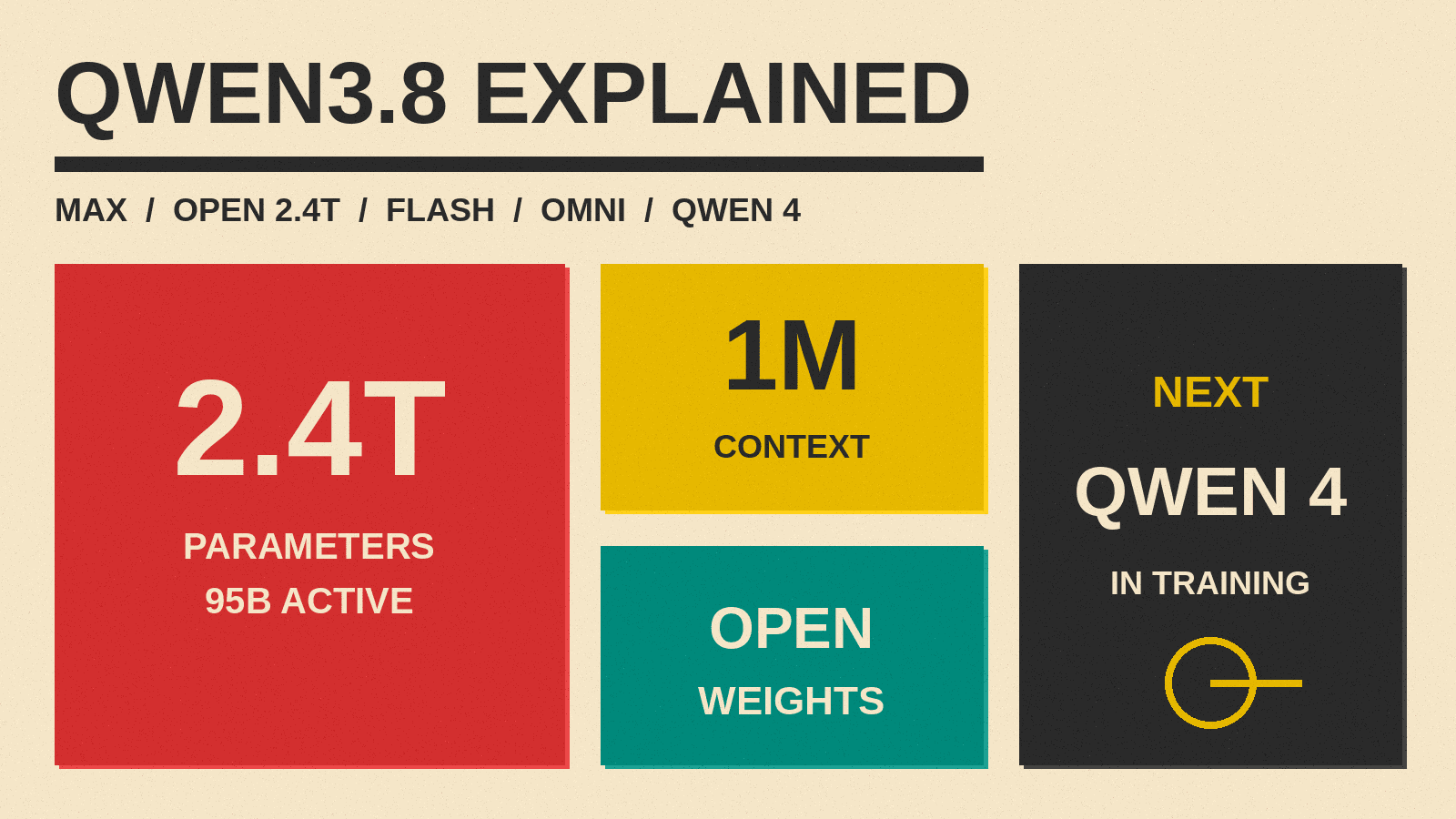
Qwen3.8 is the current generation of Alibaba's Qwen models, and it is easy to get lost in it. The name covers a closed API flagship, a September snapshot of that flagship, a 2.4-trillion-parameter open-weight release, a small dense open model, a fast API model, an experimental open model that previews the Qwen 4 architecture, and a set of omni-modal and real-time models. This explainer sorts them out, using Alibaba's own announcements, the Qwen Cloud model pages and the Hugging Face model cards.
The short version: Qwen3.8-Max launched on August 3, 2026 as Alibaba's largest model, with 2.4 trillion parameters and a 1-million-token context window. For the first time, Alibaba also published the weights of a Max-class model. At its Apsara Conference on September 22, Alibaba said Qwen 4 is in training, with no release date.
The Qwen3.8 family at a glance
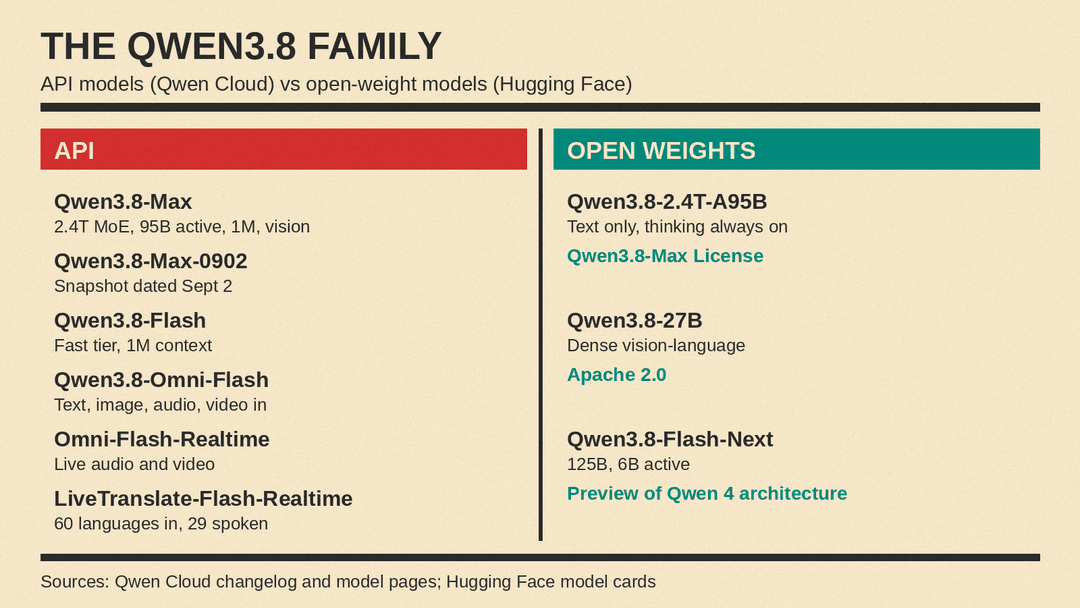
- Qwen3.8-Max (API). The flagship, announced August 3. A sparse mixture-of-experts (MoE) model with 2.4 trillion total parameters and 95 billion active, 1M context, vision input, and thinking and non-thinking modes.
- Qwen3.8-Max-0902 (API). An upgraded snapshot of Qwen3.8-Max, with the alias
qwen3.8-max-2026-09-02. - Qwen3.8-2.4T-A95B (open weights). The downloadable version of the flagship. Text only, thinking always on, under a custom "Qwen3.8-Max License."
- Qwen3.8-27B (open weights). A 27B dense vision-language model under Apache 2.0.
- Qwen3.8-Flash (API). The low-cost, fast multimodal model, with 1M context.
- Qwen3.8-Flash-Next (open weights). The open model behind Qwen3.8-Flash, and an experimental preview of the Qwen 4 architecture. 125B parameters with 6B active.
- Qwen3.8-Omni-Flash and Omni-Flash-Realtime (API). Native omni-modal models that take text, image, audio and video input.
- Qwen3.8-LiveTranslate-Flash-Realtime (API). A real-time audio and video translation model.
Qwen3.8-Max: the flagship
Alibaba's launch release calls Qwen3.8-Max "the most powerful model in its Qwen series to date." It is built on the Qwen 3.5 architecture and pairs a sparse MoE design with hybrid attention. Of its 2.4 trillion parameters, 95 billion are active, which Alibaba says significantly reduces computational cost and latency compared with dense models of similar scale.
At launch, Alibaba said the model ranked fifth in Text Arena, second in Vision Arena and fourth in Frontend Code Arena. Those are leaderboard positions as of August 3, and arena ranks change week to week.
The release leans on long autonomous runs. In internal testing, Alibaba says Qwen3.8-Max worked on a software project for 16 days and built "oh-my-cli," a self-evolving agent framework that the company then open-sourced on GitHub. Alibaba also says the model reproduced published research experiments and engineered new methods that outperformed the original papers. These are company claims.
On the API side, the Qwen Cloud model page lists a 1M-token context, up to 131K output tokens, up to 262K reasoning tokens, function calling, structured outputs, context caching, batch jobs, web search and fine-tuning.
What the benchmarks say
The benchmark table in the open-weight model card labels its column Qwen3.8-Max and compares it with Claude Opus 4.8, Claude Fable 5, GPT-5.6 Sol and the previous Qwen3.7-Max. All of these numbers are reported by the Qwen team in the card, posted in August 2026. Some rival scores come from Qwen's own runs and others from published results or leaderboards, and the footnotes show that harnesses differ by model. A few rows stand out:
- PaperBench (reproducing research papers): Qwen3.8-Max 93.0, the highest in the table, against 90.5 for GPT-5.6 Sol and 88.8 for Fable 5.
- Terminal Bench 2.1: 86.6, ahead of Opus 4.8 and Fable 5 (both 84.6) but behind GPT-5.6 Sol (88.8).
- SWE-bench Pro: 67.7, behind Fable 5 (80.0) and Opus 4.8 (69.2).
- DeepSWE 1.1: 56.6, well behind GPT-5.6 Sol (73.0) and Fable 5 (70.0).
- IFBench (instruction following): 82.8, the highest in the table.
The clearest signal is the jump from the last generation. Against Qwen3.7-Max, the new model rises from 21.6 to 56.6 on DeepSWE 1.1 and from 64.8 to 93.0 on PaperBench.
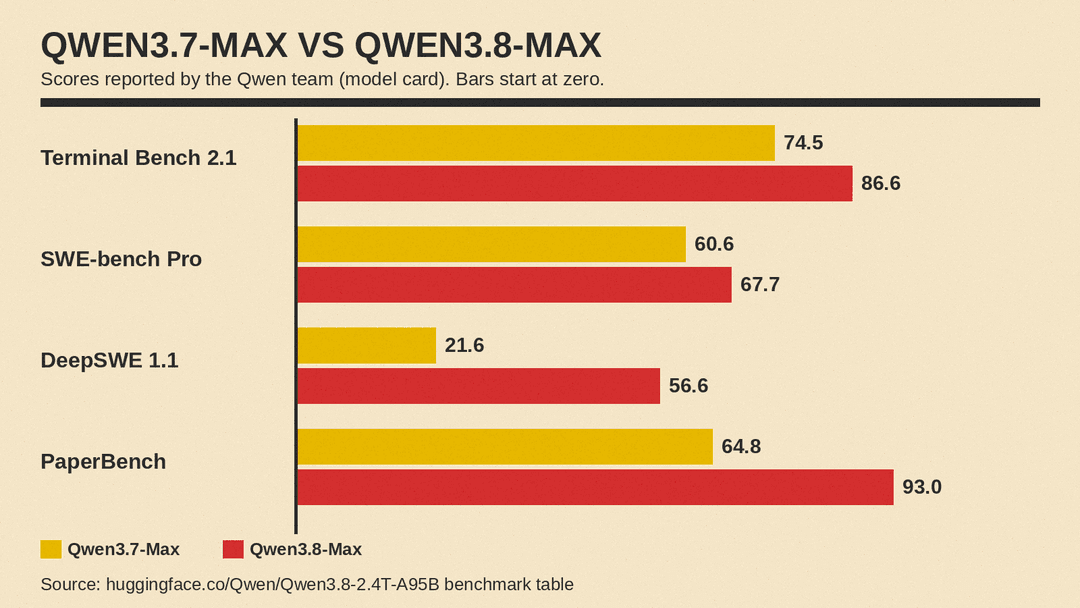
By Qwen's own numbers, the model is competitive with the US frontier on some agent and research tasks and behind it on the hardest coding tests in the table, such as SWE-bench Pro and DeepSWE 1.1.
Qwen3.8-Max-0902: the September snapshot
The snapshot dated September 2 is an upgrade of the flagship. The Qwen Cloud changelog says Qwen3.8-Max-0902 improves coding on "more complex engineering-scale projects and long-horizon autonomous development," improves multi-tool orchestration, and refines vision tasks such as chart reasoning and document parsing. It keeps the 1M context window, thinking mode and the tool set.
At Apsara on September 22, Alibaba added a related claim. It said Qwen3.8-Max ran 33 iterative cycles of what it calls Recursive Self-Improvement over a month of fully automated runs, covering pipeline design, data checks, experiments and error diagnosis. According to the company, this lifted the updated model's Artificial Analysis score from 40 to 45. The release does not say whether that updated model is the 0902 snapshot or a later one, so treat them as related but not confirmed to be the same.
If you call the API, qwen3.8-max and the dated snapshot are separate model IDs. Pin the dated ID if you need stable behavior across updates.
The open weights: what you actually get
The Qwen3.8-2.4T-A95B repository is the first time the Qwen team has put a Max-class model into open release. Alibaba said on August 3 that weights would follow the next week, and Hugging Face shows the repository created on August 8 and the weight files uploaded on August 9 (both UTC), with an FP8 version alongside it.
The open model is not identical to the API product. The model card spells out the differences:
- Text only. The open model does not accept images or video. The API version adds vision input.
- Thinking is always on. Every response starts with a reasoning block, and thinking cannot be turned off. The API version also supports non-thinking mode.
- Context. 262,144 tokens natively, extensible to 1,010,000. The API version uses 1M by default.
- Tools. The API version includes official built-in tools.
- Reasoning control. A
reasoning_effortsetting withxhigh(default),mediumandlow, pluspreserve_thinkingto keep earlier reasoning in context.
Under the hood, the card lists 92 layers in a repeating pattern of three Gated DeltaNet (linear attention) layers and one Gated Attention layer, each followed by an MoE block with 512 experts, of which 10 routed experts and 1 shared expert are active. For production or high-throughput serving, the card recommends dedicated engines: SGLang, vLLM or TokenSpeed.
The license
The weights ship under the Qwen3.8-Max License, not Apache 2.0. It is permissive for most users, with two conditions:
- If a commercial product built on the model has more than 100 million monthly active users or more than $20 million in monthly revenue, it must display the model name prominently in its interface.
- If the licensee runs a "Model as a Service" or "AI Work Assistant" business and the licensee plus its affiliates have more than $50 million in revenue over any 12 months, it needs a separate license from Qwen before commercial use. The license defines AI Work Assistant as a product mainly for AI coding or office productivity, and names Qoder and QwenWork as examples. Internal use is exempt if nothing is exposed to third parties.
In practice, that targets large API resellers and large coding or office assistant products. Companies below those thresholds, and internal use that exposes nothing to third parties, fall under the permissive terms. Z.ai took a similar route with GLM-5.3, which shipped open weights with commercial restrictions aimed at hyperscalers.
Qwen3.8-27B: the small open model
Qwen3.8-27B is a dense 27B model with a vision encoder, released under Apache 2.0. It handles images and video, has 262K native context extensible to 1M, and, unlike the large open model, lets you turn thinking off per request. For teams that want to run a current Qwen model on their own hardware, this is the practical choice. On Hugging Face it had far more downloads last month than the 2.4T model (about 7.5 million against about 26,000, as of October 19).
Qwen3.8-Flash and Flash-Next: a preview of Qwen 4
Qwen3.8-Flash is the fast, cheap tier. Qwen Cloud describes it as a multimodal model with a 1M context window that works with both OpenAI and Anthropic API protocols, so it can be dropped into tools such as Claude Code and Codex.
The more interesting part is what sits under it. The Qwen3.8-Flash-Next model card says Qwen3.8-Flash is the official API version based on Flash-Next, and calls Flash-Next an "experimental preview of the architecture that will underpin Qwen4." The card lists four changes:
- Qwen Sparse Attention (QSA). The Gated Attention layers are replaced with sparse attention that selects micro-blocks rather than single tokens, to cut long-context latency.
- Gated Residual. Widened residual streams with learned gates on reads and writes, for more expressive layers without much inference overhead.
- N-gram embedding. An extra 51B parameters in a bigram and trigram embedding table, a way to add parameters that costs less compute than more MoE experts and is easier to offload.
- Training recipe. Muon and AdamW optimizers applied to different weight types, and no batch-size warmup.
Flash-Next has 125B parameters with 6B active, plus the 51B n-gram embedding and a 4B multi-token prediction module. It ships under a "Qwen Community" license rather than Apache 2.0. Our August report on the Flash-Next release has more on its architecture and benchmarks.
Omni-Flash and the real-time models
Qwen3.8-Omni-Flash, listed on Alibaba Cloud Model Studio on September 17, is a native omni-modal model. It accepts text, images, audio and video in one context of up to 1M tokens and returns text. Alibaba says it is built on the Qwen3.8-Flash-Next architecture and targets work such as video editing, music video creation, narration, multimedia summaries and audio-video dialogue. It also understands two-channel and four-channel spatial audio.
Two real-time models round out the set. Qwen3.8-Omni-Flash-Realtime, listed on September 21, adds live audio and video interaction with text and audio output. Qwen3.8-LiveTranslate-Flash-Realtime translates speech in real time, recognizes 60 source languages and speaks 29. At Apsara, Alibaba said its latency fell from 2.8 to 2.3 seconds.
Separately, Ant Group's inclusionAI team released open Ming-3.0 speech models. Our Ming-3.0-audio explainer covers those.
Pricing (as of October 2026)
From the Qwen Cloud model pages, per million tokens:
- Qwen3.8-Max: $2 input, $6 output. Cached input $0.25 (implicit cache) or $0.17 (explicit cache read). Explicit cache creation $2.50.
- Qwen3.8-Flash: $0.15 input, $0.47 output. Cached input $0.016.
For comparison, our LLM API pricing comparison lists GPT-6.1 Sol and Gemini 4 Argon at $2 input and $10 output, and Claude Opus 5.5 at $4 and $20. Qwen3.8-Max matches the $2 input price and charges less for output. Prices change often, so check the model page before you budget.
Qwen 4 and the Apsara roadmap
At the September 22 Apsara Conference, Alibaba said:
- Qwen 4 is in training. No release date was given.
- Qwen 4.5 and Qwen 5 are on the roadmap, projected to scale to 5 to 10 trillion parameters.
- New chips. Alibaba's T-Head unit announced the Zhenwu V900 AI accelerator, with 216 GB of memory, 1,200 GB/s of chip-to-chip bandwidth and FP8 and FP4 support. T-Head says it has three times the performance of the Zhenwu M890, with mass production planned for Q1 2027.
- Compute. CEO Eddie Wu set a target for Alibaba Cloud to operate more than 20GW of global datacenter capacity by 2032.
Read with the Flash-Next card, which calls that model a preview of the architecture that will underpin Qwen 4, the roadmap points to sparse attention, gated residuals and n-gram embeddings at much larger scale, served in part on Alibaba's own chips. Policy is the other open question. Beijing is drafting its own export controls on frontier AI models, and how those rules treat open-weight releases like Qwen3.8 will matter for Qwen 4.
How to try Qwen3.8
- Chat: Qwen Studio offers Qwen3.8-Max in a browser. Alibaba also offers it in QwenWork, its workplace AI agent platform.
- API: Qwen Cloud exposes an OpenAI-compatible endpoint. Use
qwen3.8-max,qwen3.8-flashor a dated snapshot as the model name, and passenable_thinkingin the request body to control reasoning. - Self-host: Qwen3.8-27B (Apache 2.0) is the compact, deployment-friendly option. The 2.4T model and Flash-Next are much larger; their cards point to SGLang, vLLM or TokenSpeed.
- Routers: Qwen models also run through gateways such as OpenRouter, where Qwen held about 5% of text requests in the week of October 12, per our OpenRouter usage report.
Which Qwen3.8 model should you use?
- Hardest agent and research work, via API: Qwen3.8-Max, pinned to the 0902 snapshot.
- High-volume, low-cost work: Qwen3.8-Flash.
- Audio and video input: Qwen3.8-Omni-Flash, or the Realtime version for live sessions.
- Your own hardware: Qwen3.8-27B. It is the only Qwen3.8 model here under plain Apache 2.0.
- Frontier open weights you can inspect and fine-tune: Qwen3.8-2.4T-A95B, if you have the cluster and fit the license.
- Studying where Qwen goes next: Qwen3.8-Flash-Next and its technical report.
Our coverage
- Alibaba launches Qwen 3.8-Max, benchmarks fall short of claims: the Max launch, its pricing, and independent tests that put it below Alibaba's claims.
- Alibaba open-weights Qwen 3.8 with a 27B model that tops its bigger predecessor: the open-weights release of the 27B and 2.4T models and their licenses.
- Qwen 3.8 27B is excellent, but it defaults to wildly overthinking things: Simon Willison's hands-on tests of the 27B at its default xhigh reasoning setting.
- Alibaba demonstrates native Qwen 3.8 27B inference on the XuanTie C950 RISC-V CPU: Alibaba's T-Head running the 27B on a RISC-V server CPU without a GPU.
- Z Lab releases DFlash 2 for Qwen 3.8 27B: block-diffusion speculative decoding checkpoints for faster 27B serving.
- Unsloth releases Dynamic V3.0 GGUFs for Qwen 3.8 27B: quantized 27B builds for local use, including a 1-bit tier.
- Alibaba releases open-weight Qwen3.8-Flash-Next: the 125B open model with 6B active parameters that previews the Qwen 4 architecture.
Sources
- Alibaba Cloud: Alibaba Unveils Qwen3.8-Max (August 3, 2026)
- Alibaba Cloud: Alibaba Unveils Roadmap on Full-Stack AI Strategy (September 22, 2026)
- Qwen Cloud model changelog
- Alibaba Cloud Model Studio: model lifecycle and updates
- Qwen Cloud: Qwen3.8-Max model page and pricing
- Qwen Cloud: Qwen3.8-Flash model page and pricing
- Hugging Face: Qwen3.8-2.4T-A95B model card
- Hugging Face: Qwen3.8-Max License
- Hugging Face: Qwen3.8-Flash-Next model card
- Hugging Face: Qwen3.8-27B model card
