
Several open-weight coding models came out between August and October 2026. This guide covers six you can download today and one with weights promised for early November. It is written for developers who want a coding model they can host themselves, run on a laptop, or reach through a provider of their choice. Every figure below comes from the developer's own model card or launch post, checked on October 27, 2026 (Pacific Time). If you want the wider list of open models for every task, start with our guide to the best open-source LLMs in 2026.
Quick picks
- Large agent deployments, published coding benchmarks: GLM-5.3 and Kimi K3.
- Many agent runs where cost per task matters: DeepSeek-V4.1-Flash-1017.
- Agent and automation work on four data center GPUs: MiniMax M3.1 Flash.
- A 33B-scale model under Apache 2.0: Nanbeige4.3-33B.
- A coding model on a Mac or local GPU: Recursive Flint.
- Worth waiting for: Kimi K3.1 Pro, with weights due by November 4.
How we picked
We started from open-weight models whose developers pitch them for coding or coding agents, then read each model card. These picks group models by hardware and use, not by a single score. The reason is simple: every benchmark number here is self-reported, and labs use different harnesses, context limits and timeouts. Z.ai runs Terminal Bench 2.1 inside Claude Code. Recursive uses Terminus 2. DeepSeek's base V4.1-Flash card says it uses its own DeepSeek Harness for most code agent tests, while the 1017 card uses Claude Code for Terminal-Bench 4.0 and Mini-SWE-V2 for DeepSWE v1.1. A score from one table is not directly comparable with a score from another, so we compare models only inside a single developer's table, and we name the table each time.
Two more terms help. "Total parameters" sets how much memory a model needs. "Active parameters" sets how much compute each token costs. A mixture-of-experts (MoE) model loads all of its total parameters even though it uses only a fraction per token.
GLM-5.3 (Z.ai)
Z.ai released GLM-5.3 on August 14, 2026. It uses the same base model as GLM-5.2, and Z.ai says "every gain comes from post-training." The company calls it "the most capable open-weights model for coding" and reports a 50% improvement over GLM-5.2 on its in-house Z.ai Code Bench.
In the launch table (August 14, 2026), GLM-5.3 scores:
- Terminal Bench 2.1: 88.2
- Terminal Bench 3.0: 28.3
- DeepSWE v1.1: 66.9
- NL2Repo: 58.0
The GLM-5.3 model card lists SGLang, vLLM, Transformers, KTransformers and Unsloth among the supported frameworks. Thinking is set with reasoning_effort at low, high or max, and the default is max. The license is a custom GLM-5.3 license.
Pick it if you want a large open coding model and can host or rent a big deployment.
Kimi K3 (Moonshot AI)
The Kimi K3 model card describes an open-weight, native multimodal agent model with 2.8T total parameters and 104B active. It activates 16 of 896 experts per token, reads text, images and video, and supports a 1-million-token context window. Moonshot lists "long-horizon coding" as a key feature and ships the weights under the Kimi K3 License.
In Z.ai's GLM-5.3 table (August 14, 2026), Kimi K3 scores 88.3 on Terminal Bench 2.1 and 67.5 on DeepSWE v1.1, against 88.2 and 66.9 for GLM-5.3.
Pick it if you want one open model for long coding sessions that also reads images and video.
DeepSeek-V4.1-Flash-1017 (DeepSeek)
SiliconANGLE reported the release on October 18, 2026. The model card calls it a minor update to DeepSeek-V4.1-Flash with improvements across reasoning, coding, agentic tasks and visual benchmarks, and says it reduces task execution time and output length. The base V4.1-Flash card describes a multimodal MoE with 552B backbone parameters, contexts up to one million tokens, and 8B active parameters per token during prefill and 16B during decode. The license is MIT.
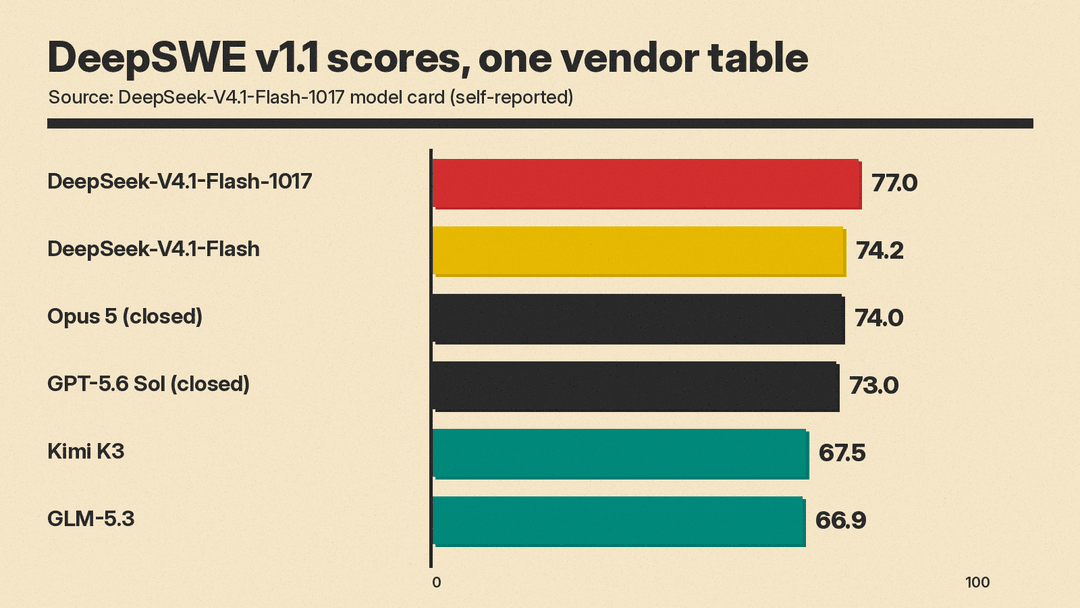
In the benchmark table on that model card (release reported October 18, 2026), DeepSeek-V4.1-Flash-1017 scores 77.0 on DeepSWE v1.1, 42.3 on Terminal-Bench 4.0 and 68.2 on NL2Repo-Bench. In the same table, Kimi K3 scores 67.5, 12.6 and 58.0, and GLM-5.3 scores 66.9, 37.9 and 58.0.
Pick it if you run many coding-agent tasks and want an MIT license.
MiniMax M3.1 Flash (MiniMax)
The MiniMax M3.1 Flash model card describes a native multimodal MoE "for coding, agentic workflows, computer use, and cybersecurity," with about 428B total parameters, 23B active per token, and a context window of up to 1,000,000 tokens. On the card it reports 73.7% on DeepSWE v1.1 and 76.2 on BankerToolBench. The vLLM recipe lists four NVIDIA Blackwell GPUs or a full node of eight Hopper GPUs.
The license is the MiniMax Community License. It is free for non-commercial use and adds conditions for commercial use, explained in our MiniMax M3.1 Flash open weights explainer.
Pick it if your coding work leans toward automation and agent tasks and you can meet the license terms.
Nanbeige4.3-33B (Nanbeige)
The Nanbeige team posted the weights on October 24, 2026, according to the Hub's commit history. The model card calls it the "flagship teacher model" of the Nanbeige4.3 series and says it "excels at complex coding and professional cowork tasks." It compares the model with Qwen3.8-27B, Muse-Glimmer-30B and Gemma4-31B using the same harness for each.
In that table, Nanbeige4.3-33B scores:
- Terminal-Bench 2.1: 80.9 (Qwen3.8-27B: 73.0)
- DeepSWE: 65.5 (Qwen3.8-27B: 42.5)
- SWE-Bench Pro: 60.3 (Qwen3.8-27B: 61.7)
The card's SGLang and vLLM examples use four-way tensor parallelism. The license is Apache 2.0.
Pick it if you want a mid-size coding agent model under a standard permissive license.
Recursive Flint (Recursive)
Recursive released Flint on October 21, 2026. The Flint model card describes an MoE model "for coding agents" with 39.8 billion total parameters and approximately 2.5 billion active per token, built to investigate codebases, fix bugs, implement features and write tests. The documented context configuration is 262,144 tokens, including prompt and output.
In Recursive's release evaluations (October 21, 2026), Flint scores 54.9% on Terminal-Bench 2.1, 89.7% on SWE-bench Pro v2 and 74.2% on SWE-bench Verified. The INT4 GGUF build is a 26.0 GB file and requires an Apple Silicon Mac with at least 48 GB of unified memory. The license is Apache 2.0.
Recursive is direct about the limits. Its launch post says Flint "may need more guidance than the larger closed-source coding models you're used to" and recommends breaking complex work into smaller subtasks. Our guide to running an AI model on your own laptop covers the local tools.
Pick it if you want coding help that runs on your own machine.
Coming soon: Kimi K3.1 Pro
Moonshot's Kimi K3.1 Pro launch post calls it "the first model in our new K3.1 series and our most capable 3T-class open-weight model to date," with a 1-million-token context window. It says the model is "a post-trained version of Kimi K3" and that "the full model weights will be released by Nov 4." For now, Moonshot lists it on Kimi.ai, Kimi Work, Kimi Code and the Kimi API.
Licenses at a glance
- Apache 2.0: Nanbeige4.3-33B, Recursive Flint.
- MIT: DeepSeek-V4.1-Flash-1017.
- Custom licenses: GLM-5.3 license, Kimi K3 License, MiniMax Community License. Read the terms before commercial use.
How to choose
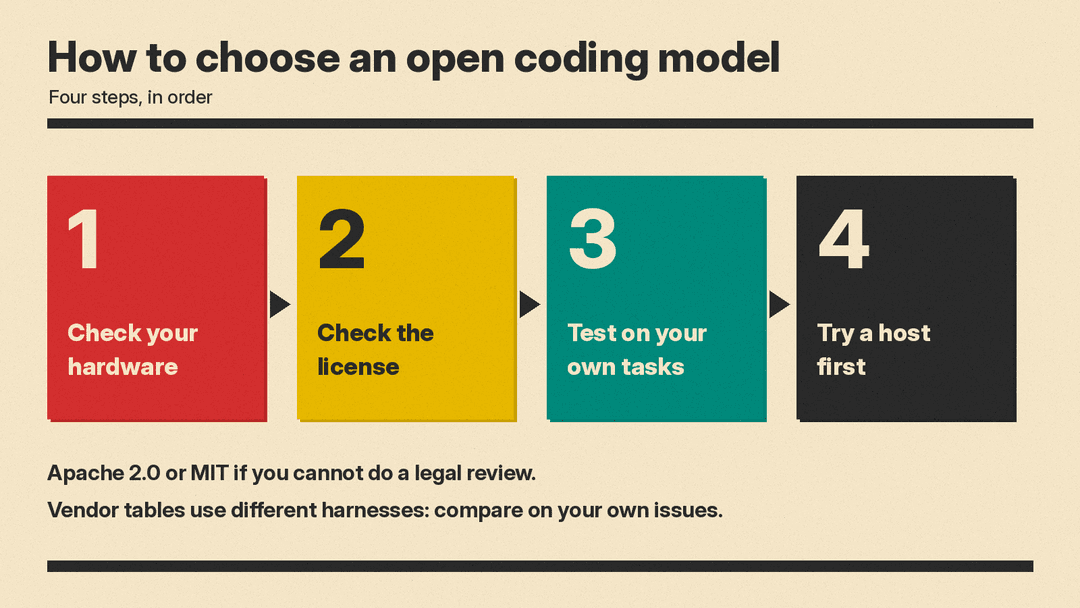
- Check your hardware. A Mac with 48 GB of unified memory can run Flint's INT4 build. Nanbeige's card examples use four GPUs. MiniMax's vLLM recipe lists four Blackwell GPUs. For GLM-5.3, Kimi K3 and DeepSeek-V4.1-Flash-1017, read the serving guide linked from each model card before you plan hardware.
- Check the license. If you cannot do a legal review, stay with Apache 2.0 or MIT.
- Test on your own tasks. Vendor tables use different harnesses. Run a set of your real issues through two or three candidates in the agent tool you already use.
- Try a host first. Before you buy hardware for a large model, test it through an API provider that serves it.
Sources
- Z.ai: GLM-5.3 launch post (August 14, 2026)
- GLM-5.3 model card (Hugging Face)
- Kimi K3 model card (Hugging Face)
- DeepSeek-V4.1-Flash-1017 model card (Hugging Face)
- DeepSeek-V4.1-Flash model card (Hugging Face)
- MiniMax M3.1 Flash model card (Hugging Face)
- vLLM recipe for MiniMax M3.1 Flash
- Nanbeige4.3-33B model card (Hugging Face)
- Nanbeige4.3-33B commit history (Hugging Face)
- Recursive: Introducing Flint
- Recursive Flint model card (Hugging Face)
- Recursive Flint INT4 GGUF (Hugging Face)
- SiliconANGLE: DeepSeek releases updated V4.1-Flash model
- TechCrunch: Recursive launches Flint
- Moonshot AI: Kimi K3.1 Pro launch post
