
The image model market changed shape in the last six weeks. OpenAI shipped GPT Image 2.5 on September 8, Ideogram shipped 4.5 on September 30, Google updated Nano Banana to 2.1 in early October, and Black Forest Labs and Krea both released new models on October 15. If you last picked an image tool in the spring, your shortlist is probably out of date.
This guide covers 10 image generators that are current as of October 2026, what each one is built for, and what the vendors publish about price. Every fact below comes from the vendor's own announcement or documentation, linked inline. We did not run our own benchmark, so quality claims are attributed to whoever made them. If you need audio rather than images, see our guide to the best AI music generators.
The short version
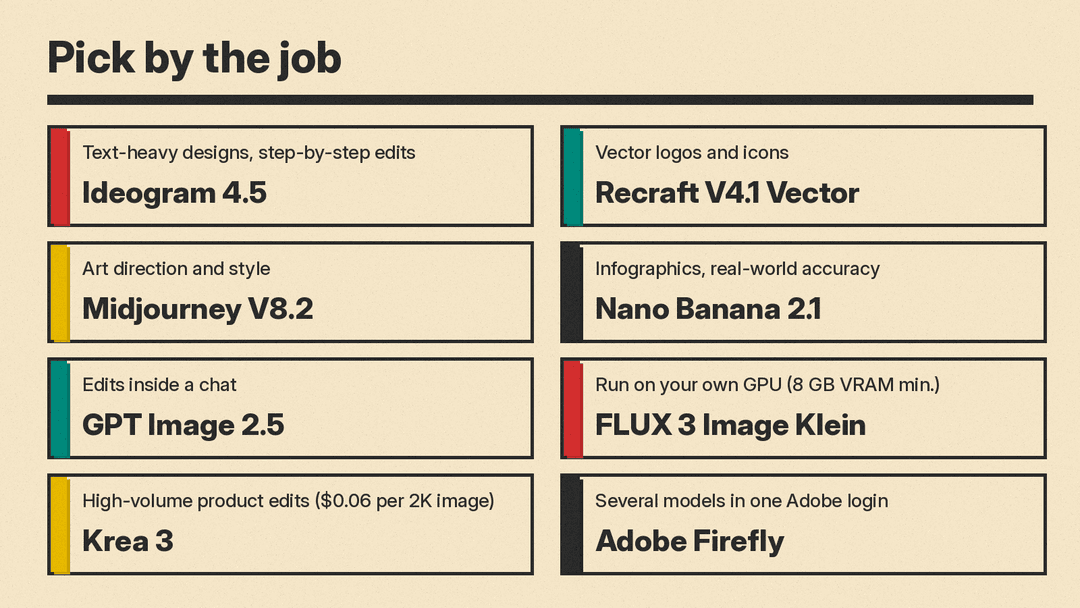
- Best default inside a chat app: ChatGPT Images 2.5 (GPT Image 2.5)
- Best for infographics, text and real-world accuracy: Google Nano Banana 2.1, with Nano Banana Pro for harder jobs
- Best for aesthetics and art direction: Midjourney V8.2
- Best for typography and multi-step edits: Ideogram 4.5
- Best for vector logos and icons: Recraft V4.1 Vector
- Best open-weights model to run yourself: FLUX 3 Image Klein
- Best for high-volume product edits: Krea 3
- Best if you already live in Adobe: Adobe Firefly, which also hosts partner models
- Also worth testing: xAI Imagine Image 2.0 and Microsoft MAI-Image-2.6
How to read prices
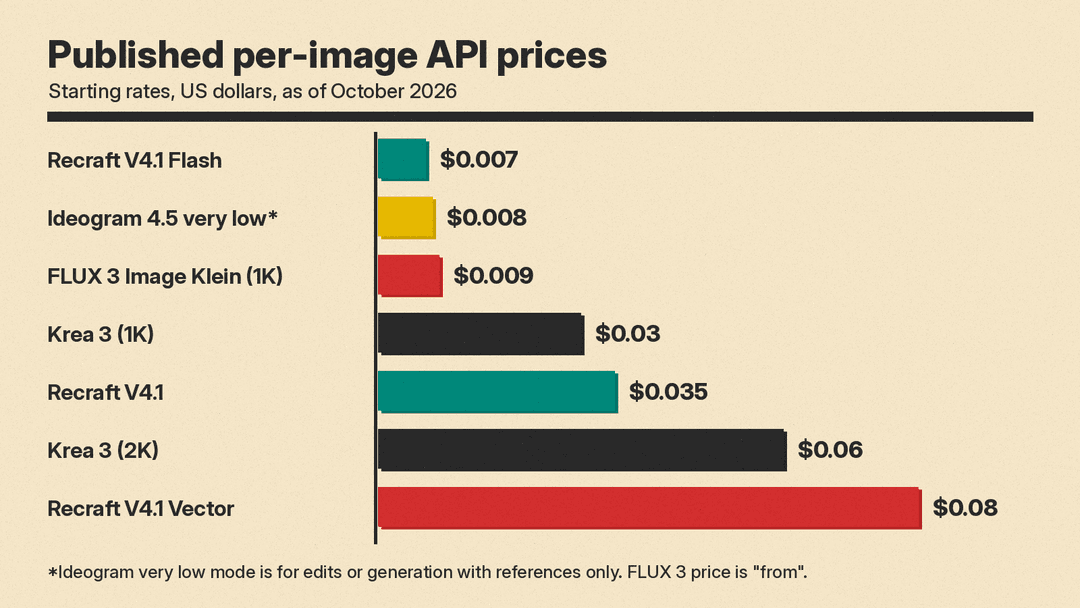
Vendors price image generation in different units, which makes direct comparison hard. Some charge a flat rate per image (Ideogram, Recraft, Krea). Some charge per token (OpenAI). Midjourney measures jobs in GPU time. Where a vendor publishes a per-image API price, we list it. Where it does not, we say so instead of estimating.
1. ChatGPT Images 2.5 and GPT Image 2.5 (OpenAI)
OpenAI announced ChatGPT Images 2.5 on September 8, 2026. The company says it produces more natural lighting, holds on to subjects from reference photos better, follows edit instructions more reliably over several turns, and cuts generation latency by up to 50% compared with Images 2.0. OpenAI also says people create more than 3 billion images a week across ChatGPT Images and its API models.
In ChatGPT, the release added Sketch (draw a rough reference directly in the chat), templates for formats like flyers and product photos, and comments you can pin on an image to target an edit.
For developers there are two API models. According to OpenAI's image generation guide, gpt-image-2.5-flare is for fast everyday generation and gpt-image-2.5-sunburst is for work where editing precision matters most. OpenAI's prompting guide describes Flare as the small model with quality comparable to GPT Image 2, and Sunburst as the base model with higher quality than GPT Image 2. Both support transparent backgrounds. The Sunburst model page lists token pricing of $8 per million image input tokens and $30 per million image output tokens, the same token rates as GPT Image 2. OpenAI does not publish a flat per-image price.
Pick it if you want one tool that handles chat-driven edits well and you or your team already use ChatGPT.
2. Nano Banana 2.1 and Nano Banana Pro (Google)
Nano Banana is Google's name for Gemini's native image generation. The Gemini API docs list several models. The newest, Nano Banana 2.1 (gemini-nano-banana-2.1), is described as the main high-efficiency model, with improved visual quality, text rendering and multi-turn consistency at 1K, 2K and 4K output. It accepts up to 14 reference images, can ground results in Google Web and Image Search, and has configurable thinking levels. Its model card is dated October 6, 2026, and says the model is based on Gemini 3.6 Flash. For ranks and API prices side by side, see our GPT Image 2.5 vs Nano Banana 2.1 comparison.
Nano Banana Pro (gemini-3-pro-image) remains Google's premium option, which the docs describe as having the highest world knowledge, localization and brand consistency. Google's model card is candid about limits: small text can be blurry at 1K, character consistency is not always perfect, and left and right can get confused. All Gemini images carry a SynthID watermark.
Pick it if your images need accurate real-world detail, legible text in several languages, or diagrams and infographics.
3. Midjourney V8.2
Midjourney's version docs list V8.2 as the current default, released July 24, 2026. Midjourney says V8.2 focuses on aesthetics, image quality and Personalization, and that it introduces a new Edit Model that replaces Omni Reference, Character Reference and the Retexture tool.
Midjourney's docs say V8.1 standard jobs render about 4 to 5 times faster than earlier versions. When V8.1 became the default in June, Midjourney said images appear in about 4 seconds in standard mode and 12 seconds in HD, and that HD renders at twice the size of V7 images. HD produces native 2K images without upscaling. Midjourney does not list a per-image price in these docs; it measures jobs in GPU minutes (V8.1 HD costs 1.3 minutes, standard costs 0.8 minutes).
Pick it if the look of the image matters more than exact instruction following, and you want style references, moodboards and Personalization profiles that learn your taste.
4. Ideogram 4.5
Ideogram says it has always led on typography and text rendering. Ideogram 4.5, released September 30, 2026, is pitched as an editing model. Ideogram's claim is that other models add artifacts, pixel shifts and color changes with each edit, while 4.5 keeps an image clean across many edits. Its Precise Edit endpoint copies untouched pixels exactly and returns the image at its original size, according to the API overview.
Pricing is per image at native 2K, across four quality modes: $0.008 (very low, references or edits only), $0.03 (low), $0.06 (medium), and $0.10 for high-quality prompt-only generation or $0.22 for high-quality generation with references or edits. Ideogram says the price does not change with prompt length, reference count or resolution. The company has said open weights are coming but has not released them.
Pick it if you design posters, packaging or social graphics with real text, or you need to change one thing at a time without the rest of the image drifting.
5. Recraft V4.1
Recraft V4.1, released May 14, 2026, has Vector models that output vectors you can reshape and recolor, according to Recraft. That matters for logos and icons, because a raster image of a logo still has to be redrawn before it can go on a sign or a business card.
Recraft publishes per-image API prices for nine variants. The main V4.1 model costs $0.035, V4.1 Pro costs $0.21, V4.1 Vector costs $0.08, V4.1 Vector Pro costs $0.30, and V4.1 Flash costs $0.007. Utility versions, which Recraft recommends for flat lighting, mockups and product listings, cost the same as their non-Utility counterparts. Recraft says all versions can be tested on every plan, including Free.
Pick it if you are making a logo, icon set or illustration that must end up as a vector.
6. FLUX 3 Image Klein (Black Forest Labs)
FLUX 3 Image Klein, released October 15, 2026, is a 5.6B-parameter open-weights model for text-to-image, editing and multi-reference generation with up to 10 reference images. It supports native 4K output and bounding boxes that control where elements are placed or confine an edit to one area.
Black Forest Labs says that in its internal evaluations Klein ranks first among the open models it compared, ahead of larger models, and rates above two closed models in the comparison, Ideogram V4.5 and FLUX.2 [pro]. Those are the company's own numbers. The practical draw is hardware: the generator weights take 11.2 GB in BF16 and 5.6 GB in FP8, and the INT8 build runs on NVIDIA GeForce RTX cards with as little as 8 GB of VRAM. BFL says the distilled model makes a 1MP image in about 4 seconds on an RTX 5090 and under 9 seconds on an RTX 4070. Hugging Face's Diffusers announcement shows how to run it in a few lines of Python. For the older generation of open models, see our comparison of FLUX.1, Stable Diffusion 3.5, PixArt-Sigma and Sana.
Through the BFL API, pricing starts at $0.009 per 1K image. The weights use the FLUX Kommunity License, which allows free commercial use for individuals and companies with annual revenue under $5M. Larger companies need a self-hosted license or the API.
Pick it if you want to run image generation on your own GPU, fine-tune a style with LoRA, or keep images off third-party servers.
7. Krea 3
Krea 3, also released October 15, is an editing model built for volume. Krea says most edits come back in under 8 seconds at native 2K, that it takes up to 6 reference images per edit, and that it leaves alone what you did not ask it to change, such as a product label. It costs $0.06 per image at 2K and $0.03 at 1K. Krea also publishes its own comparison of 100,000 edits a month at list price: $6,000 for Krea 3, $13,500 for Nano Banana Pro and $22,000 for GPT Image 2. Those competitor figures are Krea's.
It is available on krea.ai and through fal, Together AI, OpenRouter and Replicate, among others.
Pick it if you run e-commerce or ad campaigns and need many consistent variants of the same product or person.
8. Adobe Firefly
Firefly is less a single model than a workspace. Alongside Adobe's own models, its help docs list partner models from FLUX, Gemini, GPT Image, Imagen, Ideogram and Runway, plus tools for generative fill, background removal, vector generation and custom models trained on your brand. Firefly asks you to confirm when you switch to a model not built by Adobe.
Pick it if your work already moves through Photoshop, Illustrator or Adobe Express, and you want several models behind one login.
9. xAI Imagine Image 2.0
xAI's Imagine Image 2.0 is the Quality Mode on grok.com/imagine and in the Grok iOS and Android apps, and it is in the API as grok-imagine-image-2.0. xAI emphasizes typography and layout, region editing with a magic wand tool, segmentation, background removal and multi-reference editing with up to 5 input images. It also ships templates for tasks such as product shots, headshots, icons and game assets. xAI says the model ranked second on Arena's text-to-image and image edit leaderboards as of August 7, 2026.
Pick it if you already use Grok and want design templates and transparent-background exports in the same app.
10. Microsoft MAI-Image-2.6
Microsoft's MAI-Image-2.6 and MAI-Image-2.6-Flash are available through Vercel's AI Gateway, according to Vercel's October 13 changelog. Both handle photorealistic images, text rendering and targeted edits, with up to five reference images and output up to 1536 by 1536. The standard model is meant for final assets and Flash for faster, cheaper iteration.
Pick it if you are a developer who wants another option behind a single gateway API key.
How to choose
Start with the output you need, not the model with the most buzz. Whatever you pick, a clear prompt matters more than the tool; our beginner's guide to writing better AI prompts covers the basics.
- A logo. Generate concepts anywhere, but finish in Recraft V4.1 Vector or a vector editor. A raster logo is a sketch, not a deliverable.
- A poster or ad with words. Test Ideogram 4.5, Nano Banana 2.1 and GPT Image 2.5 with the same prompt and exact copy in quotes. Check spelling at full size.
- Mood, style and concept art. Midjourney V8.2 is still the reference point for taste-driven work.
- Product catalogs. Price matters at volume. Krea 3, Ideogram 4.5 and Recraft V4.1 Utility publish flat per-image rates you can budget against.
- Private or local work. FLUX 3 Image Klein runs on a consumer GPU. Read the license if your company earns over $5M a year.
What is coming next
Two things to watch. First, three unannounced OpenAI model IDs, aurora-red-alpha, aurora-green-alpha and aurora-blue-alpha, appeared in OpenAI's API model list on October 17, according to CellCog, and TestingCatalog and LuminaBench report the same names generating images in Arena tests. OpenAI has not commented, and there are no docs or prices. Some observers guess these are a GPT Image 3 test, but that is unconfirmed. Second, Ideogram has said 4.5 open weights are coming, with no date.
We will update this guide when either ships. If you also make moving images, see our guide to the best AI video generators.
Sources
- OpenAI: Introducing ChatGPT Images 2.5
- OpenAI API: Image generation guide
- OpenAI API: Image prompting guide
- OpenAI API: GPT-Image-2.5 Sunburst model page
- Google: Nano Banana image generation docs
- Google: Gemini Nano Banana 2.1 model page
- Google DeepMind: Nano Banana 2.1 model card
- Midjourney: Version docs
- Midjourney: V8.1 is now the default model
- Ideogram: Ideogram 4.5
- Ideogram: API overview
- Recraft: Recraft V4.1
- Black Forest Labs: FLUX 3 Image Klein
- Hugging Face: Welcome FLUX.3 Image Klein in Diffusers
- Krea: Introducing Krea 3
- Adobe: Generate images using partner models in Firefly
- xAI: Imagine Image 2.0
- Vercel: MAI-Image-2.6 and MAI-Image-2.6-Flash on AI Gateway
- CellCog: OpenAI Aurora models
- TestingCatalog: OpenAI testing new Aurora GPT-Image model on Arena
- LuminaBench: Three new GPT image models surface in arena testing
