

The AI video market looks different than it did a year ago. OpenAI's Sora, which OpenAI relaunched as Sora 2 in September 2025, is gone: the Sora app and website were discontinued on April 26, 2026, and the Sora 2 models and Videos API were removed from OpenAI's API on September 24, 2026. Meanwhile, three models now generate 30 seconds of video in a single pass, many of the newest models generate synchronized audio, and the newest releases compete on control (reference images, keyframes, voice references) rather than on raw clip quality.
This guide covers the AI video generators worth knowing as of October 2026. Every spec and price below comes from the vendor's own page, linked inline. We did not run our own quality benchmark, so the tools are grouped by what they are built for, not ranked by a score.
Quick picks
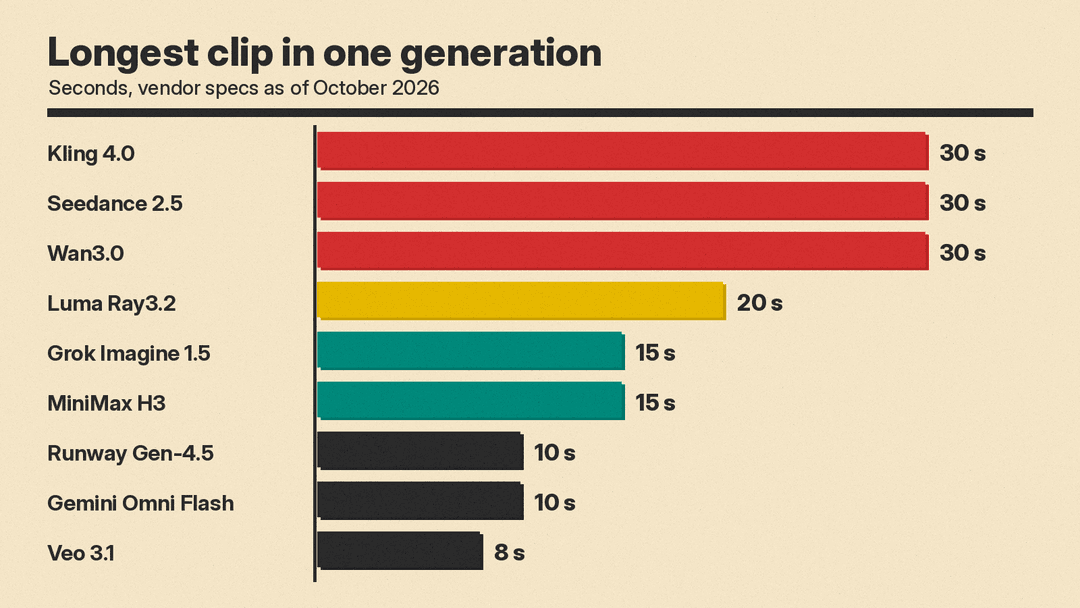
- Longest single clips: Kling 4.0, Seedance 2.5, and Wan3.0, each up to 30 seconds per generation.
- Editing video by conversation: Gemini Omni Flash in the Gemini app, Google Flow, and YouTube Shorts.
- Professional post-production pipelines: Runway Gen-4.5 with HDR delivery formats, and Luma Ray3.2 with 16-bit EXR export.
- Cheapest API per second: Grok Imagine Video 1.5 Lite at $0.02 per second at 480p.
- Open weights you can run yourself: MiniMax H3. For real-time game-engine rendering, see VAST EdenLive.
Kling 4.0 (Kuaishou)
Kuaishou launched Kling 4.0 on October 15, making it the newest major model on this list. Its headline number is native generation of up to 30 seconds in one pass. Its Omni Reference system accepts up to 15 references in a single task (up to 10 images, 5 videos, and 7 subjects), plus up to 10 keyframes to pin specific moments. Prompts can run to 8,000 tokens.
Kuaishou says Kling 4.0 outputs up to 10-bit HDR and "will also support" 4K, 1080p, and 21:9 ultrawide, so check the app for which of those are live on your account. Video extension of up to two minutes is described as coming soon. The model is available through Kling MCP and a CLI for agent workflows, while API access for enterprises and developers is listed as coming soon.
Best for: action scenes, complex camera moves, and long takes where you want one continuous shot rather than stitched clips.
Seedance 2.5 (ByteDance)
ByteDance's Seed team launched Seedance 2.5 on July 31, 2026. It generates video and audio together, up to 30 seconds per generation, and supports multiple rounds of extension (the product page says you can extend twice). Its reference limits are the most generous here: up to 30 images, 10 video clips, and 10 audio clips in one pass. It also offers timestamp-level editing, green-screen editing, and "white-model" (clay render) control for blocking out scenes.
At launch it rolled out on ByteDance's Jimeng AI and Doubao Pro, with API access announced as coming soon via BytePlus ModelArk.
Best for: multi-shot storytelling and projects with many reference assets, such as a character sheet, a location, and a voice.
Wan3.0 (Alibaba)
Alibaba Cloud made Wan3.0 generally available on August 24, 2026. It also generates up to 30 seconds natively, up from a 2 to 15 second window on Wan2.7. Its unusual feature is document input: besides text, images, audio, and video, it accepts DOC, XLS, PPT, PDF, TXT, KEY, Pages, Numbers, and Markdown files as references, so a product deck or a brief can be the starting point for a video.
Wan3.0 has the clearest public pricing of the long-clip models. Standard API rates per generated second are $0.05 at 480P, $0.10 at 720P, and $0.20 at 1080P, which Alibaba works out to about $1.50 for a 30-second 480P draft and about $6.00 for a 30-second 1080P final. Alibaba itself says audio texture and on-screen text rendering are "still maturing."
Best for: marketing and training teams turning existing documents into video, and anyone who wants predictable per-second costs.
Gemini Omni Flash and Veo 3.1 (Google)
Google now has two video models, and its developer docs say to use Gemini Omni Flash as the default and Veo 3.1 for specific needs like scene extension or last-frame control.
Gemini Omni Flash, released earlier in 2026, takes any mix of text, images, video, and audio and lets you edit the result through conversation, one instruction at a time ("make the violin invisible," "change the camera angle"). It is available to Google AI Plus, Pro, and Ultra subscribers in the Gemini app and Google Flow, and at no cost in YouTube Shorts and the YouTube Create app. In the API, the current model (gemini-omni-1.1-flash) outputs clips of 3 to 10 seconds at up to 4K and 24 FPS.
Veo 3.1 generates 8-second videos at 720p, 1080p, or 4K with native audio. It supports 16:9 and 9:16, up to three reference images, first-and-last-frame generation, and extension of earlier Veo clips. Fast and Lite variants trade some quality for speed and cost. All Google video output carries the SynthID watermark.
Best for: casual creators already paying for Google AI plans, Shorts creators, and anyone who would rather describe an edit than redo a generation.
Runway Gen-4.5 and Aleph 2.0
Runway's flagship generator is still Gen-4.5, released in December 2025. Clips run 2 to 10 seconds at 720p, cost 12 credits per second, and require a Standard plan or higher. Where Runway separates itself is delivery: since August 20, 2026, the Runway API can output Gen-4.5 in HDR10, HLG, 10-bit SDR, ProRes 422 HQ, 16-bit PNG sequences, and OpenEXR, with those formats enabled progressively per account and priced as extra credits per second.
Runway also runs Aleph 2.0 for in-context video editing and hosts other labs' models through one API, including Gemini Omni Flash at 10 credits per second for text-to-video and image-to-video.
Best for: editors and post houses that need footage to drop into a grading or compositing pipeline.
Luma Ray3.2
Luma released Ray3.2 on June 9, 2026, pitching it at studios and agencies. It allows up to 16 keyframes in a single clip, tracks facial performance for up to eight faces at once, generates native HDR with 16-bit EXR export, and produces clips up to 20 seconds at 1080p. A Reframe tool changes aspect ratio or replaces a background after generation. It is also the first time Luma has opened the Ray model's full control surface through an API.
Best for: storyboard-driven work where you need the shot to hit specific beats, and performance transfer from real actors.
Grok Imagine Video 1.5 (xAI)
xAI's Grok Imagine video models are the most transparent on price. grok-imagine-video-1.5 renders native 1080p with lip-synced speech, takes up to 14 reference images and 3 voice references, and can pin the first frame, last frame, and up to 4 frames in between, for clips of 1 to 15 seconds. It costs $0.08 per second at 480p, $0.14 at 720p, and $0.25 at 1080p.
grok-imagine-video-1.5-lite, added October 8, drops references, voices, and keyframes, and reaches 1080p by upscaling from 720p. It costs $0.02 per second at 480p, $0.03 at 720p, and $0.14 at 1080p. It is also available through Vercel's AI Gateway.
Best for: developers generating video at volume, and short dialogue clips that need lip sync.
MiniMax H3 (Hailuo)
MiniMax, the company behind Hailuo, open-sourced its H3 video model on August 3, 2026. H3 generates 4 to 15 seconds of video at 24 FPS with 32 kHz stereo audio and dialogue in 11 languages. It ships as two checkpoints: one for text-to-video and first-and-last-frame generation, and one for references (up to 9 images, 3 video clips, and 3 audio clips). The core transformer has 33B parameters.
The open release has limits. Local inference produces 768p output; the 2K regeneration step and the prompt pre-processing system that MiniMax "strongly" recommends are offered only through its paid API for now. The weights are under the MiniMax H3 Community License, not a standard open-source license. A separate accelerated version, FastH3-Omni, is scheduled to release open weights on October 20, according to launch partner Nuva Lab.
Best for: teams that want to self-host or fine-tune a current-generation model with audio.
Vidu Q4 Preview (Shengshu)
Shengshu Technology launched Vidu Q4 Preview on October 7, aimed at short-drama studios, ad agencies, and social creators. It outputs 4K with 10-bit color, supports reference voices to keep a character's voice consistent, and combines up to 15 reference images. Pricing on Vidu's platform starts at $0.045 per second at 540P and rises to $0.39 per second at 4K, with image-to-video and reference-to-video at 30% off through November 30.
Best for: character-driven short drama where acting and voice consistency matter most.
Pika 2.5
Pika 2.5 handles text-to-video and image-to-video, and its API lists both from $0.04 per second. It is a simpler tool than the others here, aimed at quick social clips through the Pika app.
Best for: fast, low-cost social content.
How to choose
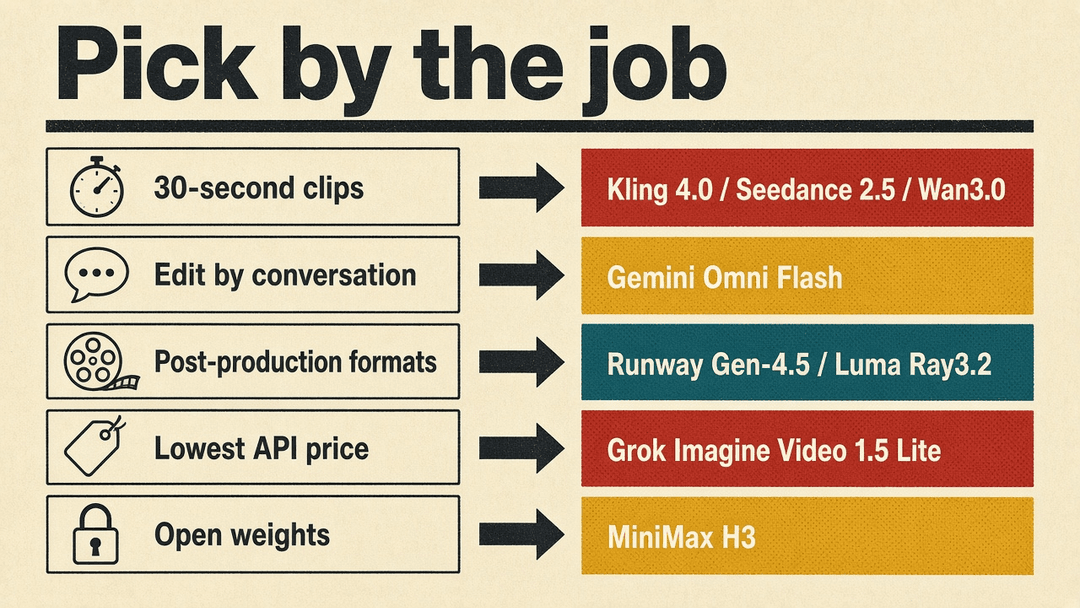
Start with the job, not the leaderboard. A few rules of thumb from the specs above:
- If your shot needs to run longer than 15 seconds without a cut, only Kling 4.0, Seedance 2.5, Wan3.0, and Luma Ray3.2 (20 seconds) generate that natively. Everything else requires extension or stitching.
- If you need the same character across many shots, look at reference limits: Seedance 2.5 (30 images), Kling 4.0 (15 references), Vidu Q4 (15 images), and Grok Imagine 1.5 (14 images) accept the most.
- If you are a developer, published per-second prices make Grok Imagine, Wan3.0, Vidu, and Pika easy to budget. Kling 4.0 and Seedance 2.5 API access was still listed as coming soon in their launch announcements.
- If footage goes to a colorist, Runway's HDR and EXR outputs and Luma's EXR export matter more than an extra few seconds of clip length.
- If you used Sora, export anything you still have from OpenAI's sunset page and pick a replacement based on the above; OpenAI listed no recommended replacement model when it shut down the API.
What to watch
The next shift is clip length beyond 30 seconds. VideoGen, a San Francisco startup, said on October 19 that its Model 1 plans and generates up to ten minutes of video from one prompt, but AI Affairs reported it could not verify the claims and that benchmarks and pricing are not out yet. Platforms are also stitching longer work together with agents: In an OpenAI customer story, Higgsfield CEO Alex Mashrabov says users of his platform can now create videos over 10 minutes long, up from about one minute. Kling's two-minute extension and Seedance's multi-round extension point the same way.
Specs and prices in this guide are as of October 19, 2026. Vendors change both often, so check the linked pages before you commit a budget. For plan and API prices side by side, see our AI video generator pricing comparison.
Sources
- Kuaishou: Kling AI officially launches Kling 4.0
- ByteDance Seed: Introducing Seedance 2.5
- ByteDance Seed: Seedance 2.5 product page
- Alibaba Cloud: Wan3.0 at general availability
- Google: Introducing Gemini Omni
- Google AI for Developers: Video generation in the Gemini API
- Google AI for Developers: Gemini Omni Flash
- Google AI for Developers: Veo 3.1
- Runway Help Center: Creating with Gen-4.5
- Runway API changelog
- Runway model catalog
- Luma: Introducing Ray3.2
- xAI docs: Grok Imagine video overview
- Vercel: Grok Imagine Video 1.5 Lite on AI Gateway
- MiniMax: MiniMax H3 is now open source
- Nuva Lab: FastH3-Omni launch
- Shengshu Technology: Vidu Q4 Preview launch
- Pika API: Pika 2.5 models
- OpenAI Help Center: What to know about the Sora discontinuation
- OpenAI: Sora 2 is here
- OpenAI API deprecations
- AI Affairs: VideoGen unveils Model 1
- OpenAI: Higgsfield takes AI video from 1 minute to over 10
