Generative AI7 articles

Generative AI

Articles

  • Stability AI Secures 6M Series B Backed by Major Music Labels and Electronic Arts

    Stability AI has secured $76 million in a Series B financing round backed by a syndicate of major entertainment and gaming publishers. The investor roster includes the world's three largest record labels—Universal Music Group (UMG), Warner Music Group (WMG), and Sony Music Entertainment—alongside video game publisher Electronic Arts (EA), AMD Ventures, and Pacific Alliance Ventures. The transaction marks a structural evolution for the company behind Stable Diffusion, which has shifted toward bu

    1 min
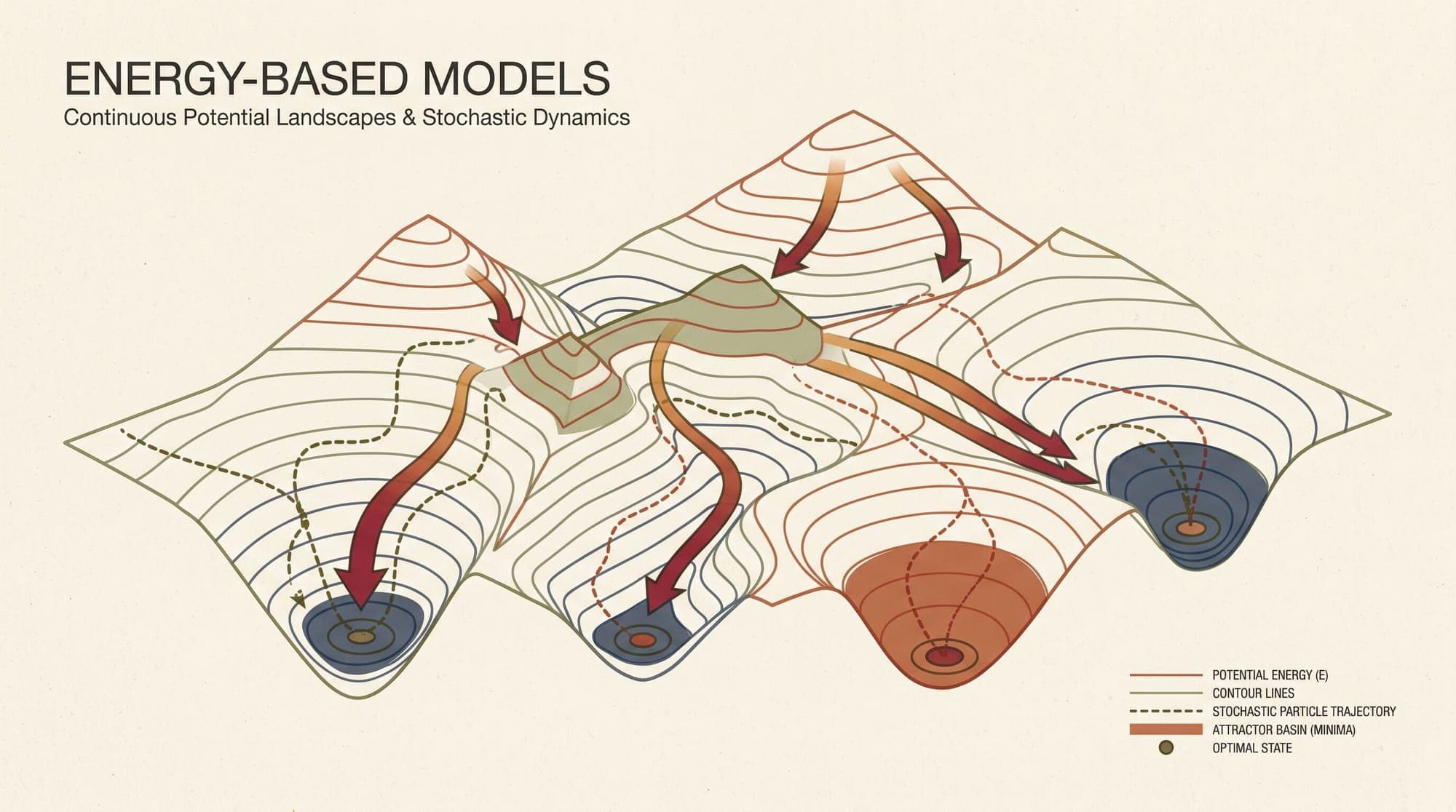
  • Energy-Based Models: How Energy Landscapes, Contrastive Divergence, and Langevin Dynamics Unify Generative Learning

    Energy-Based Models: How Energy Landscapes, Contrastive Divergence, and Langevin Dynamics Unify Generative Learning Probabilistic modeling in machine learning fundamentally centers on estimating data distributions over high-dimensional spaces. Standard generative architectures achieve this by enforcing structural constraints: autoregressive models factorize joint distributions through causal chains, normalizing flows constrain network architectures to invertible bijections with tractable Jacobi

    1 min
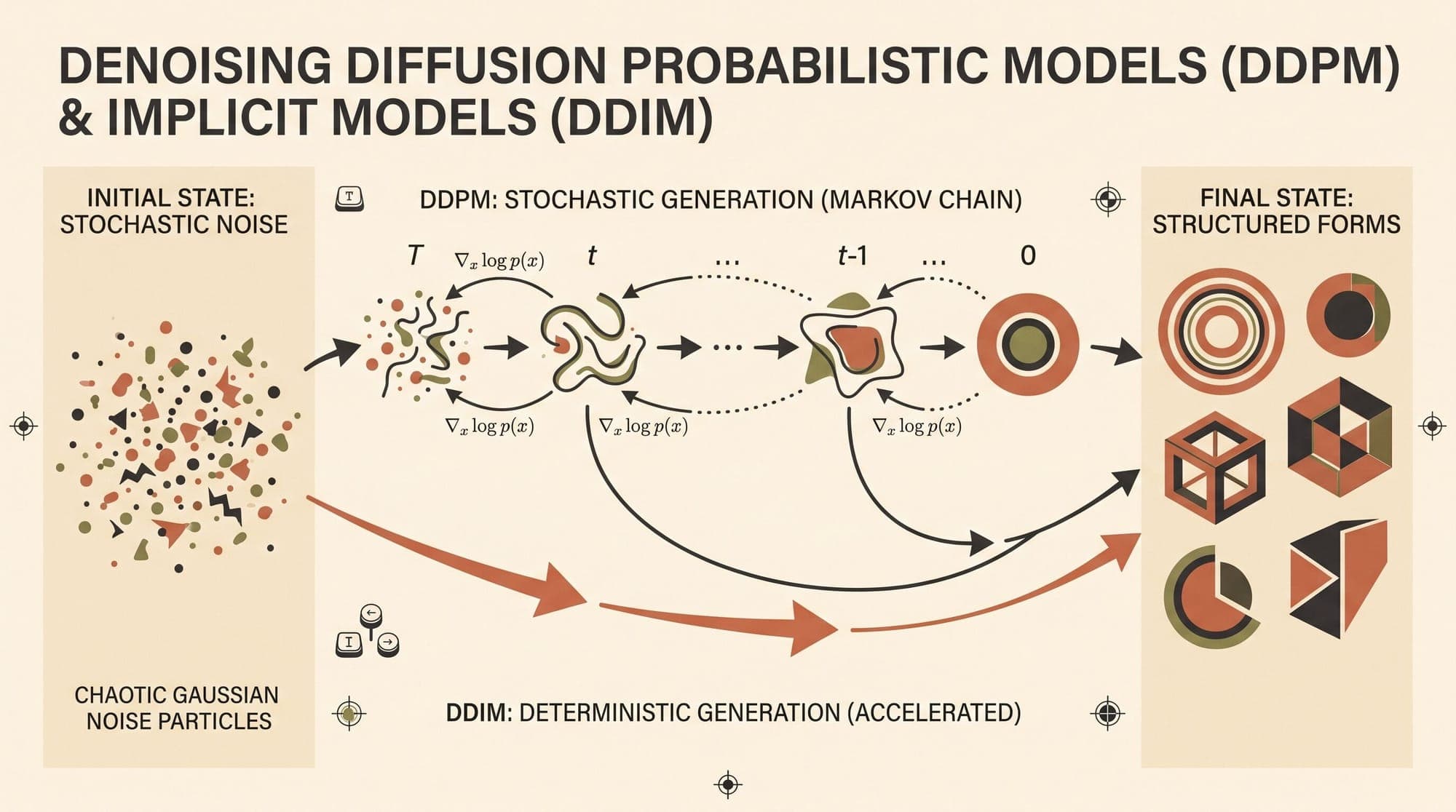
  • Denoising Diffusion Probabilistic Models and DDIM: Mathematical Foundations, Variance Schedules, and Fast Deterministic Sampling

    Generative modeling in continuous state spaces underwent a fundamental transformation with the formulation of Denoising Diffusion Probabilistic Models (DDPM) by Ho et al. (2020), building on the non-equilibrium thermodynamics foundations established by Sohl-Dickstein et al. (2015). Prior to diffusion models, deep generative synthesis was dominated by Generative Adversarial Networks (GANs), which suffered from training instability and mode collapse, and Variational Autoencoders (VAEs), which ofte

    1 min
  • Variational Autoencoders: Mathematical Derivation of the ELBO, the Reparameterization Trick, and Mitigating Posterior Collapse

    Variational Autoencoders: Mathematical Derivation of the ELBO, the Reparameterization Trick, and Mitigating Posterior Collapse Traditional autoencoders map high-dimensional data into deterministic latent vectors. While effective for dimensionality reduction and non-linear feature compression, deterministic autoencoders fail as generative models because their latent representations lack continuous probabilistic structure. Unregularized latent spaces contain wide regions of empty space and severe

    1 min
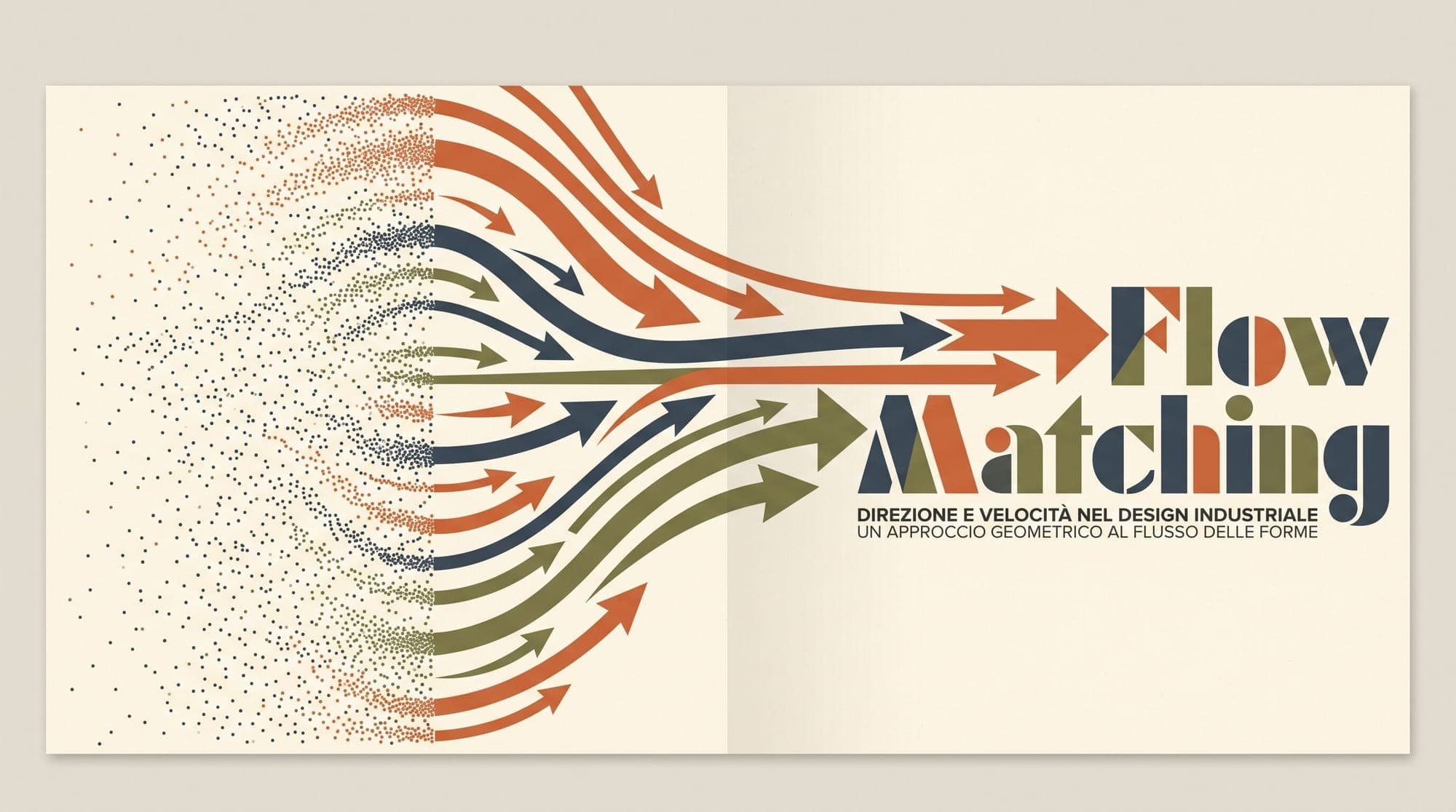
  • Flow Matching for Generative Modeling: How Continuous Normalizing Flows and Optimal Transport Paths Replace Diffusion SDEs

    Flow Matching for Generative Modeling: How Continuous Normalizing Flows and Optimal Transport Paths Replace Diffusion SDEs Generative modeling underwent a structural shift with the introduction of Flow Matching (FM), formulated independently by Lipman et al. (2022), Albergo and Vanden-Eijnden (2022), and Liu et al. (2022). While Denoising Diffusion Probabilistic Models (DDPM) and score-based Stochastic Differential Equations (SDEs) established state-of-the-art sample quality across vision and a

    1 min
  • Score-Based Generative Modeling via Stochastic Differential Equations: How Continuous SDEs and Score Matching Unify Diffusion Models

    Diffusion and score-based models represent one of the foundational paradigms of modern generative artificial intelligence, underpinning systems across image synthesis, video generation, audio modeling, and continuous multimodal representations. For years, generative diffusion was approached from two distinct perspectives: discrete-step denoising diffusion probabilistic models (DDPM) pioneered by Sohl-Dickstein et al. and Ho et al., and score matching with Langevin dynamics (SMLD / NCSN) introduc

    1 min
  • Classifier-Free Guidance: How Score Extrapolation and Implicit Classification Steer Generative Models

    Conditional generative models face an inherent tension between mode coverage and prompt adherence. When a model is trained to maximize data log-likelihood, its learned distribution matches the broad, messy variety of the underlying dataset. In unconditional generation, this diversity is desirable. In conditional generation, however, unconditional priors dilute the prompt: models generate generic, average samples that only weakly align with nuanced text descriptions, spatial layouts, or class lab

    1 min