
Google Labs on November 18, 2026 introduced Stitch Loop, which it calls "a new experiment" and "a long-running product agent that connects to your codebase and live metrics to continuously improve what you've shipped." The agent proposes changes, writes code in a cloud sandbox and opens GitHub pull requests that a person must approve. Access starts with a waitlist that opened the same day.
The announcement, written by Justin Toupin, Director, Product Management, Google Labs, says Stitch Loop comes "As part of a new direction for Stitch." Google says "Millions of designers, developers, and founders already use Stitch to turn ideas into working interfaces in minutes."
What is Stitch Loop?
Per Google's post, Stitch Loop is meant for the work that comes after a feature ships. The post says coding agents help teams ship features fast, "but their job ends the moment your pull request merges." It lists the work that follows: patching vulnerabilities, speeding up checkout, and diagnosing signup drop-offs buried in noisy feedback.
Google says Stitch Loop finds what needs fixing and "keeps working 24/7 on your product until your goals are met." Google labels it a new experiment from Google Labs.
How does Stitch Loop work?
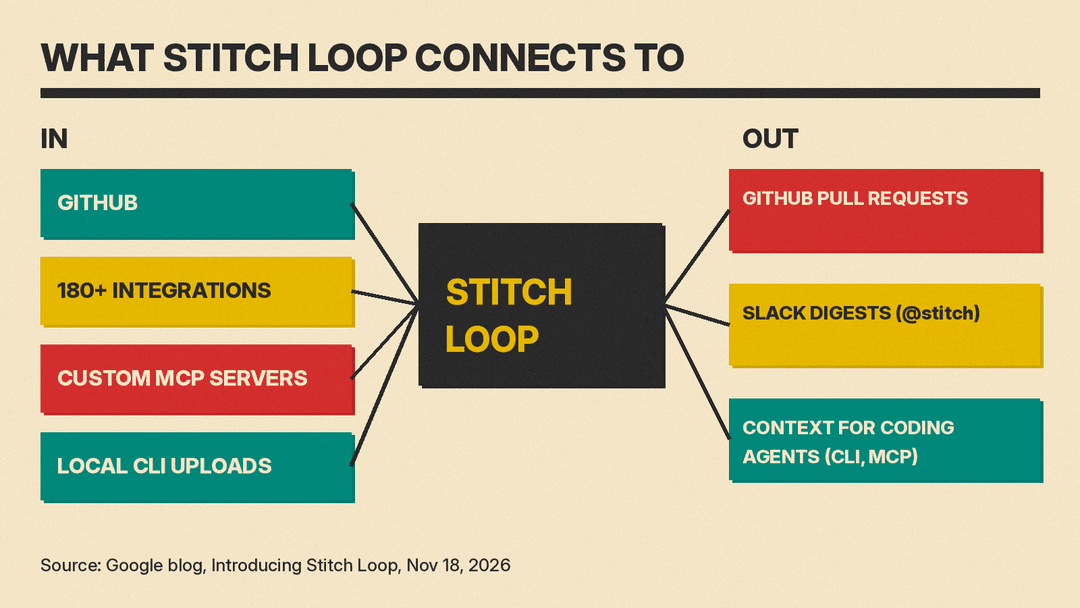
Setup starts with connecting GitHub and your product context, which the post describes as logs, user behavior and feedback. Google says this can come from over 180 integrations, custom MCP servers, or local CLI uploads. (For background on the protocol, see our plain-English guide to MCP.)
Stitch Loop then runs what Google calls evergreen loops, each aimed at a measurable outcome. You get three default loops out of the box and can add your own anytime. Per the post, each loop runs through four steps:
- Suggestions. Stitch Loop surfaces opportunities to make progress toward your goals, grounded in evidence from your product.
- Solutions. Each suggestion comes with one or more solutions, each with tradeoffs and scoping, along with visual design options where applicable.
- Build. Once you choose a direction, Stitch Loop writes the code in an isolated cloud sandbox and opens a GitHub pull request for your approval. When relevant, the PR contains screenshots and videos of the work.
- Reflect. Stitch Loop monitors live product data as it works toward your goal and learns from every positive or negative result. Once the goal is met, it keeps watching in case the metric slips.
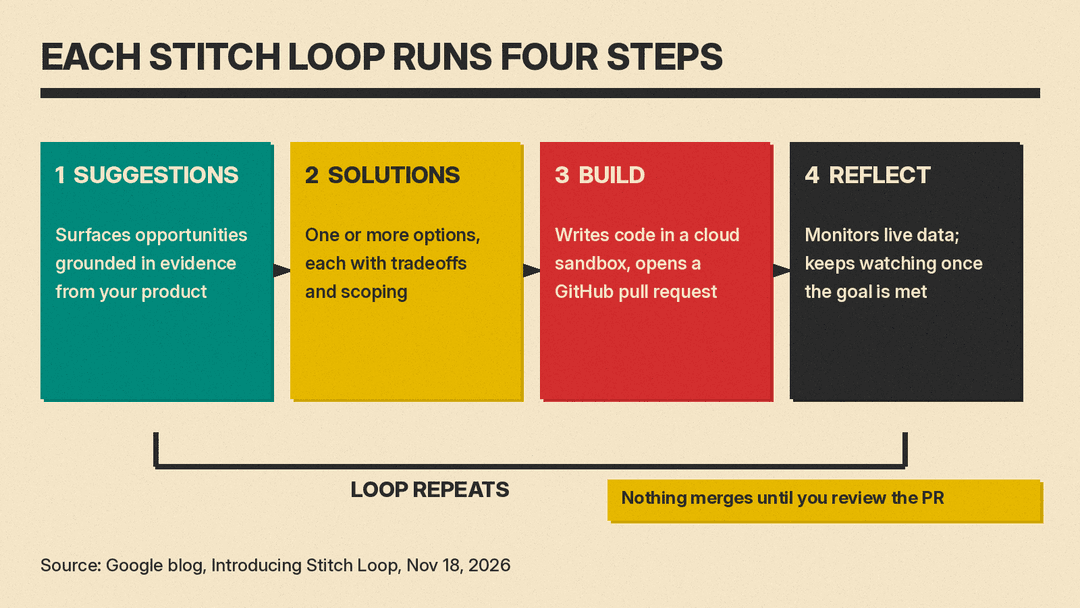
The post is direct about control: "You always have the final call. Nothing merges until you review the PR."
Which loops come built in?
Google says Stitch Loop comes with built-in loops for cybersecurity, latency and accessibility. You can also create custom loops. The example Google gives is improving checkout conversion.
The post describes the security loop in more detail. It pairs Gemini 4 Carbon's cyber security capabilities with CodeMender, which Google describes as "Google DeepMind's autonomous agent that improves code security." Together they scan your codebase for security vulnerabilities. Stitch Loop flags each issue it finds with evidence and opens a PR with a proposed fix for your review.
CodeMender is not new. Google DeepMind introduced it on October 6, 2025 as "a new AI-powered agent that improves code security automatically." In that post, DeepMind said that over the six months it had been building CodeMender, it had upstreamed 72 security fixes to open source projects. It also said that, at the time, all patches generated by CodeMender were reviewed by human researchers before they were submitted upstream.
Does Stitch Loop work with other coding agents?
Yes, according to Google. The post says you can use Stitch Loop "as a service layer for coding agents, like Google Antigravity." Any coding agent you prefer can pull persistent product context from Stitch Loop through the Stitch CLI and MCP, which Google says can power mixed-model setups and fully autonomous improvements in an existing workflow. Antigravity itself recently previewed /swarm multi-agent teams.
Stitch Loop also works in Slack. Per the post, you can mention @stitch to get daily insight digests and to create new loops.
How is it different from a coding agent?
Google draws the line itself. In the post, a coding agent's job ends when a pull request merges, while Stitch Loop is described as continuing to work against product goals and live metrics after code is in production. Both still end in a pull request. Stitch Loop does not merge code on its own; a person reviews each PR.
For a primer on the software that runs agents like these, see our explainer on what an AI agent harness is.
Who can get Stitch Loop, and what does it cost?
Per the post, the Stitch Loop waitlist opens for all users, globally, with eligible Google AI Ultra users getting priority access. You join at stitch.google.com/loop/waitlist, and Google asks for feedback in the Google Labs Discord.
The announcement gives no price for Stitch Loop and no date for access beyond the waitlist. It does not say which programming languages or frameworks are supported.
Sources
- Introducing Stitch Loop: A new way to build and evolve products, Google blog, November 18, 2026
- Stitch Loop waitlist, Google Labs
- Introducing CodeMender: an AI agent for code security, Google DeepMind, October 6, 2025
