
The Trump administration is considering a requirement that US companies publicly disclose their use of Chinese AI models, Reuters reported on November 18, 2026, citing three people. Reuters described the idea as "a bid to discourage reliance on the technology without imposing new restrictions that could anger industry or Beijing." Reuters said it was not clear whether the idea had support inside the administration.
For any business that runs Qwen, Kimi or DeepSeek, the report matters because it points to a new kind of pressure: not a ban, but a public label.
What the proposal would require
According to Reuters, the Treasury Department and the White House Office of Science and Technology Policy (OSTP) have discussed the plan. Companies that use Chinese AI models would be required to post that information on their websites.
Reuters said it was "not immediately clear if the idea was gaining traction within the administration or if it would be enshrined in a formal rulemaking process if it does move forward." Reuters also said the proposal shows officials are looking at ways to discourage use of Chinese AI through a "name and shame" campaign while keeping a broader anti-regulation stance on AI.
The White House, the Treasury Department and Alibaba did not respond to Reuters' requests for comment. The Chinese Embassy in Washington told Reuters that Beijing opposes politicizing trade and tech issues, which will "only stifle global AI advances and serve no one's interests."
Which companies are named
Reuters said the plan would apply to companies such as Airbnb, which uses Qwen, an Alibaba model, to power its AI customer service agent. Under the plan, companies like Airbnb would be required to post that on their websites.
Airbnb told Reuters that its AI activity "runs overwhelmingly on U.S.-origin models" and that it uses "only a limited number of China-origin models, all of which are open-source and run only through approved U.S.-based service providers, keeping data and operations separate and protected."
Reuters also named two companies that a House investigation has already contacted. One is Anysphere, the maker of the Cursor coding tool; Reuters said its Composer 2 model was built on a version of Kimi, from Moonshot AI. The other is DoorDash. Moonshot, DoorDash and SpaceX, which Reuters said bought Anysphere, did not immediately respond to Reuters.
What Congress has already asked companies
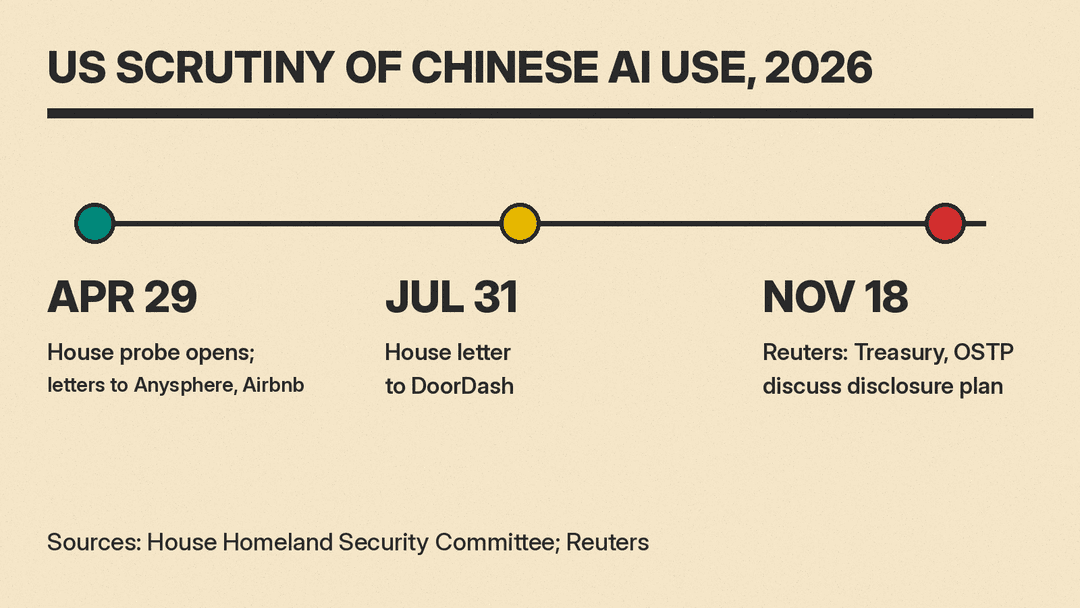
On April 29, 2026, House Homeland Security Committee Chairman Andrew Garbarino and House Select Committee on China Chairman John Moolenaar announced a joint investigation into the national security and cybersecurity risks of PRC-developed AI models, including systems from companies such as DeepSeek, Alibaba, Moonshot AI and MiniMax. The first letters went to Anysphere and Airbnb.
The letter to Airbnb says Airbnb stated publicly that it relies on Qwen over American alternatives because it is "fast and cheap." The committees wrote that they have "serious concerns about the national security and data-security implications of that approach." The letter asked for documents identifying each Chinese AI model that Airbnb has deployed, tested, piloted or is evaluating, the business function it serves, and whether it is accessed via API, self-hosted on Airbnb infrastructure, or run through a third-party inference provider.
On July 31, 2026, the chairmen sent a letter to DoorDash. According to the letter, DoorDash co-founder Andy Fang publicly stated on July 6 that DoorDash routed harder tasks in an internal AI code review system to a US-developed frontier model and lower-level work to Kimi K2.6. The committees asked DoorDash for a complete inventory of PRC-developed models it had evaluated or used since January 1, 2025, by August 14, 2026.
The same press release quotes the letter's view of why companies pick these models. The committees "recognize that U.S. companies, from large technology firms to startups, may evaluate and deploy PRC-developed open-weight models because they can provide competitive capabilities, lower costs, greater customization, and alternatives to reliance on a small number of proprietary model providers."
Moolenaar welcomed the administration's talks. "Disclosure is an important step in managing the potential risks posed by the diffusion of Chinese open-weight models in the United States," he said in a statement to Reuters. Reuters said he noted that risks remain even when US companies run Chinese models on their own infrastructure.
How this fits with earlier US moves
Reuters said Treasury Secretary Scott Bessent stated in July that the administration could sanction Chinese AI companies if they were found guilty of intellectual property theft through distillation of American models. Reuters also said US officials have so far stopped short of restricting or taking punitive action against Chinese AI companies. Federal civilian agencies are a separate case: the Department of Homeland Security has ordered DeepSeek removed from agency IT.
Usage is the backdrop. Reuters said Chinese AI models were the three most popular by token usage in October 2026 on OpenRouter, an AI model marketplace. We covered an earlier OpenRouter ranking of Chinese models in October.
What it would mean for a business
The proposal is still at the discussion stage, so there are no details on which companies, models or uses a rule would cover. The House letters give a sense of what tracking could involve: the model name and version, the developer, the business function, and whether the model runs through an API, on a company's own servers, or through a third-party host.
Airbnb's answer to Reuters also shows one argument a company can make: that open-weight models run on US infrastructure keep data apart from the Chinese developer. Moolenaar's statement shows that some lawmakers do not accept that this removes the risk.
Sources
- Reuters via Yahoo News: Exclusive: Trump administration weighs forcing US firms to disclose Chinese AI use (Nov 18, 2026)
- House Committee on Homeland Security: joint investigation announcement (Apr 29, 2026)
- Committee letter to Airbnb (PDF)
- House Committee on Homeland Security: investigation continues, DoorDash letter (Jul 31, 2026)
- Committee letter to DoorDash (PDF)
