
Artificial intelligence on farms now comes in three distinct forms. There are chat assistants that answer agronomy questions. There are photo and imagery tools that spot crop problems. There are machines and sensors that act directly on the field. The best choice depends on the specific job you need done rather than the technology buzzword. Every vendor claim below is the vendor's own statement, and the list is current as of November 2026.
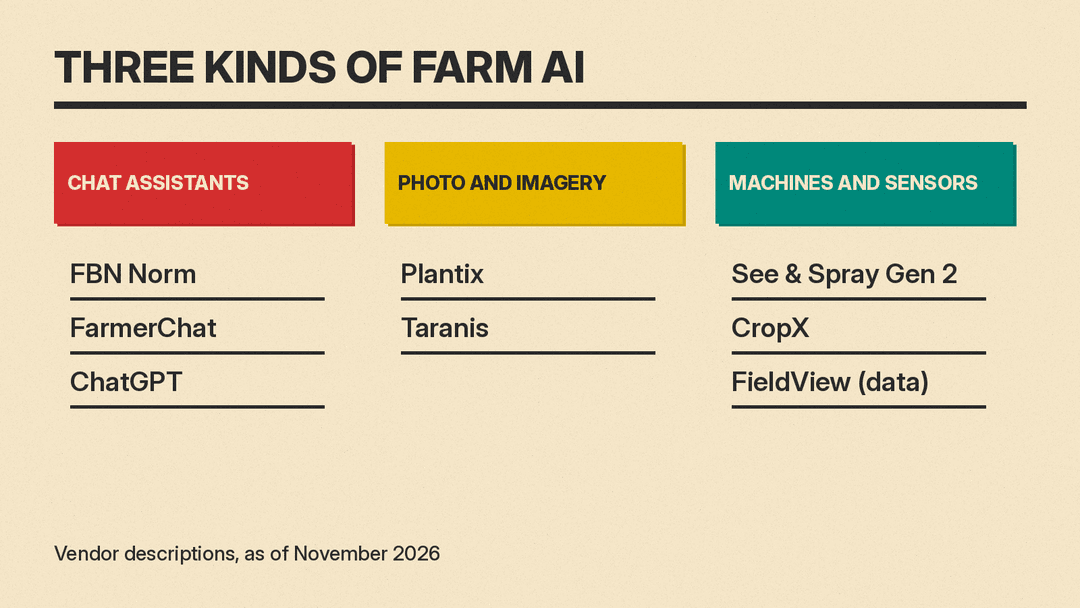
Best AI tools for farmers at a glance
Farmers have many options. Smallholders often need free or low cost advice via phone. Row crop growers may need label verification. Advisors covering large areas need detailed imagery. Those with new equipment might look for automated spraying. Irrigation managers need real time soil data. This guide covers eight real tools across these jobs, each linked to its own site.
FBN Norm: US row crop label checks
FBN Norm is an "AI Advisor" from Farmers Business Network. It answers specific agronomy questions. Example queries include plantback intervals after Enlist One herbicide for non traited soybeans. It also handles tank mix instructions for paraquat products. Norm can create lists such as pesticide modes of action. The page states it knows a lot about crop and animal agriculture. It emphasizes that more context leads to more accurate responses. The page also warns: "Norm can make mistakes. Check important info." This tool suits US row crop growers checking label questions. Good to know: always confirm against the product label.
FarmerChat by Digital Green: Voice and text for smallholders
FarmerChat, from the development organisation Digital Green, describes itself as "your free farming assistant". You can ask by voice, text, or photo. Advice is tuned to local soils, crops, and climate. Digital Green says it works "in any language a farmer speaks". It covers crops, livestock, and weather. Its Google Play listing says it is trusted by farmers across Ethiopia, Kenya, Nigeria, India and more. Digital Green published an open dataset of 1.4M farmer questions and FarmerChat answers on Hugging Face. This tool suits smallholder farmers who need accessible advice.
Plantix: Photo diagnosis for sick crops
Plantix calls itself the "#1 FREE app" for crop diagnosis and treatments. You take a photo of a sick crop and get a diagnosis and treatment suggestions in a few seconds. A community of agri experts answers questions. It includes a library on crop diseases and prevention. Plantix says it has answered more than 150 million crop related questions. Its business arm is Plantix Intelligence which offers API Toolkit, Crop Insights, and Demand Creation. This tool suits small growers and agronomists who want a quick photo check.
Taranis: Leaf level crop intelligence for advisors
Taranis provides AI powered crop intelligence at the leaf level. It is built for advisors such as agronomists and retailers serving growers. Drones collect submillimeter image resolution of every acre. Its imagery covers stand counts, weeds, insect damage, nutrient deficiencies, disease pressure and field health. Taranis says its AI is trained on more than 500 million data points. It offers Ag Assistant which it calls the agriculture industry's first generative AI powered agronomy engine. This is a vendor claim. Taranis Yield Impact estimates yield loss in bushels per acre tied to each detected threat. This tool suits crop advisors and larger operations.
John Deere See & Spray Gen 2: Targeted herbicide application
John Deere See & Spray Gen 2 uses camera vision technology and machine learning. It tells in season crops from weeds and sprays only the weeds. The Australia page says it is factory installed on 400 and 600 Series sprayers. Full boom lighting allows 24 hour targeted application in fallow fields. It can apply real time variable rates from biomass detection. Support comes from the local John Deere dealer. This tool suits those cutting herbicide on row crops with new equipment. Good to know: availability and models differ by country so check your local Deere site and dealer.
CropX: Real time irrigation insights
CropX is called the complete digital agronomy platform. It combines real time soil moisture and temperature data from its sensors. It also uses local weather data, satellite imagery, and machinery integrations. It gives agronomic insights and tailored recommendations based on your field data. Products include irrigation planning, disease control, crop nutrition monitoring, and soil sensors. This tool suits irrigated farms needing precise water management.
Climate FieldView: The data layer for decisions
Climate FieldView is a digital farming platform. It helps collect, connect, and share crop data. Users scout fields, build prescriptions, and analyze yield data. It connects with 60 plus partners. The FieldView site says farmers using its seed scripts saw an average gain of 5 bushels per acre compared with users who wrote their own scripts. Its FieldView Drive 2.0 device syncs field data and sends seed scripts without a thumb drive. FieldView is not a chatbot. Think of it as the data layer that prescriptions and other AI decisions rely on. It suits operations that want a strong data foundation first.
ChatGPT: General office assistance
ChatGPT is a general AI assistant, not a farm product. It is useful for office work. Tasks to try: a first draft of a letter to a landlord or buyer, a plain summary of a long program notice, or a spreadsheet formula for input costs. Good to know: it is not an agronomy source. Verify any rate or chemical advice with labels and your agronomist. This tool suits administrative tasks but not technical crop advice.
How to choose the right tool
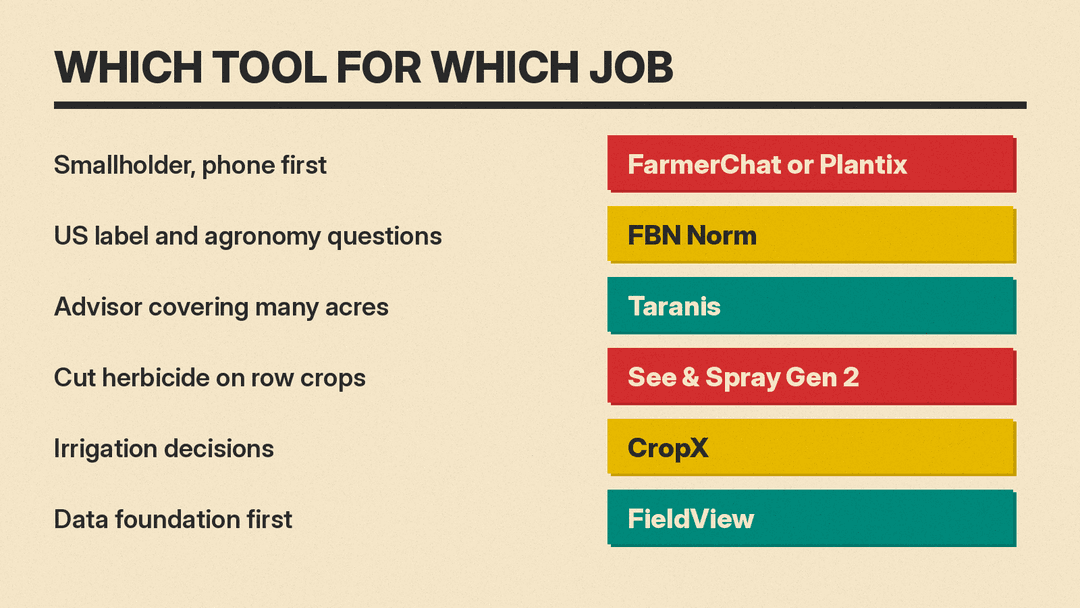
Select the tool based on your primary need. If you are a smallholder or phone first user, try FarmerChat or Plantix. For label and agronomy questions in the US, use FBN Norm. If you are an advisor covering many acres, look at Taranis. To cut herbicide on row crops with new equipment, consider See & Spray. For irrigation management, use CropX. If you need a data layer first, start with FieldView.
Limits to keep in mind
Be aware of the limitations of these technologies. Chat assistants can be wrong as FBN explicitly states. Photo diagnoses depend heavily on image quality. Vendor yield and savings numbers are the vendor's own claims and results vary by operation. Always check pesticide and fertilizer rates against the label and local rules before applying.
