
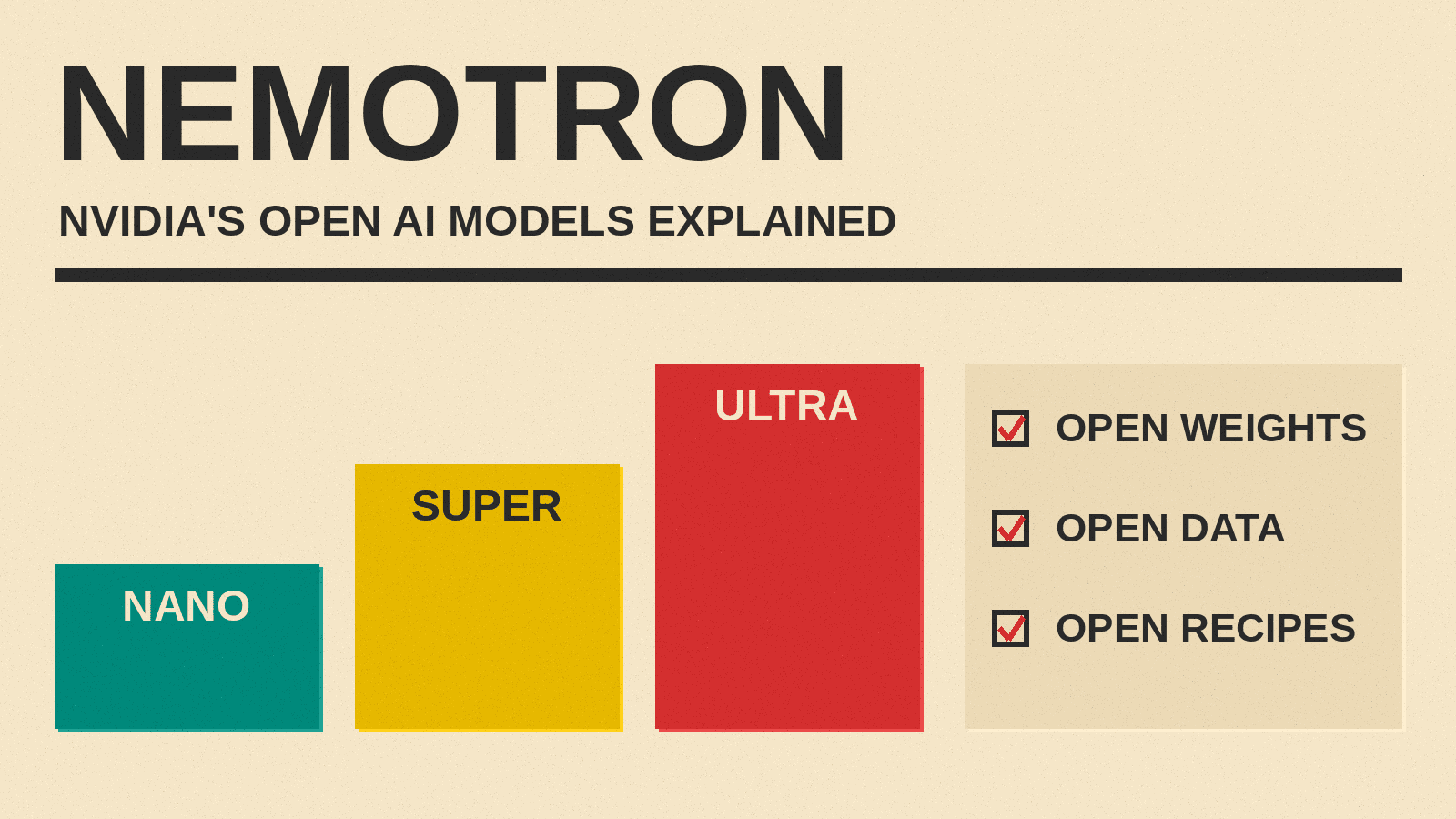
Nemotron is NVIDIA's family of open AI models. NVIDIA is best known for its chips, and Nemotron is the part of the company that publishes models you can download, run on your own hardware and change for your own use.
This guide explains what Nemotron is, how the family is organized, what "open" means here, what the license lets you do, and how to try a Nemotron model yourself. Facts below come from NVIDIA's own announcement, technical blog, GitHub repository, license page and Hugging Face listings, as checked on November 8, 2026.
What Nemotron is, in one paragraph
NVIDIA's Nemotron GitHub repository describes Nemotron as "a family of open, high-efficiency multimodal models purpose-built for agentic AI." An agent is an AI system that carries out multistep tasks, such as calling tools, reading results and deciding what to do next. NVIDIA's pitch is not one chatbot. It is a set of models in different sizes, plus the training data and recipes behind them, so companies and developers can build their own specialized agents.
How NVIDIA describes Nemotron
NVIDIA's Nemotron 3 announcement frames the family around "transparent, efficient and specialized agentic AI development across industries." The same release says NVIDIA released "a collection of state-of-the-art open models, training datasets and reinforcement learning environments and libraries."
So the release is more than trained model weights: NVIDIA also publishes large parts of the data and the training methods. If you want background on the difference between downloadable weights and closed models, see our guide to open-weight versus closed AI models.
The model tiers: Nano, Super, Ultra and more
NVIDIA groups Nemotron models by size. The GitHub repository lists four tiers:
- Nano: "Optimized for edge and PC deployments."
- Lightning: "Fast, high-volume task execution for long-running agents."
- Super: "Single GPU deployment with highest throughput."
- Ultra: "Multi-GPU datacenter applications."
When NVIDIA announced Nemotron 3, it described three sizes:
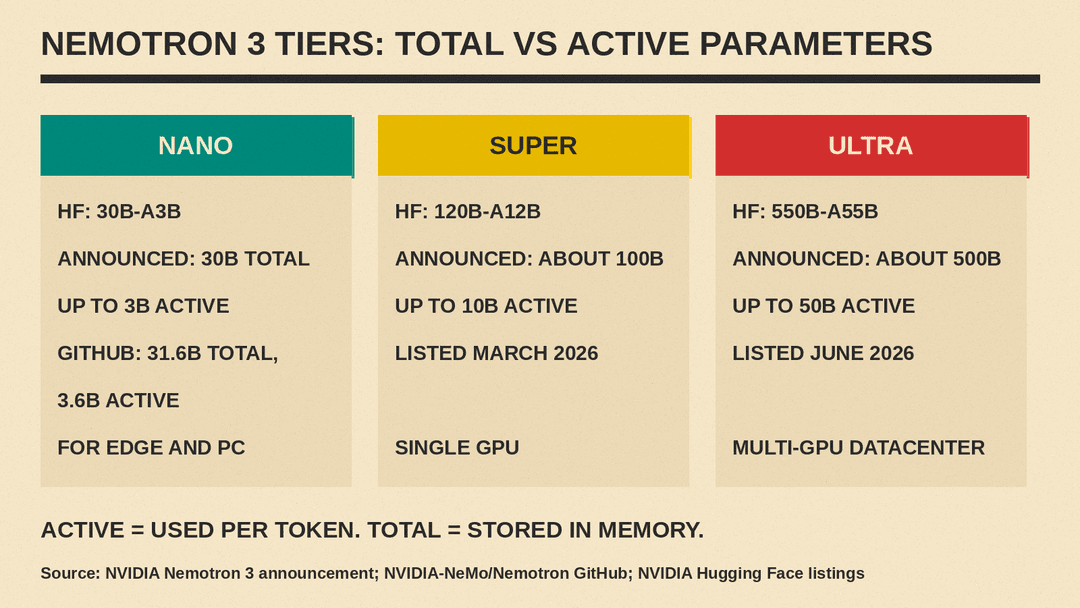
- Nemotron 3 Nano, "a small, 30-billion-parameter model that activates up to 3 billion parameters at a time."
- Nemotron 3 Super, with "approximately 100 billion parameters and up to 10 billion active per token."
- Nemotron 3 Ultra, with "about 500 billion parameters and up to 50 billion active per token."
The model listings on Hugging Face use slightly different numbers in their names. As of November 8, 2026, NVIDIA's Hugging Face page lists Nemotron 3 Super 120B-A12B and Nemotron 3 Ultra 550B-A55B. For Nano, the repository name Nemotron 3 Nano 30B-A3B matches the announcement's 30 billion total and 3 billion active, so the names read as total parameters followed by active parameters. The announcement figures were approximate and came before Super and Ultra were published. The Hugging Face repositories for Super and Ultra appeared later, in March and June 2026. The GitHub repository gives a more exact Nano figure: "31.6B total parameters, 3.6B active per forward pass."
Nemotron 3 is no longer the newest generation. NVIDIA has since released Nemotron 3.5 models. Nemotron 3.5 Lightning, a 30B-A3B model that the GitHub repository says is "built for the high-volume execution layer of long-running agents," has an NVIDIA release blog dated August 11, 2026. Nemotron 3.5 Super VL, a 120B-A12B vision-language model the repository describes as "built for multimodal agentic reasoning over text, images, and video," followed on October 15, 2026, alongside Nemotron 3.5 Bolt, a model line for local agents on PCs. We covered Lightning, Super VL and Bolt when they shipped.
As of November 8, 2026, NVIDIA's Hugging Face page lists no Nemotron 3.5 Nano or Ultra model, so Nemotron 3 Nano and Nemotron 3 Ultra are still the newest models in those two tiers.
Parameters are the numbers inside a model that were set during training. More parameters usually means more capability, but also more memory and compute. Our guide on how much memory you need to run an AI model locally explains how those numbers turn into hardware requirements.
What "active" parameters mean
Nemotron 3 models are mixture-of-experts (MoE) models. In an MoE model, only part of the network does work for each token, the small piece of text the model reads or writes. That is why NVIDIA quotes two numbers: the total size, and how many parameters are active at once.
A model with 30 billion parameters but only about 3 billion active can respond faster and cheaper than a dense 30 billion parameter model, because it does less math per token. It still has to store all 30 billion parameters in memory. Our explainer on mixture of experts models covers this in more detail.
The hybrid Mamba-Transformer design
Most large language models use a design called the Transformer. NVIDIA's technical blog on Nemotron 3 says the family uses "a hybrid Mamba-Transformer mixture-of-experts (MoE) architecture." Mamba is a different kind of layer that processes long sequences efficiently. Mixing the two is NVIDIA's way of keeping quality while lowering cost on long inputs.
NVIDIA ties that design to long context. The technical blog mentions "a native 1M-token context window," and the announcement says Nemotron 3 Nano has "a 1-million-token context window." A context window is how much text a model can read at once.
NVIDIA also makes speed claims for Nano. Its announcement says Nemotron 3 Nano reaches "up to 4x higher token throughput compared with Nemotron 2 Nano and reduces reasoning-token generation by up to 60%." Those are NVIDIA's own figures, not independent tests.
What NVIDIA opens beyond the weights
NVIDIA's technical blog lists several open datasets released with Nemotron 3:
- Nemotron-pretraining: a "3-trillion-token dataset with richer coverage of code, math, and reasoning."
- Nemotron-post-training 3.0: a "13-million-sample corpus for supervised fine-tuning and reinforcement learning."
- Nemotron-RL datasets: RL datasets and environments "for tool-use, planning, and multi-step reasoning."
- Nemotron agentic safety dataset: "nearly 11-thousand AI agent workflow traces" for studying safety and security risks in agents.
The same blog says NVIDIA's synthetic pretraining corpus, nearly 10 trillion tokens, "can be inspected or repurposed," and that training recipes are in the GitHub repository. It also names open libraries for building and testing models: NeMo Gym, RL, Data Designer and Evaluator.
There is a limit worth knowing. The GitHub repository says its Nano recipes "train exclusively on the open-sourced subset of training data," and that "results will differ from the tech report benchmarks, which used additional proprietary data." So you can follow NVIDIA's method, but you cannot fully rebuild the exact released model from public data alone.
The license: what you can and cannot do
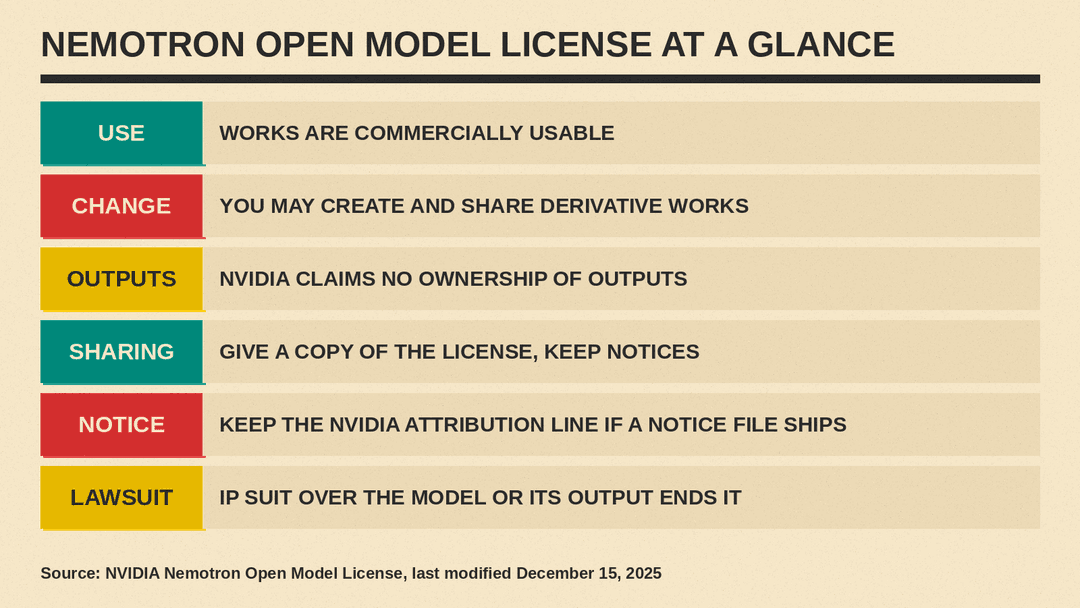
NVIDIA's technical blog says the Nemotron 3 weights are released under "the NVIDIA Open Model License." The license page for Nemotron is titled the NVIDIA Nemotron Open Model License, last modified December 15, 2025. Always check the model card of the exact model you download, because the license varies by model and dataset.
The Nemotron license page says three things up front:
- "Works are commercially usable."
- "You are free to create and distribute Derivative Works."
- "NVIDIA does not claim ownership to any outputs generated using the Works or Derivative Works."
It grants a "perpetual, worldwide, non-exclusive, no-charge, royalty-free, irrevocable license." There are conditions:
- If you redistribute the model or a modified version, you must give recipients a copy of the license and keep NVIDIA's copyright, patent, trademark and attribution notices.
- If the model ships with a NOTICE file, your copies must include the line "Licensed by NVIDIA Corporation under the NVIDIA Nemotron Model License."
- If you sue anyone claiming the model or its output infringes a patent or copyright, your license for that model ends on the day you file.
This is NVIDIA's own license, not a standard one like Apache 2.0. Read the full text before you build a product on it.
Newer models use a different license. As of November 8, 2026, the Hugging Face model cards for Nemotron 3 Nano and Nemotron 3 Super name the NVIDIA Nemotron Open Model License, but the cards for Nemotron 3 Ultra and the Nemotron 3.5 models, including Lightning, Super VL, Bolt and Transcribe, name OpenMDW-1.1. That license grants permission "free of charge, to deal in the Model Materials without restriction." Its conditions are similar: keep a copy of the agreement and the notices when you redistribute, and your rights end if you sue claiming the model infringes a patent or copyright. It places no restrictions on outputs.
Beyond chat models
Nemotron is not only text chat. As of November 8, 2026, NVIDIA's Hugging Face listings include several other kinds of models under the Nemotron name:
- Multimodal models: the GitHub repository describes Nemotron 3 Nano Omni as a model "with native text, image, video, and audio support."
- Speech: models such as Nemotron 3.5 Transcribe. We covered it in our post on Nemotron 3.5 Transcribe and Granary v2.
- Search helpers: embedding and reranking models, such as Nemotron 3 Embed and Nemotron 3.5 Rerank, which help apps find the right documents.
- Safety: a content safety model, Nemotron 3.5 Content Safety.
Some earlier Nemotron models carry Meta's Llama name, such as Llama 3.1 Nemotron Nano VL 8B. For more on Meta's family, see our explainer What Is Llama?
What Nemotron is good at
The GitHub repository says Nemotron models "excel at coding, math, scientific reasoning, tool calling, instruction following, and visual reasoning." NVIDIA's announcement suggests Nano for "software debugging, content summarization, AI assistant workflows and information retrieval at low inference costs." The Nemotron research page says Super "is optimized for collaborative agents and high-volume workloads such as IT ticket automation."
These are NVIDIA's descriptions. If you plan to rely on a model for real work, test it on your own tasks first.
How to try a Nemotron model
You have three common options.
- Download from Hugging Face. NVIDIA's models are at huggingface.co/nvidia. Many come in several file formats. You will see BF16 (full precision), FP8 and NVFP4 (smaller, compressed versions) and, for some models, GGUF files for local apps. Our guide to GGUF vs Safetensors explains the file types.
- Run it locally. GGUF versions can work in local apps. Our step-by-step guide on how to run a Hugging Face model in Ollama or LM Studio walks through it. Check the memory needs first: even Nano has about 30 billion total parameters.
- Use server software. The GitHub repository says you can deploy Nemotron "with support for NeMo, TensorRT-LLM, vLLM, SGLang, and NIM microservices." This is the route for teams running models on their own GPUs or in the cloud.
NVIDIA's technical blog says Nemotron 3 Nano is "specifically designed for DGX Spark, H100, and B200 GPUs." It can run on other hardware, but NVIDIA tunes it for its own chips.
Nemotron vs other open model families
Compared with other open-weight families we have explained, such as Llama, Gemma and Qwen, Nemotron has three distinguishing traits, based on NVIDIA's materials:
- It focuses on agents, efficiency and long context, rather than a general consumer chatbot.
- It releases large parts of its training data, recipes and libraries, not only the weights.
- It is built by the company that makes the hardware, and tuned for NVIDIA GPUs.
The bottom line
Nemotron is NVIDIA's family of open models, data and tools for building AI agents. It comes in tiers from small Nano models for PCs to large Ultra models for data centers. The Nemotron 3 models use a hybrid Mamba-Transformer mixture-of-experts design with long context. Nemotron 3.5 is the newest generation, led by Lightning and Super VL. The weights are commercially usable under NVIDIA's own license or OpenMDW-1.1, depending on the model, and NVIDIA also publishes much of the training data. If you want an open model you can inspect, change and run on your own NVIDIA hardware, Nemotron is worth a look.
Sources
- NVIDIA Newsroom: NVIDIA Debuts Nemotron 3 Family of Open Models
- NVIDIA Technical Blog: Inside NVIDIA Nemotron 3
- NVIDIA Technical Blog: Nemotron 3.5 Lightning
- NVIDIA Technical Blog: Nemotron 3.5 Super VL
- NVIDIA Research: Nemotron 3 Family of Models
- NVIDIA-NeMo/Nemotron on GitHub
- NVIDIA Nemotron Open Model License
- OpenMDW License Agreement, version 1.1
- NVIDIA on Hugging Face
