
Nvidia's newest Nemotron release has three parts, and two of them are built for your own machine. Alongside Nemotron 3.5 Super VL, the 120B enterprise model we covered when it shipped, the company released Nemotron 3.5 Bolt 74B-A9B 24GB and announced a smaller Bolt E4B 4GB. Bolt 74B is a 2-bit open-weight model meant to run local agents on RTX Spark laptops and DGX Spark. This post covers the Bolt side: what the model is, what hardware it needs, and what Nvidia's own numbers say about speed.
What Nvidia released, and when
Nvidia's announcement is dated October 15, 2026. It splits the family by tier:
- Nemotron 3.5 Super VL: 120B parameters, for "specialized always-on agents."
- Nemotron 3.5 Bolt 74B-A9B 24GB: "optimized to balance intelligence and speed per GB for local agentic workloads."
- Nemotron 3.5 Bolt E4B 4GB: "optimized for intelligence per GB for fast conversational agents."
Super VL and Bolt 74B are available now. Nvidia says Bolt E4B comes October 23. In Nvidia's lineup, Super VL and Bolt join Lightning, released in August, and Ultra.
The Hugging Face commit history puts the first commit for the Bolt 74B repository at October 15, 2026, 8:42 AM PT. Its GGUF and BF16 sibling repositories have initial commits from the same minute. TechCrunch reported the launch on October 19. No Bolt E4B repository was on Nvidia's Hugging Face page when we checked on October 19.
All Bolt 74B repositories use the OpenMDW-1.1 license, and the model card says the model "is ready for commercial or non-commercial use."
What Bolt 74B is
The model card lists 74B total parameters with 9B active, a hybrid LatentMoE backbone that mixes Mamba-2 and Transformer layers, with a C-RADIO v4-H vision encoder, and up to 256K tokens of context. It takes text, images and video and returns text. Nvidia lists English and coding languages as primary, with Spanish, French, German, Italian and Japanese also supported.
Bolt was not trained from scratch. Nvidia compressed it from Super VL with Star Elastic, its own architecture search and compression method. The card describes five training stages:
- Compression: Star Elastic cuts the parent from 120B-A12B to 74B-A9B and fixes expert top-K at 9, down from 22, with a target of under 24 GB at batch size 1 and 128K context.
- Vision adaptor training: the parent's vision tower is reattached and only the projection layers are fine-tuned.
- Supervised fine-tuning: vision-heavy SFT, then checkpoint merging.
- Reinforcement learning: RLHF and end-to-end RL on MCP and SWE environments.
- Quantization: all experts go to IQ2_XXS at 2.0625 bits per element, with quantization-aware distillation to recover accuracy. Mamba layers are kept at NVFP4 and the embedding and output layers at Q8_0.
Nvidia's research page gives the reasoning: in its experiments, for a fixed memory budget, compressing a large model to 2 bits beats training a smaller model from scratch and quantizing it to 4 bits.
What it takes to run
There are three main downloads, plus two drafter repositories:
- 24GB (vLLM): the packed model, about 24.1 GB in the repository. The card lists vLLM on Nvidia Ampere (A100), Hopper (H100-80GB) or Blackwell.
- 24GB GGUF (llama.cpp): a 22.02 GB model file plus a 1.73 GB vision projector.
- BF16: full-precision weights, about 150 GB in the repository, which Nvidia says are "intended primarily for customization and post-training rather than direct production inference."
- LiLiCorr and LiLiCorr GGUF: the speculative decoding drafter that the deployment recipes use.
The 2-bit build is the only quantized version Nvidia publishes, and it needs more than its 24 GB file size. The GGUF card gives two llama.cpp recipes:
- 28GB recipe: RTX Spark 64GB or an RTX discrete GPU with 32GB or more. 65,536-token context, one sequence at a time, up to 6 draft tokens, q8_0 KV cache.
- 32GB recipe: RTX Spark 128GB or an RTX discrete GPU with 48GB or more. The full 262,144-token context, one sequence, up to 7 draft tokens.
Nvidia's blog says the model also runs on GeForce RTX PCs, DGX Spark, DGX Station and RTX PRO workstations, with support in llama.cpp, Ollama, LM Studio, Unsloth and vLLM. If you have not run a model locally before, our beginner's guide to Ollama, LM Studio and llama.cpp covers the basics.
How fast it is, by Nvidia's own numbers
Nvidia says Bolt is "faster than most popular dense models while smarter than most popular MoE models with a similar memory footprint." Its own speed table supports both halves of that sentence. It is not the fastest model in the table.
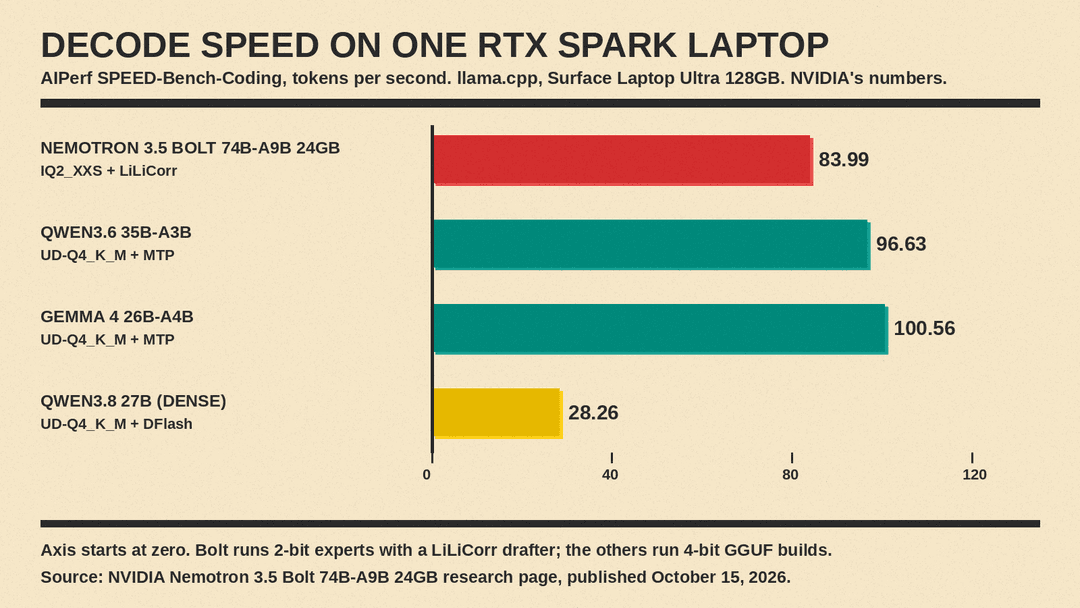
Nvidia ran all four models with llama.cpp on a Surface Laptop Ultra with 128GB, an RTX Spark machine. On AIPerf SPEED-Bench-Coding, Bolt with its LiLiCorr drafter decoded 83.99 tokens per second. That is behind 4-bit builds of Qwen3.6 35B-A3B (96.63) and Gemma 4 26B-A4B (100.56), and ahead of the dense Qwen3.8 27B (28.26). On AA-AgentPerf Local, a replay of agent trajectories, Bolt took 600.80 seconds, against 453.97 for Qwen3.6, 480.68 for Gemma 4 and 1,043.28 for Qwen3.8 27B.
Benchmarks
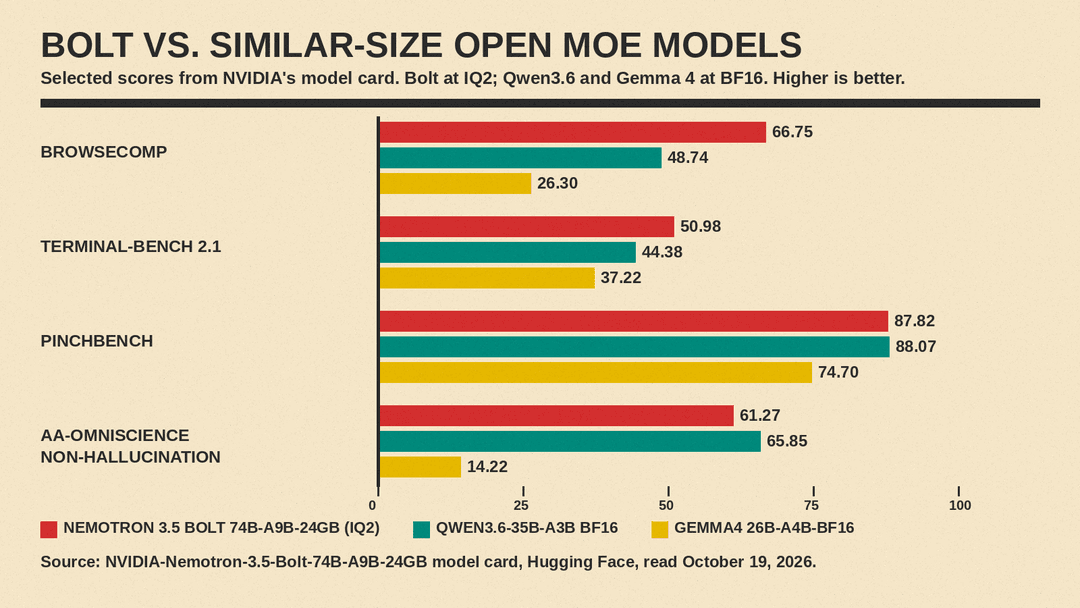
The model card compares Bolt at IQ2 with Qwen3.6-35B-A3B, Gemma4 26B-A4B and Nemotron 3.5 Lightning 30B-A3B, all at BF16. Bolt leads on most rows: BrowseComp 66.75 against 48.74 for Qwen3.6, Terminal-Bench 2.1 50.98 against 44.38, GPQA Diamond 86.43 against 83.40.
It does not lead everywhere. On PinchBench, Qwen3.6 scores 88.07 to Bolt's 87.82 in this table, although Nvidia's blog calls Bolt "the #1 open model in its class on PinchBench," which refers to the public leaderboard. On AA-Omniscience non-hallucination, Bolt scores 61.27, below Qwen3.6 (65.85) and Lightning (68.81). Nvidia also notes that it measured Qwen3.6 at 51.2 on MCP-Atlas, while the reported score is 62.8.
Super VL and the speed claims
Super VL is covered in our earlier post. One new detail from today's coverage: TechCrunch reports that Nvidia claims Super VL completes tasks faster than Anthropic's Opus 5 and OpenAI's GPT 6.1 models when it is post-trained on specific agentic tasks. That is Nvidia's claim, and Nvidia's announcement does not include that comparison.
Why it matters
Bolt is an open-weight model built around a laptop memory budget rather than a data center one. Nvidia also publishes the BF16 weights, so others can fine-tune it or make their own quantized builds. The tradeoff is clear in Nvidia's own tables: higher scores than similar-size MoE models on most agent benchmarks, at a lower decode speed than the fastest of them. For other models that fit on one machine, see our October guide to open-weight LLMs.
Sources
- NVIDIA blog: Open From Data Center to Desktop: NVIDIA Expands Nemotron Family With Highest Efficiency Super VL and Bolt Models (October 15, 2026)
- NVIDIA Research: Nemotron 3.5 Bolt 74B-A9B 24GB (October 15, 2026)
- Hugging Face: nvidia/NVIDIA-Nemotron-3.5-Bolt-74B-A9B-24GB
- Hugging Face: nvidia/NVIDIA-Nemotron-3.5-Bolt-74B-A9B-24GB-GGUF
- Hugging Face: nvidia/NVIDIA-Nemotron-3.5-Bolt-74B-A9B-BF16
- Hugging Face commit history: Bolt 74B-A9B 24GB
- TechCrunch: Nvidia launches new open models to run agents in the enterprise and on PCs (October 19, 2026)
