
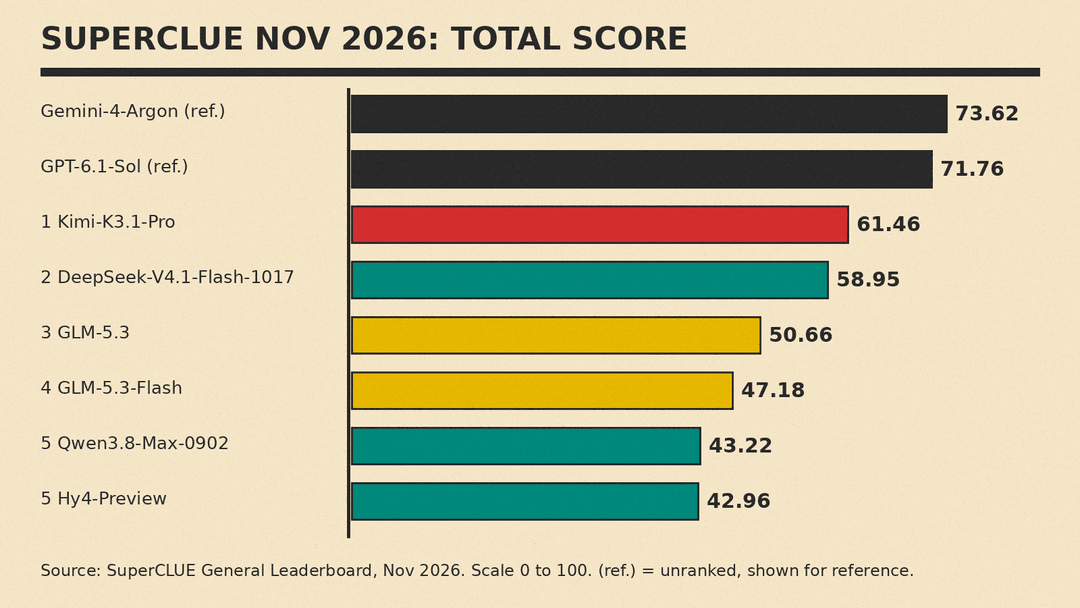
SuperCLUE, a Chinese benchmark group, has a November 2026 general leaderboard whose report page carries a November 5, 2026 update date. Moonshot AI's Kimi-K3.1-Pro holds rank 1 with a total score of 61.46. Two foreign closed models sit above it with no rank: Google's Gemini-4-Argon at 73.62 and OpenAI's GPT-6.1-Sol at 71.76. The leaderboard page says international models and some domestic models are excluded from the ranking and shown for reference only.
This post reads the table as SuperCLUE printed it on the leaderboard and report pages, checked in the early hours of November 5, 2026 (Pacific time). We could not see the full report text or the test items, so the limits are listed near the end.
What SuperCLUE tested
According to the November 2026 report page, the evaluation covers five dimensions: agentic coding, mathematical and scientific reasoning, hallucination control, precise instruction following, and long context. It shows results for 19 models. The page's latest-update line is dated November 5, 2026.
SuperCLUE also says that models within a 1-point difference are treated as tied in ranking. That rule explains why several models share a rank number in the table.
The ranking
The table lists 19 rows. Four have no rank: Gemini-4-Argon, GPT-6.1-Sol, Grok-4.7 from xAI (49.66) and Darwin-180B-RSI-R3 from VIDRAFT (43.08). The other 15 carry rank numbers 1 to 10. In the Open/Closed column, 11 of those 15 are labeled "Open Source" and 4 are labeled "Closed Source": Qwen3.8-Max-0902, Doubao-Seed-2.1-Pro-260915, LongCat-2.5-Preview and Spark-X2.6.
The ranked rows, with total score and the table's rank:
- Rank 1: Kimi-K3.1-Pro (Moonshot AI), 61.46.
- Rank 2: DeepSeek-V4.1-Flash-1017 (DeepSeek), 58.95.
- Rank 3: GLM-5.3 (Zhipu AI), 50.66.
- Rank 4: GLM-5.3-Flash (Zhipu AI), 47.18.
- Rank 5: Qwen3.8-Max-0902 (Alibaba), 43.22, and Hy4-Preview (Tencent), 42.96.
- Rank 6: Doubao-Seed-2.1-Pro-260915 (ByteDance), 42.06; MiniMax M3.1-Flash, 41.35; Step-5-Preview (StepFun), 41.23; MiniMax-M3, 41.17.
- Rank 7: Qwen3.8-Flash (Alibaba), 39.81, and LongCat-2.5-Preview (Meituan), 39.59.
- Rank 8: MiMo-V2.6-Flash (Xiaomi), 36.40.
- Rank 9: Spark-X2.6 (iFlytek), 35.39.
- Rank 10: MiMo-V2.6-Pro (Xiaomi), 34.57.
Kimi's total is 12.16 points below Gemini-4-Argon and 10.30 below GPT-6.1-Sol. It is 2.51 points above DeepSeek-V4.1-Flash-1017, and DeepSeek is 8.29 points above GLM-5.3. GLM-5.3 at 50.66 sits 1.00 point above Grok-4.7 at 49.66, which the table shows for reference.
Two entries are preview versions. The table lists Hy4-Preview, not the final Tencent release we covered in Tencent Hy4 Launches With Vision and Computer Use, and LongCat-2.5-Preview, not the model in Meituan LongCat-2.5. Treat those two scores as scores for the preview builds. LongCat's API changelog (in Chinese) lists LongCat-2.5-Preview on September 25, 2026 and LongCat-2.5 on November 2, 2026.
Where each model is strong
The total score hides a lot. The five columns for the three top-ranked open-labeled models, as printed in the table:
- Kimi-K3.1-Pro: agentic coding 57.69, math and science 63.16, hallucination control 67.78, instruction following 44.83, long context 87.25.
- DeepSeek-V4.1-Flash-1017: agentic coding 65.38, math and science 71.05, hallucination control 43.89, instruction following 43.10, long context 66.25.
- GLM-5.3: agentic coding 53.85, math and science 65.79, hallucination control 43.61, instruction following 17.24, long context 77.60.
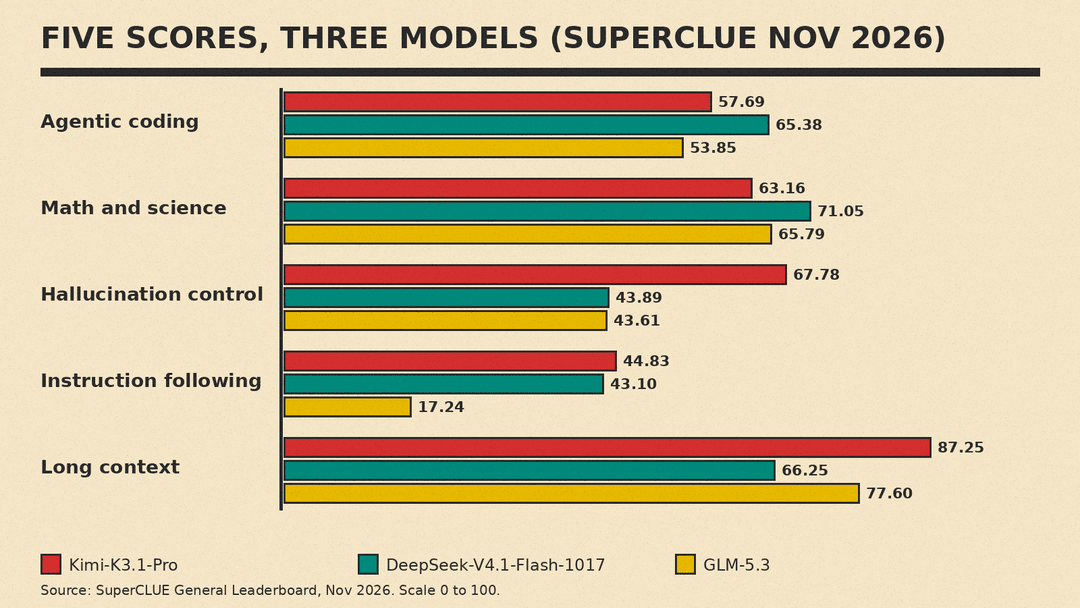
DeepSeek leads Kimi on two columns. Its agentic coding score of 65.38 is 7.69 points above Kimi's and equals Gemini-4-Argon's 65.38. Its math and science score of 71.05 is 7.89 points above Kimi's and also equals Gemini's 71.05. Kimi scores higher in the other three columns. Its hallucination control score of 67.78 is 23.89 points above DeepSeek's, and it is 4.17 points above GPT-6.1-Sol's 63.61. Its long-context score of 87.25 is 21.00 points above DeepSeek's and 0.89 below GPT-6.1-Sol's 88.14.
Instruction following is the weak column for the domestic models. Gemini-4-Argon and GPT-6.1-Sol both score 68.97. Kimi is the best domestic score at 44.83, and the lowest ranked entry in the column is MiniMax M3.1-Flash at 5.17.
The table also lists model sizes. It prints Kimi-K3.1-Pro as "2.8TB" total and 104B active parameters. Moonshot's own model card gives 2.8T total parameters, as we reported in Kimi K3.1 Pro Weights Are Out, so the "TB" in the SuperCLUE table looks like a unit label, not a different size. The table prints "TB" for other models too, for example 2.4TB for Qwen3.8-Max-0902 and 1.02TB for MiMo-V2.6-Pro. For DeepSeek-V4.1-Flash-1017 the table prints "552B 主干" in the total column and "输入 8B、输出 16B" in the active column. We keep that text as printed and do not interpret it.
How to read the scores
A different benchmark gives a different gap. Our comparison of Kimi K3.1 Pro, DeepSeek V4.1 Flash and MiniMax M3.1 Flash uses the Artificial Analysis Intelligence Index, where Kimi scored 46 and DeepSeek 33 as of November 4, 2026. SuperCLUE puts the same two models 2.51 points apart. The two benchmarks use different tasks and different scales, so the numbers do not convert.
Several limits apply to the SuperCLUE table:
- It is one monthly snapshot of 19 models, with a November 5, 2026 update date on the report page.
- The page does not show, in the text we could retrieve, how many items sit behind each score. The agentic coding column moves in steps of about 3.85 points between neighboring scores (for example 57.69, 53.85 and 50.00). That pattern suggests a small number of items per score, but the page does not say so.
- The report page also mentions an estimate of agentic coding cost per task that assumes a 95% input cache-hit rate. The figures were not readable in the text we retrieved.
- The ranking leaves out the foreign models and some domestic models, so rank 1 means first among the ranked rows, not first in the whole table.
Why it matters
For teams choosing a Chinese open model, the useful part is the per-column view. If your work leans on long documents and low made-up-fact rates, Kimi's columns in this table are stronger. If it leans on code and math tasks, DeepSeek's columns are higher in this table. If strict instruction following matters, every ranked Chinese model is far below the two foreign closed models in this table, and some score below 10.
The benchmark does not run your tasks. Run your own test set before switching a model in production.
Sources
- SuperCLUE General Leaderboard, November 2026
- SuperCLUE November 2026 evaluation report page
- Kimi K3.1 Pro Weights Are Out: License and Benchmarks
- Kimi K3.1 Pro vs DeepSeek V4.1 Flash vs MiniMax M3.1 Flash
- Tencent Hy4 Launches With Vision and Computer Use
- Meituan LongCat-2.5: 1.6T Model Trained on Chinese Chips
- LongCat API Docs: changelog (in Chinese)
