
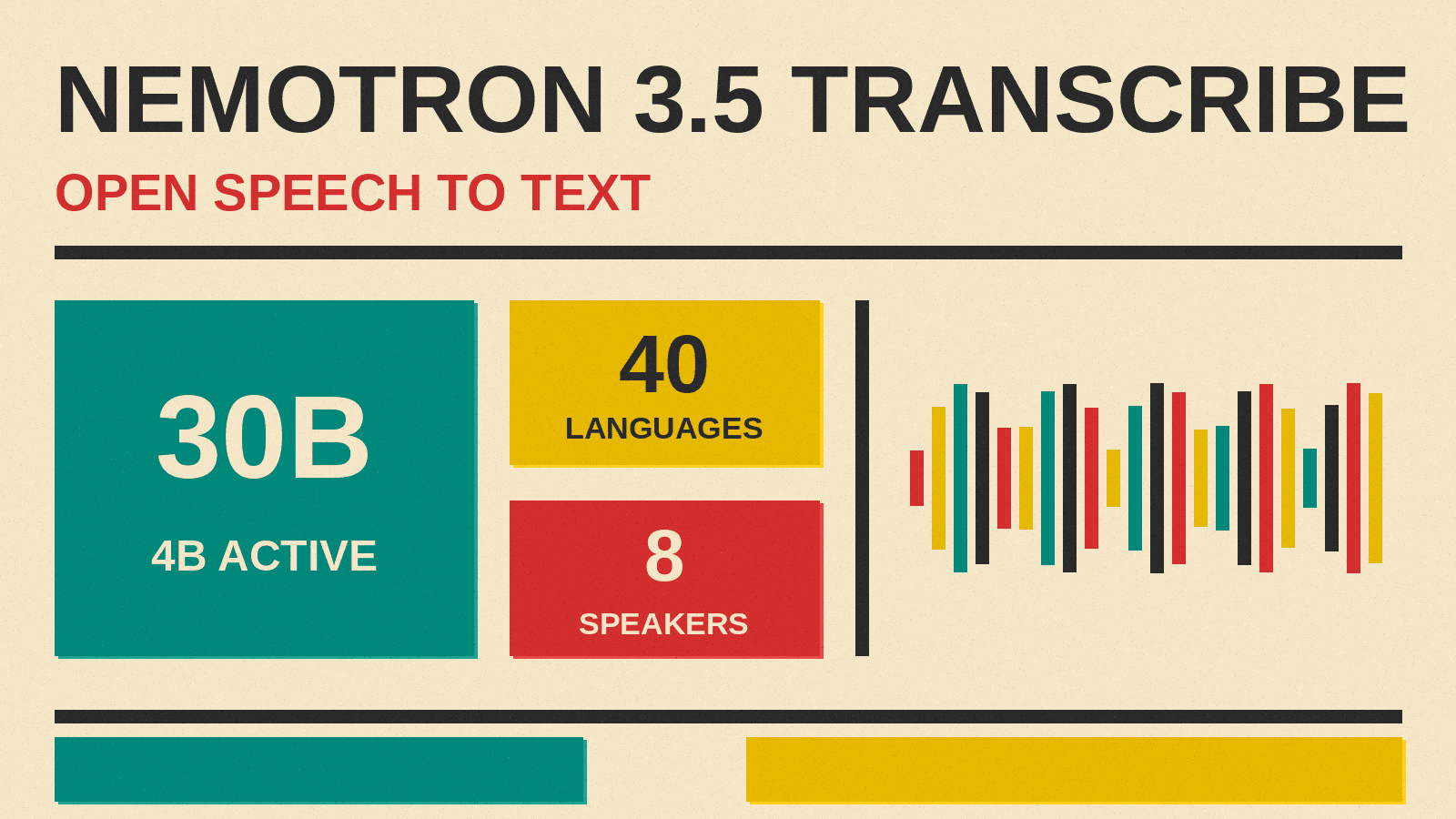
NVIDIA has released Nemotron 3.5 Transcribe, an open-weight speech model that turns recorded audio into text, and Granary v2, the open data pipeline and manifests behind it. The announcement on the Hugging Face blog went up on October 28, 2026. The model is on Hugging Face and ModelScope today, with hosted endpoints from partners for people who do not want to run it themselves.
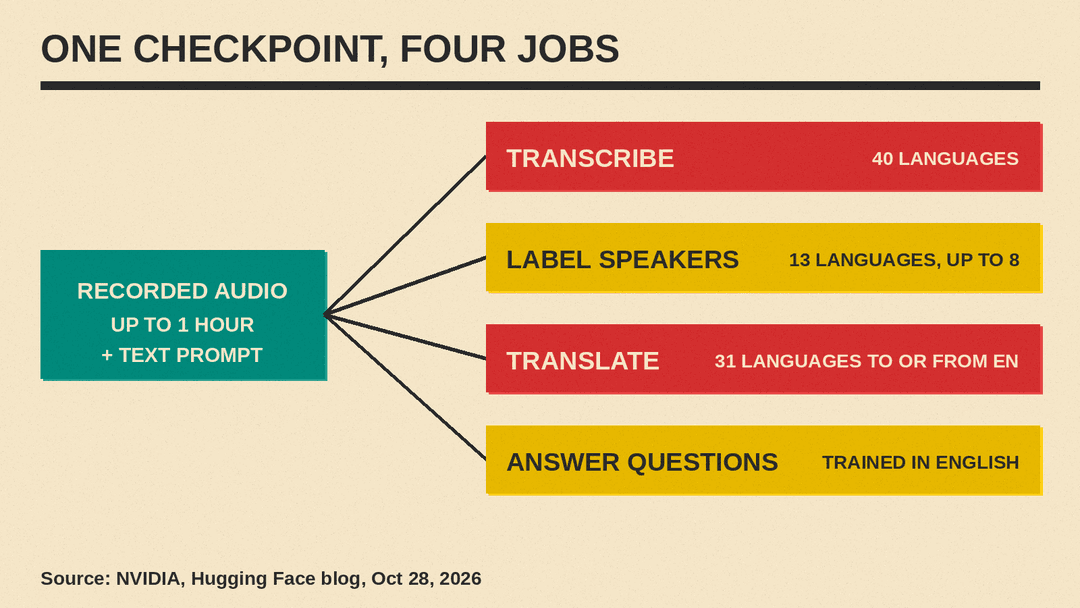
NVIDIA's pitch is one checkpoint for four jobs: transcription, speaker labels, translation and questions about the audio. You steer it with plain-language instructions.
What the model does
According to NVIDIA, Nemotron 3.5 Transcribe:
- transcribes 40 languages
- translates 31 of them to or from English
- labels speakers (diarization) in 13 languages, up to eight speakers per recording
- handles recordings up to an hour long
- answers questions about audio, a task trained in English only
- supports word-level timestamps
The same checkpoint can turn one meeting recording into different outputs, depending on the prompt. NVIDIA's examples include "Transcribe this recording and label each speaker," "Translate this audio into English," and "What decisions were made in this meeting?" For unfamiliar jargon, the model accepts a list of likely terms in the prompt, such as medical terms (NVIDIA's example lists HbA1c and metformin), with an instruction to use them only when the audio supports them.
Two limits matter. It is built for recorded audio, not live streaming. And NVIDIA itself says to spot-check names, speaker changes and answers against the recording.
Why it is small to run for its size
The name gives the shape: 30B total parameters, about 4B active per token (30B-A4B). The model card puts the active count at about 4.3B, including the audio encoder. NVIDIA pairs a speech encoder with a hybrid Mamba and Transformer mixture-of-experts language model, built on Nemotron 3.5 Lightning, so only a small slice of the network works on each token. Speaker cues from NVIDIA's Sortformer component reach the language model with the audio features, so the model tags each speaker turn while it writes, instead of relying only on a later step to attach speakers to words.
For people who run models locally, the practical news is partly still pending. NVIDIA says quantized versions are "coming soon," aimed at RTX Spark, DGX Spark and Jetson AGX Thor, along with local deployment through NeMo-Speech.cpp. Today the checkpoint can be served with vLLM or SGLang-Omni, both supported from day one. Hosted endpoints are listed at Baseten, DeepInfra and Simplismart. The model card already links FP8 and NVFP4 versions, but those pages were not public when we checked on October 28.
For how other open speech-to-text models are served in production, see our comparison of faster-whisper, Moonshine, SenseVoice and NeMo Canary.
Word-level timestamps come from the transcription step. When you already have a transcript and only need the timing, a forced aligner does that job; see our explainer on ElevenLabs Cue, which times every character in an audio file.
On throughput, NVIDIA says the forthcoming NVFP4 quantized version processed 100 hours of audio in under three minutes on one RTX PRO 6000 Blackwell Server Edition GPU, measured on 30-second clips at high concurrency. That is a vendor benchmark on a data-center card, not a laptop figure.
The model card lists the license as OpenMDW 1.1. Read it before commercial use.
The benchmark claims
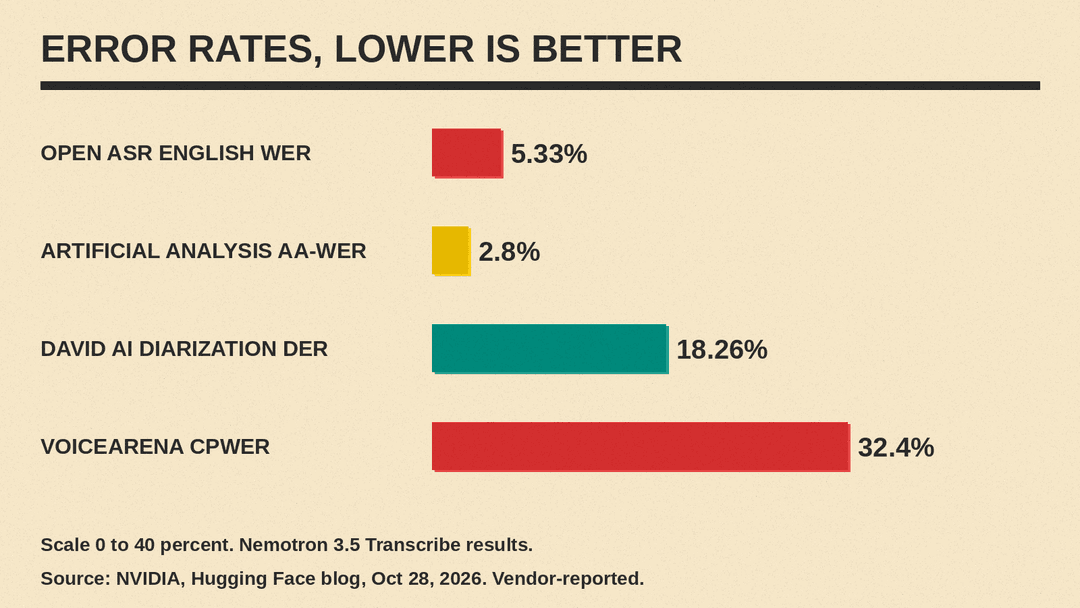
NVIDIA reports these results, all lower-is-better error rates:
- Hugging Face Open ASR Leaderboard, English: first among open-weight models at 5.33% average word error rate (WER), with API models excluded.
- Model card Open ASR comparison: 4.62% mean WER across seven languages and 10.98% on long-form audio, the lowest among the open-weight models compared.
- Artificial Analysis: tied for first among open-weight models at 2.8% AA-WER, with about 4B active parameters versus 24B for the model it ties.
- David AI's multilingual diarization leaderboard: 18.26% diarization error rate across 21 languages, the lowest of 14 systems, just ahead of NVIDIA's own Nemotron 3 Diarization at 18.38%.
- VoiceArena Diarization-Bench: first of 14 systems at 32.4% cpWER on English full sessions with two to eight speakers.
The four leaderboards are run outside NVIDIA, so they are stronger evidence than the model card comparison. The model card notes that Transcribe's training data includes data licensed from David AI, but not the DAI-ASR-I18N evaluation set. The gap in the diarization results is small, and the second-place system in both is also from NVIDIA.
Granary v2: the data, opened up
Granary v2 is the curation pipeline that prepared the multilingual speech used in training, built with NVIDIA NeMo Curator. The public manifest covers 463,062 hours across 48 languages and 16 source corpora, up from 25 languages in Granary v1. NVIDIA notes these figures describe the dataset release, not the model's full training mix.
Each recording gets three transcript forms: verbatim spoken form ("twenty-five euros"), written form with filler words, and clean written form ("I paid €25."). The pipeline also produces audio captions, question-and-answer pairs, biasing terms and translations with quality scores. The manifests do not include the audio itself; you download source audio separately under each corpus's original license.
Fine-tuning for a specialty
NVIDIA shows the adaptation path with a medical case study on Eka Care's benchmark of Indian doctors and medical students. A better prompt alone cut full-benchmark WER from 30.8% to 23.8%. Fine-tuning on mostly synthetic medical speech then cut WER on held-out speakers from 22.44% to 12.17%, a 45.8% relative drop. General English accuracy on LibriSpeech slipped slightly, from 1.54% to 1.69%. The full adaptation took about 14 GPU-hours on one NVIDIA GB300.
NVIDIA also ships fine-tuning tutorials and an agent skill that lets a coding agent run the workflow.
Why it matters
Nemotron 3.5 Transcribe puts transcription, speaker labels, translation and audio questions in one open-weight model, and NVIDIA released the data recipe alongside it. For teams that handle meetings, classes or clinical notes and cannot send audio to a cloud API, it is an open-weight option they can run on their own hardware. The caveats: the local quantized builds are not out yet, and most numbers come from NVIDIA's own announcement. You can try it now in the Hugging Face demo.
