
OpenAI, Anthropic, and Google have each shipped a new top model in recent weeks. GPT-6 Astra came first, Claude Opus 5.5 followed on September 22, 2026, and Gemini 4 Argon launched on October 13, 2026. This guide compares the three on price, context and output limits, published benchmarks, usage limits in the API and in consumer apps, and the work each one suits best.
All figures are as of October 2026 and come from each vendor's own pricing pages, model docs, and launch posts, linked inline. Benchmark scores are vendor-reported unless stated otherwise. For a wider price comparison that includes mid-tier and budget models, see our LLM API pricing guide.
A note on model names
All three names are real, current API model IDs: gemini-4-argon, gpt-6-astra, and claude-opus-5-5. They are not all the same tier, though.
- Gemini 4 Argon is Google's flagship. Google's model list calls it "our flagship reasoning model."
- GPT-6 Astra is OpenAI's most capable model. Its model page calls it "our most capable model for the most demanding work." OpenAI released GPT-6.1 Sol later, on September 29, but Sol is a cheaper model.
- Claude Opus 5.5 is the model Anthropic tells most users to start with, but it is not Anthropic's most capable or most expensive model. Anthropic's models overview says to "start with Claude Opus 5.5 for most workloads" and to use Claude Fable 5.1 "for demanding reasoning and long-horizon agentic work." Fable 5.1 costs $10 input and $50 output per million tokens, the same as GPT-6 Astra.
So on price, this is a comparison of one $10 / $50 model (Astra) with two cheaper models. Where it helps, this guide also gives Fable 5.1 figures.
Price per million tokens
All prices are in US dollars per one million tokens, Standard tier, for the first-party API.
Gemini 4 Argon
From the Gemini API pricing page and the launch post:
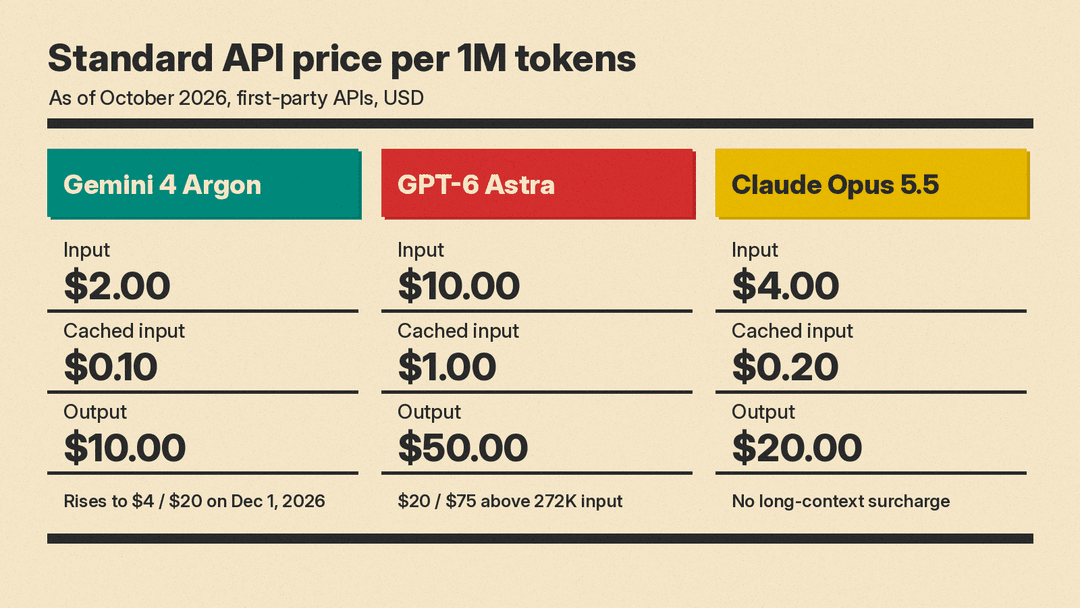
- Input: $2.00 through November 30, 2026, then $4.00 starting December 1, 2026.
- Output (includes thinking tokens): $10.00 through November 30, 2026, then $20.00 starting December 1, 2026.
- Cached input: $0.10 through November 30, then $0.20. Google lists "implicit caching only (explicit caching is not supported)." The launch post describes this as 95 percent off input.
- Batch and Flex: $1.00 input and $5.00 output during the introductory period, which is half of Standard.
- Priority: $3.60 input and $18.00 output during the introductory period, then $7.20 and $36.00.
- Free tier: not available for Argon.
- Long prompts: no separate long-context rate is listed for Argon.
Google calls the current price "introductory." Its footnote says that after November 30, 2026, "the price of $4 per 1M input tokens and $20 per 1M output tokens will apply."
GPT-6 Astra
From OpenAI's API pricing page and the GPT-6 Astra model page:
- Input: $10.00.
- Cached input: $1.00.
- Cache writes: $12.50 (1.25x input).
- Output: $50.00.
- Long prompts: requests with more than 272K input tokens are billed at 2x input and cache rates and 1.5x output for the full request, which is $20.00 input, $2.00 cached input, and $75.00 output.
- Batch and Flex: 50 percent of Standard, so $5.00 input and $25.00 output.
- Fast mode: 2x Standard, $20.00 input and $100.00 output. OpenAI says Fast mode delivers "up to 2x the speed of Standard processing."
- Ultrafast: $60.00 input and $300.00 output, listed only for Astra and GPT-6.1 Sol.
No promotion currently applies to Astra.
Claude Opus 5.5
From Anthropic's pricing docs and the Opus 5.5 announcement:
- Input: $4.00.
- Output: $20.00.
- Cache reads: $0.20 (0.05x input, a lower multiplier than the 0.1x on most Claude models).
- Cache writes: $5.00 for the 5-minute cache, $8.00 for the 1-hour cache.
- Batch: $2.00 input and $10.00 output.
- Fast mode: $8.00 input and $40.00 output. Anthropic's pricing page says this gives "up to 2.5x faster speeds" at "2x standard pricing." Fast mode does not work with the Batch API.
- Long prompts: no surcharge. Anthropic says Claude 4.6 and later models (except Haiku 5.5) bill the full 1M context window at standard rates.
- US-only inference: 1.1x on all token prices.
Anthropic says Opus 5.5 input and output prices are 20 percent lower than Opus 5, and cache reads are 60 percent lower. For reference, Claude Fable 5.1 is $10 input, $0.25 cache reads, and $50 output.
What this means in practice
At list price today, Argon costs one fifth of Astra per token, and Opus 5.5 costs two fifths. After December 1, Argon's Standard price ($4 / $20) will match Opus 5.5. Astra's 272K threshold also matters: a 400K-token prompt to Astra pays $20 per million input tokens for the whole request, while Opus 5.5 still pays $4.
Token counts are not equal across vendors. Anthropic says Claude 4.7 and later models use a tokenizer that "produces approximately 30% more tokens for the same text." Measure your own prompts on each model before you compare costs.
Context window and maximum output
- Gemini 4 Argon: 1,048,576-token context window, shared between input and output. Max output is 65,536 tokens by default for synchronous calls, and up to 1,048,576 tokens with long decode (model page). Inputs: text, image, video, audio, and PDF. Knowledge cutoff: March 2026, per the model card.
- GPT-6 Astra: 1,050,000-token context window and up to 128,000 output tokens. Inputs: text and image. Knowledge cutoff: April 30, 2026.
- Claude Opus 5.5: 1M-token context window and 128K max output on the synchronous Messages API. On the Message Batches API, it supports up to 300K output tokens with a beta header. Inputs: text and image. Reliable knowledge cutoff: June 2026.
Argon is the only one of the three whose model page lists audio and video input, and the only one that can produce outputs approaching 1M tokens in one request.
Benchmarks
Each vendor publishes a comparison table that includes at least one of the other two models. The tables do not always agree, because vendors use different harnesses, effort settings, and sometimes different versions of a benchmark. The scores below are grouped by who published them.
Google's table (Gemini 4 Argon model card)
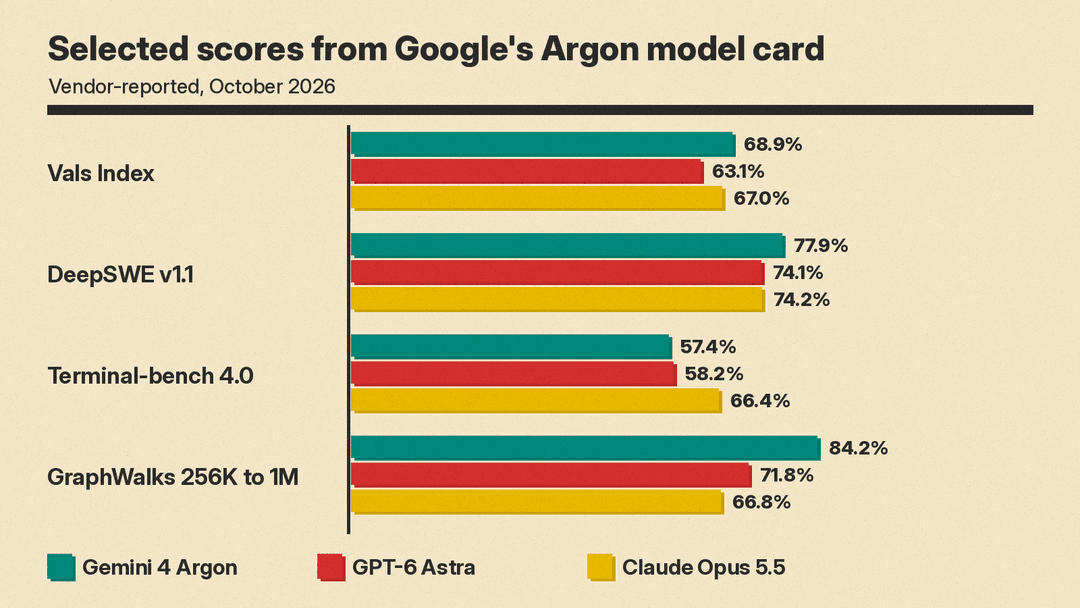
Google's model card lists all three models side by side. Scores are shown as Argon / Astra / Opus 5.5:
- Vals Index (knowledge work): 68.9% / 63.1% / 67.0%
- AutomationBench: 51.3% / 41.4% / 42.5%
- DeepSWE v1.1 (agentic coding): 77.9% / 74.1% / 74.2%
- FrontierSWE v2: 55.0% / 65.5% / 62.3%
- Terminal-bench 4.0: 57.4% / 58.2% / 66.4%
- PostTrainBench (ML engineering): 45.3% / 44.3% / 49.3%
- GraphWalks, 256K to 1M tokens (long context): 84.2% / 71.8% / 66.8%
- LVBench (video understanding): 91.7% / 87.5% / 83.7%
- CWE-bench v1 (cybersecurity): 68.0% / 68.0% / 67.0%
In Google's own table, Argon leads on knowledge work, long context, and video, while Opus 5.5 leads on Terminal-bench 4.0 and PostTrainBench and Astra leads on FrontierSWE v2.
Anthropic's table (Opus 5.5 announcement)
Anthropic's announcement compares Opus 5.5 with GPT-6 Astra but not with Argon, which launched later. Scores are shown as Opus 5.5 / Astra:
- Terminal-Bench 4.0: 66.4% / 57.9% (Astra figure as reported by OpenAI, at high effort)
- FrontierCode v1.1 (Main): 54.4% / 53.3%
- GDPval-AA v2.1 (knowledge work, Elo): 1846 / 1542
- AutomationBench (run by Zapier): 40.0% / 41.4%
- Humanity's Last Exam, with tools: 67.7% / 57.2%
- Terminal-Bench-Science 0.1: 58.7% / 64.6%
Anthropic adds that "benchmark margins have become a less reliable guide to real-world differences" and that Opus 5.5 was tested with production safeguards on, which "likely reduces" some scores.
OpenAI's table (GPT-6 Astra announcement)
OpenAI's announcement compares Astra with Claude Fable 5.1 and Opus 5, not with Opus 5.5 or Argon. Selected Astra scores:
- Terminal-Bench 4.0: 57.9%
- DeepSWE v1.1: 74.1%
- OSWorld 2.0 (offline set, partial score): 72.6%
- Agents' Last Exam: 59.3%
- FrontierMath Tier 4 (v2): 97.6%
- GPQA Diamond: 96.0%
- OpenAI MRCR v2, 8-needle, 512K to 1M: 96.3%
- ARC-AGI-3: 99.9%, run with OpenAI's Responses API harness, which OpenAI says "changes two settings"
OpenAI notes that its "evaluation scores are the maximum at any effort."
Where the vendor tables disagree
Some scores for the same model differ between vendors:
- Astra on Agents' Last Exam: 59.3% in OpenAI's table, 34.2% in Google's table.
- Astra on Terminal-Bench 4.0: 57.9% from OpenAI, 58.2% from Google.
- Astra on Terminal-Bench Science 0.1: 64.6% from OpenAI, 68.1% from Google.
- Opus 5.5 on AutomationBench: 40.0% from Anthropic (run by Zapier), 42.5% from Google.
The largest gap, on Agents' Last Exam, is too large to be noise and probably reflects a different harness or setting. Treat any single number with care, and run your own evaluations on your own tasks.
Usage limits
API rate limits
- GPT-6 Astra: OpenAI lists Standard limits by usage tier on the model page: Build tier 5,000 requests per minute (RPM) and 1,000,000 tokens per minute (TPM); Launch tier 10,000 RPM and 4,000,000 TPM; Grow tier 15,000 RPM and 40,000,000 TPM.
- Claude Opus 5.5: Anthropic's rate limits page lists Start tier at 1,000 RPM, 2,000,000 input tokens per minute (ITPM), and 400,000 output tokens per minute (OTPM); Build tier at 5,000 RPM, 5,000,000 ITPM, and 1,000,000 OTPM; Scale tier at 10,000 RPM, 10,000,000 ITPM, and 2,000,000 OTPM. Opus 5.5 has its own limit, separate from older Opus models, and a default Fast mode limit on Start, Build, and Scale tiers. For comparison, Fable 5.1 starts at 1,000 RPM and 500,000 ITPM.
- Gemini 4 Argon: Google's rate limits page adds spend-based limits on a rolling 10-minute window: $10 for Tier 1, $50 for Tier 2, and $200 for Tier 3. It also lists Batch enqueued token limits for Argon of 5,000,000 (Tier 1), 500,000,000 (Tier 2), and 1,000,000,000 (Tier 3). Argon is not available on the free tier.
Consumer apps
- ChatGPT: OpenAI says Astra is available to ChatGPT Plus, Pro, Business, and Enterprise users, and that "Astra usage is included within the existing subscription allowances," with credits available for extra usage. Pro, Business, and Enterprise also get GPT-6 Astra Pro. Enterprise admins must turn Astra on; it is off by default.
- Claude apps: Anthropic's pricing page lists Opus on Pro, Max 5x, Max 20x, Team, and Enterprise, but not on Free. Limits reset on a rolling five-hour window, and paid plans add weekly limits. Anthropic says Pro gives "at least 5x more usage per 5-hour session than Free," and Max gives "5x or 20x more usage per 5-hour session than Pro." With Opus 5.5, Anthropic raised five-hour limits on Pro, Max, Team, and seat-based Enterprise plans.
- Gemini app: Google says Argon is available to Google AI Pro and Ultra subscribers in the Gemini app and AI Mode in Search, and to Ultra subscribers in Google Antigravity. Google's Gemini app limits page says limits refresh every 5 hours until a weekly limit is reached. AI Pro gets 4x the standard limits and AI Ultra gets "5x or 20x higher than AI Pro limits depending on your subscription." AI Pro and Ultra get a 1 million token context window in the app.
None of the three vendors publishes a fixed message count for their consumer plans. All three say usage depends on prompt length, model, and features.
Best use for each model
These suggestions follow from the published prices, limits, and vendor benchmarks above. They are not the result of our own testing.
Choose Gemini 4 Argon for
- Long-context work. It has the highest vendor-reported long-context score in Google's table (84.2% on GraphWalks at 256K to 1M tokens) and can produce very long outputs with long decode.
- Video and audio input. It is the only one of the three whose model page lists both.
- Cost-sensitive frontier work before December 1. At $2 / $10 it is the cheapest of the three until the introductory period ends.
- Knowledge work in finance and legal, where Google reports leading scores on Vals Index and Vals Finance Agent v2.
Choose GPT-6 Astra for
- Computer use and professional tasks, where OpenAI reports 72.6% on OSWorld 2.0 (offline set) and 59.3% on Agents' Last Exam.
- Math and science reasoning, with 97.6% on FrontierMath Tier 4 and 96.0% on GPQA Diamond in OpenAI's table.
- High-throughput API use, since its Grow tier allows 40,000,000 tokens per minute.
- Teams already on ChatGPT plans, since Astra is included in Plus, Pro, Business, and Enterprise allowances.
It is the most expensive of the three. Keep prompts under 272K input tokens where you can, to avoid the long-context rate.
Choose Claude Opus 5.5 for
- Agentic terminal coding. It has the top Terminal-Bench 4.0 score in both Google's table (66.4%) and Anthropic's table.
- Long agent sessions with large cached context, because cache reads cost $0.20 and there is no long-context surcharge across the 1M window.
- Knowledge work measured by GDPval-AA, where Anthropic reports 1846 against 1542 for Astra.
- A middle price point between Argon's introductory price and Astra.
If Opus 5.5 is not enough for a task, Anthropic's own guidance is to try Fable 5.1, at Astra-level pricing.
Summary
- Cheapest today: Gemini 4 Argon at $2 / $10, rising to $4 / $20 on December 1, 2026.
- Most expensive: GPT-6 Astra at $10 / $50, with higher rates above 272K input tokens.
- Middle: Claude Opus 5.5 at $4 / $20, with cache reads at 5 percent of input (the same ratio as Argon) and no long-context surcharge.
- Largest output per request: Argon, with long decode up to about 1M tokens.
- Benchmarks: each model leads on different tests, and vendor tables do not always agree on the same model.
Check the linked pricing pages before you commit, since two of these prices are scheduled to change or are under promotion, and run your own evaluations on representative tasks.
Sources
- Google: Gemini 4 Argon launch post
- Google DeepMind: Gemini 4 Argon model card
- Gemini API: Gemini 4 Argon model page
- Gemini API: Models
- Gemini API: Pricing
- Gemini API: Rate limits
- Gemini Apps: Limits and upgrades
- OpenAI: GPT-6 Astra announcement
- OpenAI API: GPT-6 Astra model page
- OpenAI API: Pricing
- Anthropic: Introducing Claude Opus 5.5
- Anthropic: Models overview
- Anthropic: API pricing docs
- Anthropic: Rate limits
- Anthropic: Plans and pricing
- llms.blog: LLM API Pricing Compared (October 2026)
