
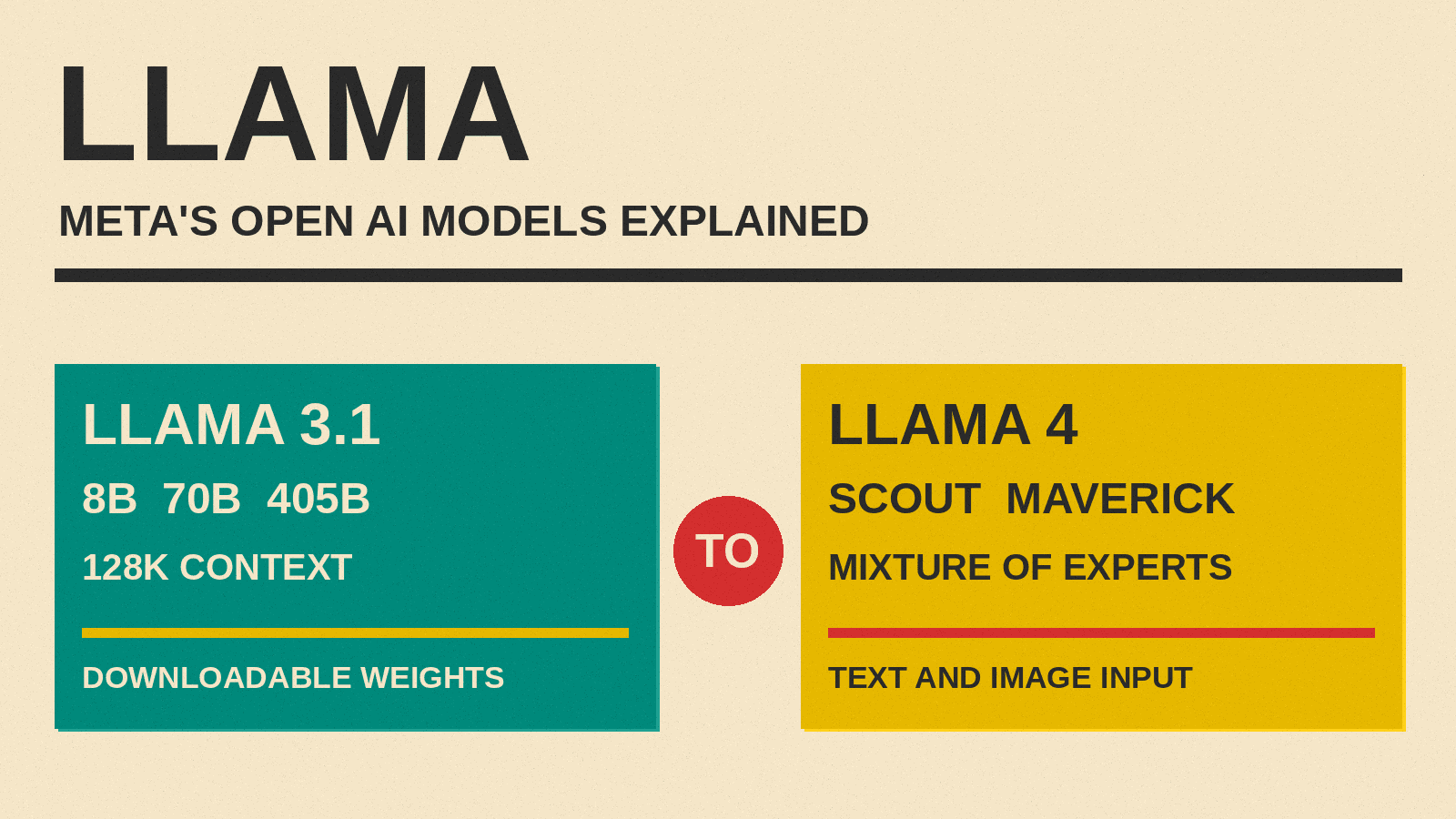
Llama is the name of a family of AI language models from Meta. You may have seen it mentioned next to ChatGPT, Gemini and Claude. Unlike those, Meta lets the public download Llama's model files. That one choice sets Llama apart from the closed models.
This guide explains what Llama is, how it works at a basic level, how the versions differ, what you are allowed to do with it, and how it fits with Meta's newer models. It is written for people who are not developers. Every fact comes from Meta's own pages, the model card on Hugging Face, or the license text, all listed at the end. Where a detail changes over time, the guide gives the date it was checked.
The short answer
Llama is a set of large language models made by Meta. A large language model is a program trained on very large amounts of text, and in some cases images, so it can write, answer questions and summarize. If you want the basics first, read our AI glossary, which defines terms such as LLM.
What makes Llama different is how it is shared. Meta publishes the model files, called weights, so people can download them and run them on their own hardware. The weights are free to download, but they come with a license. That license is custom. It is not one of the standard open source licenses.
Meta describes the arrangement in its Llama 4 announcement. It says it is "making Llama 4 Scout and Llama 4 Maverick available for download today on llama.com and Hugging Face." Meta's earlier Llama 3.1 announcement says that, unlike closed models, "Llama model weights are available to download."
What "open" means here
People often call Llama "open source". Meta uses that phrase in some of its own posts. The more precise term for what Llama offers is open weights. You get the trained model, not the full recipe of data and code used to build it.
Our guide to open-weight versus closed AI models covers the difference in detail. For this article, three points matter:
- You can download Llama and run it without sending your prompts to Meta. Meta's Llama 3.1 post says developers can run the models "in any environment, including on prem, in the cloud, or even locally on a laptop," and it adds that this can be done "all without sharing data with Meta."
- You can customize it. Meta's post says developers can "train on new datasets, and conduct additional fine-tuning." Our explainer on what fine-tuning is shows how that works.
- You must follow the license. The rules are set per version, and the Llama 4 terms are covered below.
How Llama is built, in plain English
Llama models are transformers. That is a common design for language models. A transformer reads text in small pieces called tokens and predicts the next token, over and over, until it has written an answer.
Meta describes the Llama 3.1 design as "a standard decoder-only transformer model architecture with minor adaptations rather than a mixture-of-experts model to maximize training stability." In other words, every part of the model is used for every token.
Llama 4 changed that. Meta says Llama 4 models are its "first models that use a mixture of experts (MoE) architecture." In an MoE model, a single token only activates a fraction of the total parameters. Parameters are the numbers inside the model that were set during training. Our explainer on mixture of experts models explains why this matters for speed and cost.
Meta also says Llama 4 is "natively multimodal." That means the model can take both text and images as input, using what Meta calls early fusion, which mixes text and image tokens inside one model. The Hugging Face model card says the Llama 4 models take "multilingual text and image" as input and produce "multilingual text and code" as output.
The Llama versions you will hear about
Meta has released several generations. This guide covers the two that Meta describes in its own announcements, Llama 3.1 and Llama 4.
Llama 3.1
Meta announced Llama 3.1 on July 23, 2024. The release included three sizes: 8B, 70B and 405B. The "B" stands for billions of parameters.
Meta's announcement made these points:
- Llama 3.1 405B was described as "the first frontier-level open source AI model" in Meta's takeaways list. Meta also said it believed it was "the world's largest and most capable openly available foundation model." Those are Meta's own claims.
- The models expand the context length to 128K and add support across eight languages. Context length is how much text a model can consider at once.
- Meta trained the 405B model on "over 15 trillion tokens", using "over 16 thousand H100 GPUs".
- Meta said it changed the license to allow developers to use the outputs from Llama models, including the 405B, to improve other models.
- Meta said it had "more than 300 million total downloads of all Llama versions to date" at that time.
That license change matters for a topic we cover elsewhere. Using a big model to teach a smaller one is called distillation. Our explainer on model distillation describes the idea.
Llama 4
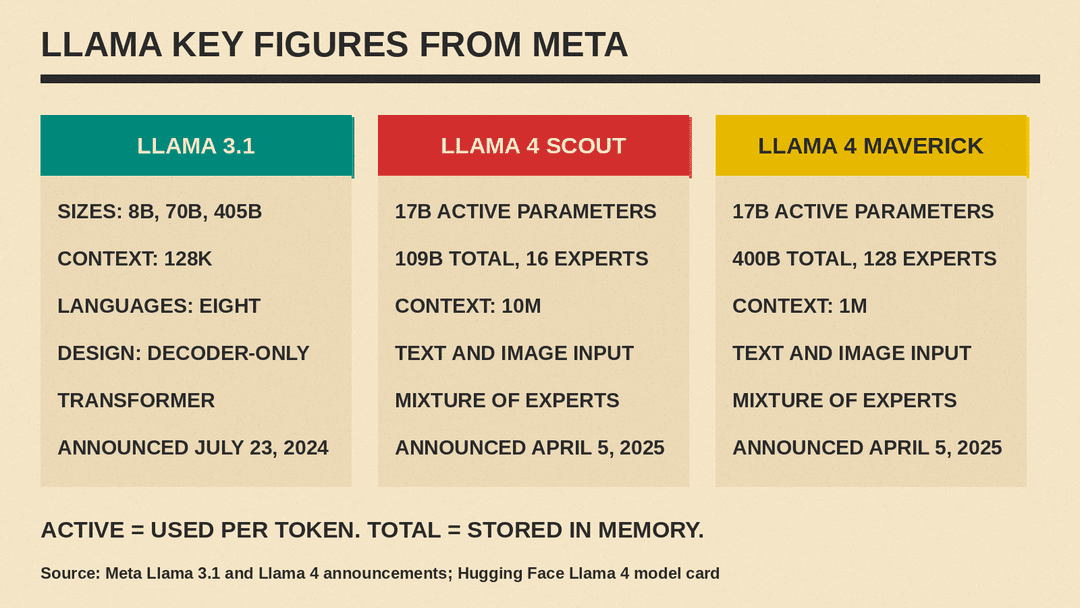
Meta announced Llama 4 on April 5, 2025. The first two models were Llama 4 Scout and Llama 4 Maverick. The Hugging Face model card lists these figures:
- Llama 4 Scout has 17 billion active parameters and 109 billion total parameters, with 16 experts. Its context length is 10M tokens.
- Llama 4 Maverick has 17 billion active parameters and 400 billion total parameters, with 128 experts. Its context length is 1M tokens.
- Both list a knowledge cutoff of August 2024.
The gap between "active" and "total" is the core of MoE. Only 17 billion parameters work on each token, but all 109 billion or 400 billion must be stored in memory. Meta says: "while all parameters are stored in memory, only a subset of the total parameters are activated while serving these models."
Meta also described a third, larger model, Llama 4 Behemoth. In the April 2025 announcement, Meta said Behemoth was "still training" and used it as a teacher for the smaller models. Meta said it had 288 billion active parameters and "nearly two trillion total parameters." Meta says it codistilled Llama 4 Maverick from Behemoth as a teacher model.
Here are the key figures in one picture:
What you can do with Llama
Meta's Llama 4 model card says the models are "intended for commercial and research use in multiple languages." Instruction-tuned versions are meant for assistant-like chat and visual reasoning. Pretrained versions can be adapted for text generation.
In practice, people use Llama in a few ways:
- Chat and writing help. Apps built on Llama can draft, summarize and answer questions.
- Image questions. Llama 4 can take images as input, for example to describe or compare them.
- Private, local use. Because the weights can be downloaded, a person or a company can run Llama on its own machine. Our guide on how much memory you need to run an AI model locally explains the hardware side. Meta's Llama 4 post says Scout "fits on a single H100 GPU (with Int4 quantization)." Check that guide before you assume a model will fit on your computer.
- Custom models. Developers can fine-tune Llama for a task or a language. The Llama 4 model card says developers may fine-tune the models for languages beyond the 12 it officially supports, if they follow the license and acceptable use policy.
- Safety tools. Meta also publishes companion tools. The Llama 4 announcement names Llama Guard, an input and output safety model, and Prompt Guard, a classifier for jailbreak and prompt injection attempts.
Meta also says Llama models were "always intended to work as part of an overall system" that can call outside tools. That is why Meta released reference applications and a proposed interface called Llama Stack along with Llama 3.1.
Who makes money from it, and the license
This is the part most beginners skip, and it is where Llama differs from a standard open source project. The Llama 4 Community License Agreement is the actual contract. The model card calls it "a custom commercial license."
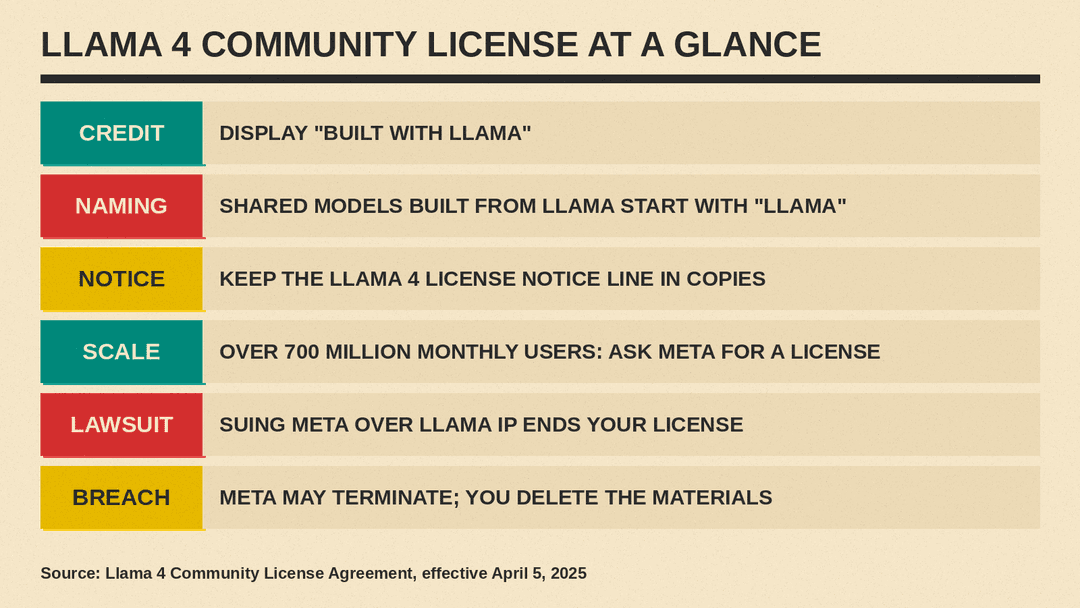
Here are the main terms of the Llama 4 license, in plain English:
- You may use, copy, change and distribute the models. The license grants a "non-exclusive, worldwide, non-transferable and royalty-free limited license."
- You must show credit. If you distribute Llama or a product that contains it, you must "prominently display 'Built with Llama' on a related website, user interface, blogpost, about page, or product documentation."
- You must name derived models a certain way. If you use Llama or its outputs to create, train, fine-tune or improve an AI model that you share, the name must begin with "Llama".
- You must include a notice. Copies you distribute must carry the line "Llama 4 is licensed under the Llama 4 Community License, Copyright © Meta Platforms, Inc. All Rights Reserved."
- You must follow the acceptable use policy. It is part of the contract by reference.
- Very large companies need a separate deal. If, on the Llama 4 release date, a company's products had more than 700 million monthly active users in the preceding calendar month, it must request a license from Meta. Meta may grant it "in its sole discretion."
- A lawsuit can end your license. If you sue Meta, or any entity, claiming that Llama or its outputs infringe your intellectual property, your licenses under the agreement end.
- Meta can end the agreement for breach. On termination you must delete the Llama Materials and stop using them.
Here is the same list as a single graphic:
These terms matter most if you plan to share Llama or build a product on top of it. Always read the license that ships with the specific model you download. Our guide on how to read an AI model card shows where to find it.
How to get Llama
Meta says the Llama 4 models are available at llama.com and on Hugging Face. On the Hugging Face page, access is gated. Before you can download, the page asks you to provide your full legal name, date of birth and full organization name, and it warns that mistakes may prevent access. It also says the information is handled under the Meta Privacy Policy. Read that notice before you submit the form.
Many people never download the files directly. Meta's Llama 4 announcement lists a long set of partners, including Hugging Face, ollama and vLLM, and says the models would be available through cloud and data platforms. For local apps, see our guide to running a model on your own laptop with Ollama, LM Studio and llama.cpp.
Pick the size that fits your computer. A 109 billion parameter model needs far more memory than a small one, even if only part of it is active at a time.
Where Llama stands now
Meta's own site shows a shift. As of November 4, 2026, llama.com redirects to Meta's developer site at dev.meta.ai, whose home page opens with the heading "Your next build starts with Muse." Its recent models list includes Muse Wonder, Muse Wonder Full, Muse Spark 1.3, Muse Spark Open, SAM 3.1, Muse Voice Transcribe, Muse Image and Muse Glimmer. No Llama model appears in that list.
One of those, Muse Spark Open, is an open-weight model. Meta's announcement, dated October 15, 2026, calls it "the most capable US open-weight model to date" and says it has 816B total parameters (42B active) and a 1M-token context window. Meta says the weights are released under the Muse Model License "with limited commercial terms." That is a different license from the Llama 4 Community License. We covered the details in our report on Meta's Muse Spark Open release.
What this means in practice:
- The Llama 4 license and model card are still posted at the links in the sources list, and the Llama 4 terms above come from that license text.
- If you want Meta's Muse Spark Open model, check its page and its license, and do not assume the Llama terms apply.
- The Llama 4 license requires that a shared model built from Llama or its outputs starts its name with "Llama". Expect to see that naming on derived models.
Common questions
Is Llama free? The Llama 4 license grants a "royalty-free limited license" to use and share the models, with the conditions listed above. You still need a computer to run it, or a company that hosts it for you.
Is Llama private? Running Llama on your own machine means your prompts stay on your machine, as Meta's post describes. If you use Llama through a hosted service or a Meta product, that service's own privacy policy applies.
Is Llama the same as Meta AI? No. In April 2025, Meta described Meta AI as an assistant "built with Llama 4" that people could try in WhatsApp, Messenger, Instagram Direct and on the web. The assistant is a product. Llama is a family of models.
Can Llama see images? Llama 4 can take images as input. The model card says it was tested for image understanding up to 5 input images. Llama 3.1 has no image input, according to the Llama 4 model card's benchmark tables, which mark it "No multimodal support."
How is Llama different from DeepSeek, Qwen or Gemma? All of them are families of models with downloadable weights from different companies, each with its own license and sizes. Read our explainer on Gemma and our guide to China's AI labs, which covers DeepSeek and Qwen, for comparison.
Key takeaways
- Llama is Meta's family of AI models, shared as downloadable weights.
- Llama 3.1 came with 8B, 70B and 405B sizes and a 128K context length.
- Llama 4 introduced a mixture of experts design and image input, with Scout and Maverick as the first two models.
- The Llama 4 Community License is custom. It requires credit, a naming rule and a notice, and it sets a 700 million monthly user threshold.
- As of November 4, 2026, llama.com redirects to Meta's developer site, which leads with its Muse models, including the open-weight Muse Spark Open, which has its own license.
Sources
- Meta: The Llama 4 herd (April 5, 2025)
- Meta: Introducing Llama 3.1 (July 23, 2024)
- Llama 4 Community License Agreement
- Hugging Face model card: Llama-4-Scout-17B-16E-Instruct
- Meta: Introducing Muse Spark Open (October 15, 2026)
- Meta: llama.com, which redirects to the dev.meta.ai home page, as of November 4, 2026
