
This is an opinion piece. The facts come from the linked papers; the argument is mine.
"Emergent abilities" is a widely repeated idea in AI. The story goes like this: you make a language model bigger, and at some size a skill suddenly switches on that smaller models did not have at all. It is a dramatic story, and it shapes how people talk about AI progress and AI risk.
My view is that most people should hold this story much more loosely. The best evidence I know says that many of these sudden jumps tell you about the ruler, not the model. A jump on a chart is often a measuring choice. Before you treat one as a new ability, ask how it was scored.
Where the idea comes from
The standard definition comes from a 2022 paper, Emergent Abilities of Large Language Models, by Jason Wei and co-authors, published in Transactions on Machine Learning Research. Its abstract says: "We consider an ability to be emergent if it is not present in smaller models but is present in larger models. Thus, emergent abilities cannot be predicted simply by extrapolating the performance of smaller models."
That second sentence is the part that matters. If skills appear without warning, then nobody can forecast what the next, larger model will be able to do. The same abstract adds that "additional scaling could further expand the range of capabilities of language models." That is a reasonable thing to say, and it is also a claim that invites a lot of guessing.
The paper that pushed back
In 2023, Rylan Schaeffer, Brando Miranda and Sanmi Koyejo of Stanford published Are Emergent Abilities of Large Language Models a Mirage?. It was later named one of two Outstanding Main Track Papers at NeurIPS 2023.
Their claim is specific. They argue that for a given task and model family, "emergent abilities appear due the researcher's choice of metric rather than due to fundamental changes in model behavior with scale." In their words, "nonlinear or discontinuous metrics produce apparent emergent abilities, whereas linear or continuous metrics produce smooth, continuous, predictable changes in model performance."
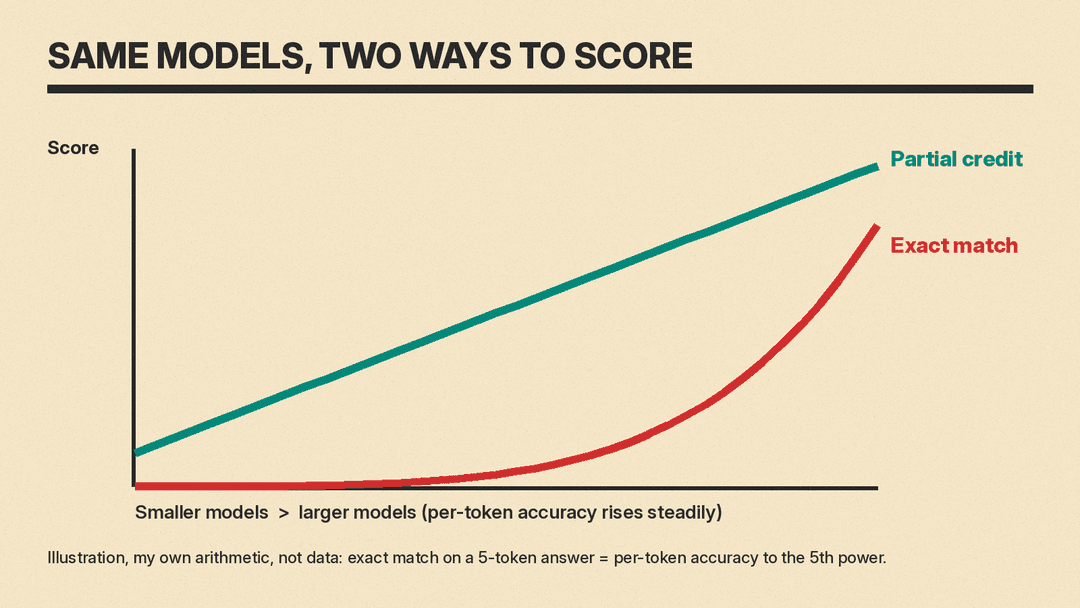
The idea is easy to see with an all-or-nothing score. Exact match gives a model credit only if every token of its answer is right. Say a correct answer is five tokens long. A model that gets each token right half the time will get the whole answer right only about 3% of the time (0.5 to the fifth power). A model that gets each token right 90% of the time will get the whole answer right about 59% of the time. That example is my own arithmetic, but it follows the paper's point that this kind of score "scales geometrically in target length." The skill under the hood improved steadily. The score looks like it fell off a cliff and then shot up.
What they actually found
The mirage paper tests this in three ways, and the results are worth stating exactly.
- Same outputs, different score. On 2-digit multiplication and 4-digit addition with the InstructGPT/GPT-3 family, the models show emergent abilities when scored by accuracy. When the authors switch to Token Edit Distance "while keeping the models' outputs fixed," performance "smoothly, continuously and predictably improves with increasing scale."
- More test data. With more test examples, the authors report that "even on Accuracy," the family's performance "is above chance and improves in a smooth, continuous, predictable manner." Small models looked like zeros partly because there was too little data to measure them.
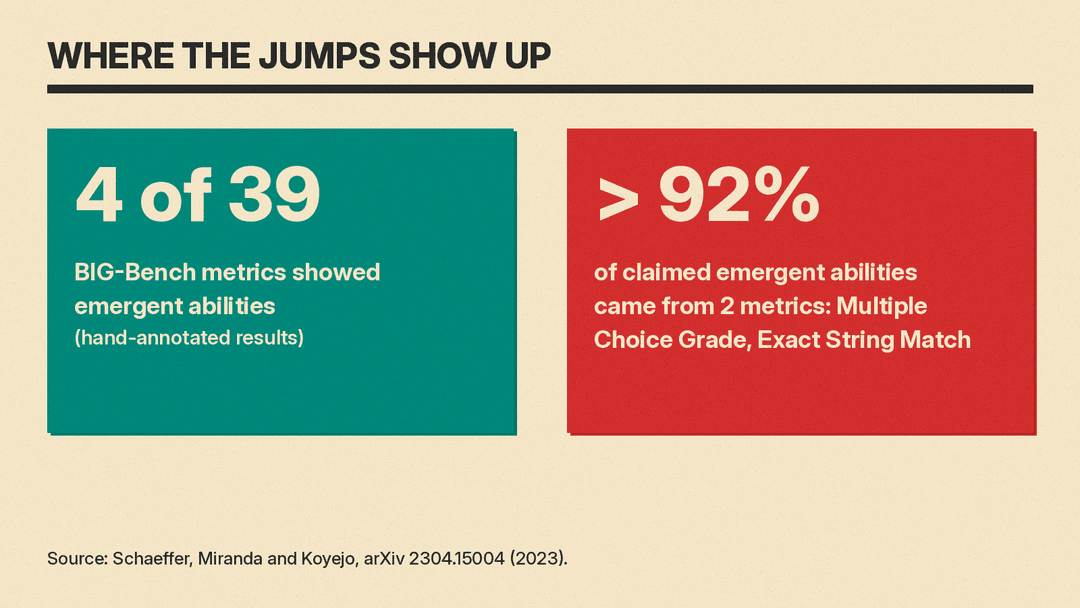
- A look across BIG-Bench. In hand-annotated results, emergent abilities appear with 4 of 39 metrics, and 2 metrics, Multiple Choice Grade and Exact String Match, "account for > 92% of claimed emergent abilities." When the authors re-scored LaMDA's emergent abilities on Multiple Choice Grade with Brier Score, a continuous metric, the emergent abilities "disappeared."
They also went the other way and produced "never-before-seen seemingly emergent abilities" in vision models just by choosing the metric. If you can create a jump on purpose with a scoring rule, a jump on its own proves little.
What the paper does not say
This is where I want to be careful, because the paper is careful. The authors write: "We emphasize that nothing in this paper should be interpreted as claiming that large language models cannot display emergent abilities." Their message is that previously claimed emergent abilities "might likely be a mirage induced by researcher analyses."
So the honest summary is not "emergence is fake." It is narrower: many famous examples look a lot less sudden when you score them in a way that gives partial credit, or when you test small models on enough examples. The same paper notes other work, such as Caballero and co-authors, that treats emergent abilities as real, caused by "a change in the governing power law." The debate is not closed.
Why I think this matters for everyone else
You do not need to read scaling papers to be affected by this idea. It shows up in product launches, in investor talk and in safety debates. Here is why I think the mirage paper should change how you read those claims.
A sudden jump is a weak reason for awe. When a chart shows a skill going from zero to strong in one model size, the first question is how it was scored. If the answer is "right or wrong, nothing in between," the jump may be built into the score. Our explainer on how to read AI benchmark scores covers why the scoring method matters as much as the number.
Smooth progress is still progress. The mirage paper does not say models stop getting better with scale. It says they often get better steadily. That fits the broader picture described in our scaling laws explainer. To me, steady and predictable is a more useful finding than sudden and mysterious, because you can plan around it.
It cuts both ways on risk. The paper notes that emergent abilities have been used to warn that "larger models might one day, without warning, acquire undesired mastery over dangerous capabilities." If many jumps come from scoring, then careful measurement with partial credit could give earlier warning, not less. That is an argument for better tests, not for relaxing.
Small details decide big headlines. The authors also point to a statistics problem: BIG-Bench has "≥ 220 tasks, ∼ 40 metrics per task, ∼ 10 model families." With that many combinations, some will look dramatic by chance. I made a similar point about leaderboard ranks: a single headline number hides a lot of choices.
What to ask next time
When someone says a model "suddenly" learned something, I would ask three plain questions:
- Was the score all-or-nothing, or did it give partial credit?
- How many test examples were the smaller models tried on?
- Does the jump survive if you score the same answers a different way?
If nobody can answer, treat the jump as a claim, not a discovery. The skill may be real. The suddenness is the part that needs proof.
