
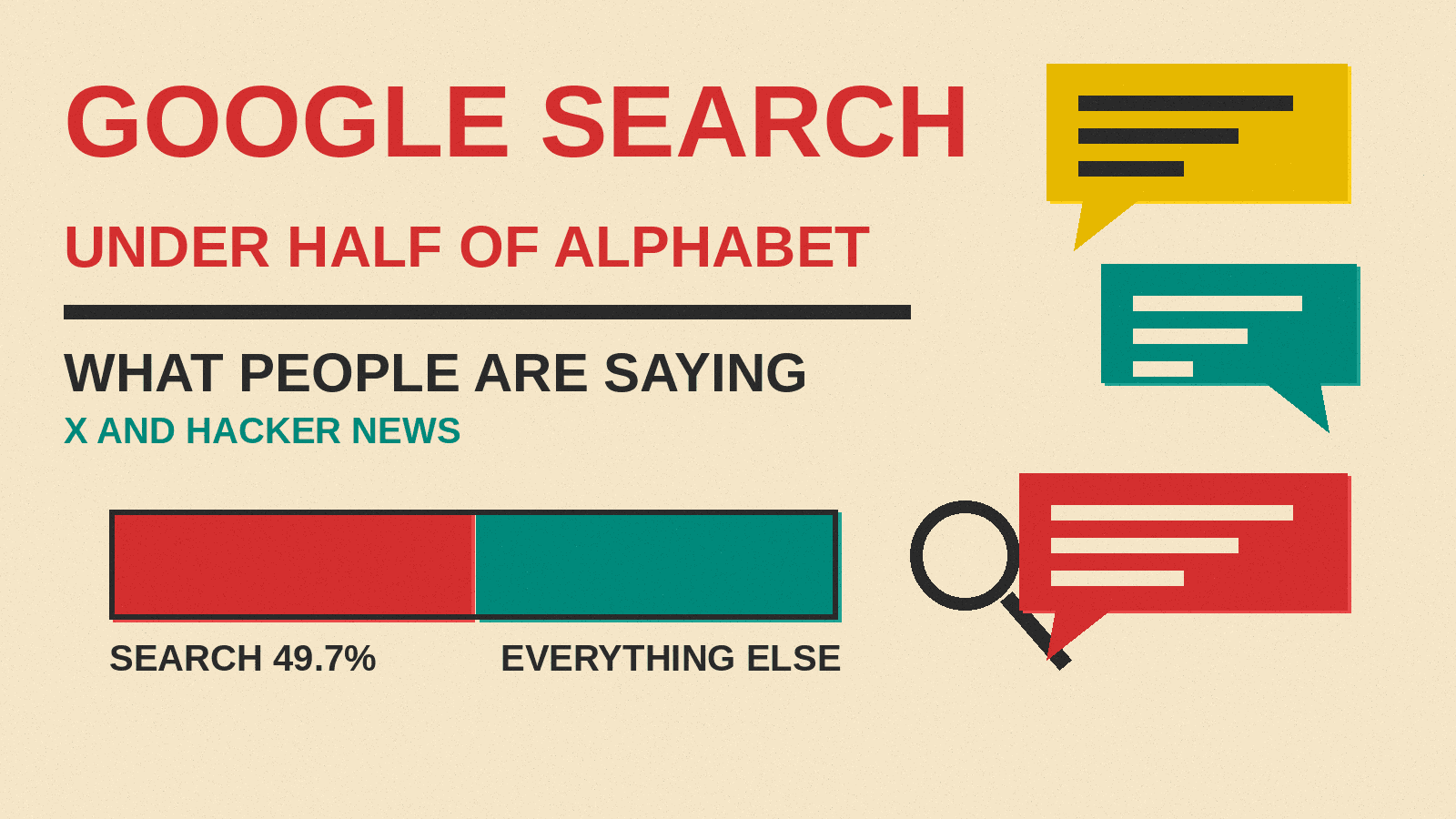
For the first time since Alphabet started reporting it as its own line, Google Search brought in less than half of the company's revenue. That one number, published Thursday by the data site Kadoa, landed on the same day Alphabet stock fell about 13% and lost roughly $500 billion in market value, which NBC News called the company's worst one-day performance ever, as covered in our post on the record stock drop. The reaction split into two camps: people who read it as AI eating Google's core business, and people who pointed out that Search revenue still grew.
The Hacker News thread on Kadoa's chart, posted at 9:42 AM PT, had 270 points and 204 comments at 11:28 AM PT. On X, most of the detailed posts came from investors working through the earnings release and call. Reddit could not be read from our tools for this roundup, so the reactions below come from X and Hacker News. For the full numbers, see our posts on Alphabet's Q3 results and the record stock drop.
The number people were arguing about
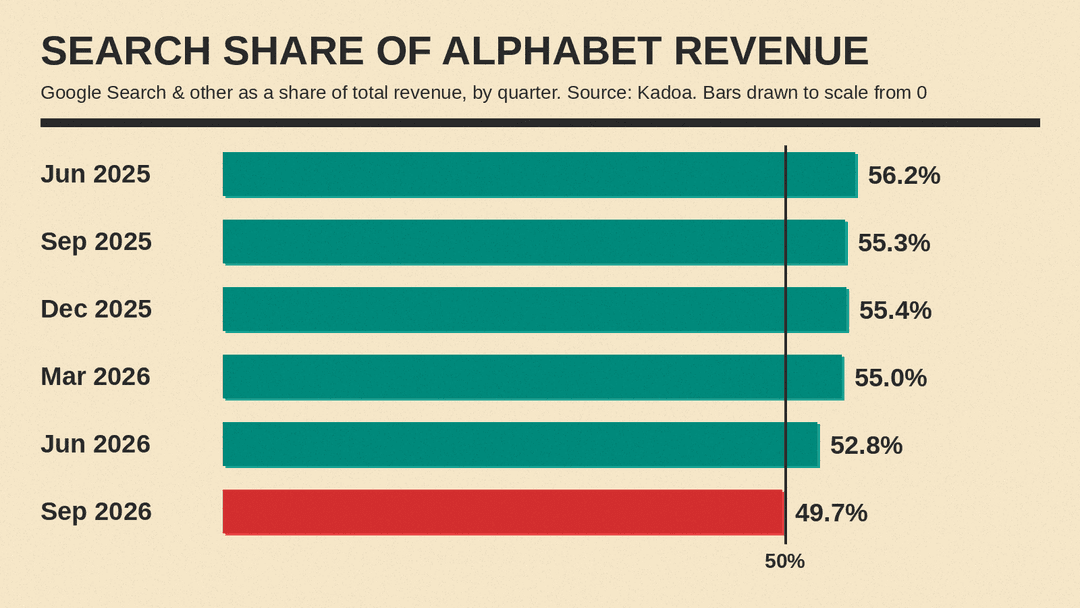
Kadoa's Company Atlas says Google Search made $63.4 billion of Alphabet's $128 billion in revenue in the quarter to September 2026, or 49.7%. In the 31 quarters before, Search was between 52.8% and 62.0% of revenue. Over the same years, Google Cloud grew from 4.4% of revenue to 24.1%. Alphabet's earnings release gives the exact figures: $63.35 billion from Google Search & other out of total revenues of $127.6 billion.
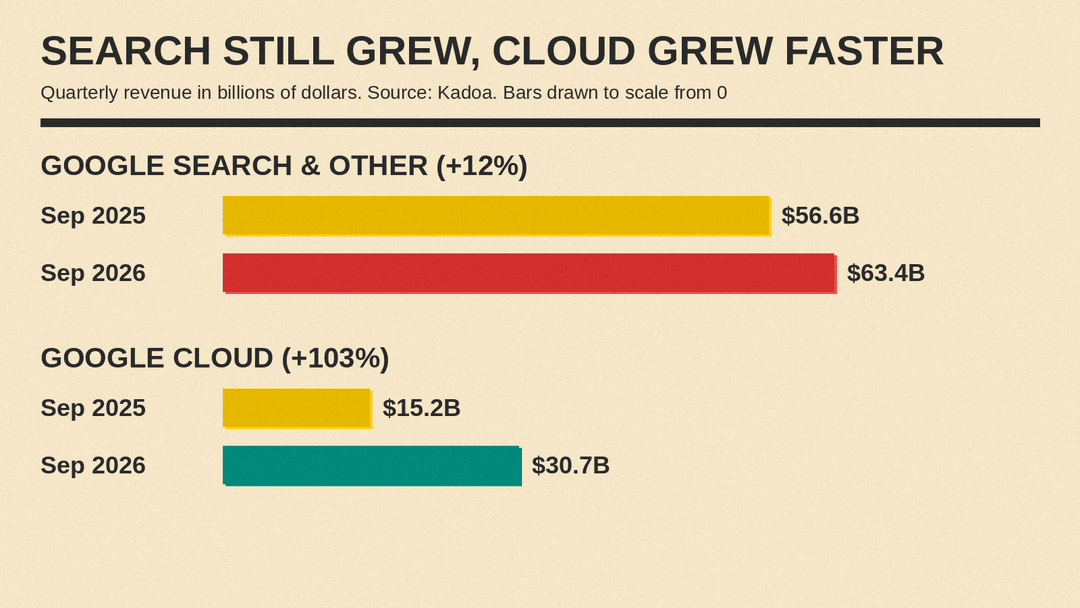
Kadoa is careful about what that means. Search revenue was up 12% year over year, while everything else at Alphabet was up 40% and Google Cloud was up 103% to $30.7 billion. In its words: "Search revenue still grew: the share fell because the rest of Alphabet grew faster." The Search line is what Alphabet reports as "Google Search & other," which also covers ads on Gmail, Maps and Google Play.
Hacker News: "Search revenue isn't down"
Several commenters spent their time correcting a reading of the headline that the article itself does not make. When pmkary joked that Google published "Attention is All You Need" and "brought this devastation to Google," five of the six replies pushed back. senordevnyc wrote: "Search revenue isn't down, both search revenue and overall Google revenue are up, it's just that search is a smaller portion of the total pie because Google Cloud is climbing faster." WheatMillington asked: "Devastation? Are you and I reading the same financial reports?"
The same thing happened under lifeisstillgood, who argued that search numbers are down because AI is a better search engine. JumpCrisscross replied that Google Search & other revenue grew 12% year over year, and that paid clicks grew 8% and cost per click 4% over the same period, citing the SEC filing.
Others accepted the growth but questioned its shape. andriy_koval noted that the 12% growth is against Q3 2025, and that the line is flat against Q2 2026. Kadoa's own table agrees: $63.3 billion in the June quarter and $63.4 billion in September. freediver called the 12% growth "pretty remarkable (in the age of AI)" and asked for "a rational explanation."
Hacker News: the case against Google Search
Some commenters did read the chart as a verdict on the product. gh-qq blamed "are you a robot" checks and AI summaries, and mhardcastle replied that they had stopped using Google search "because of the captcha issue." wnevets called forcing users onto AI Overviews "a bold strategy," and WarmWash answered with a joke: "Don't worry, the AI overview is actually just a salesman for advertisers going through an introductory period."
There was also a useful bookkeeping argument. notatoad asked whether Google Cloud includes everything people pay Google for besides ads. Four replies said no or not exactly, and one said generally yes. steve1903 wrote that Cloud is "GCP, Workspace and Gemini Enterprise," while consumer subscriptions such as YouTube Premium and consumer Gemini plans sit in Google Services. jonas21 said a percentage-share chart was "a bit unconventional" and posted a chart of revenue in dollars instead.
X: the AI Mode problem
On X, the focus was less on the share chart and more on why investors sold. A common explanation in the posts we read came from the earnings call. Asked why Search slowed while queries grew, Google chief business officer Philipp Schindler said, per the Motley Fool transcript, that foreign exchange was "the single largest driver of Search deceleration relative to Q2," followed by changes in some ad categories. He added that "the strong growth in AI Mode queries had an impact because of the lower monetization we were seeing in AI Mode." That last point is the one investors on X picked up. Sundar Pichai said on the same call that query growth "is the highest it's been in the last 5 years."
@MelvinInvests, in a post with about 34,100 views at 11:28 AM PT, put it this way: "People are using Google more, but Google is making less from each search." The post argued that Google "is being forced to cannibalize its own ad business to keep users from leaving for ChatGPT and Claude," and ended: "The burden of proof is now on Google." @_Investinq framed the same worry as whether AI is "quietly eating the most profitable franchise ever built."
The most-viewed post we found was more cautious. @VanquishTrader, at about 53,100 views, called the selloff "less a rejection of its AI position than a repricing of economics of replacing Search." The post notes that management had flagged tougher comparisons and currency, "so slowdown cannot be attributed entirely to AI Mode, and Alphabet doesn't disclose revenue per AI query." @sharohiqinc said much the same in one line: "I see a monetization gap, not proof Search is dying."
X: the spending
The second complaint was cash. Alphabet spent $51.4 billion on capital expenditures in the quarter and reported negative free cash flow of about $9.1 billion. @LeoNelissen listed the slowing Search line, AI Mode monetization, capex and margin pressure from third-party compute, then wrote: "Now, I don't think this was a bad quarter. Far from it." The concern, in that post, is "how much of that growth will eventually translate into cash for shareholders."
Several posters said the earnings-per-share miss looked worse than the business. @DelphisLens wrote that "$0.55 of that gap is an $8.7B paper loss on equity stakes, not the business," and that what worried people was the spending. @SergeyCYW called it "a strong quarter, despite the market's negative reaction." @VanquishTrader went further on cash, noting that adding back the accrued $5.2 billion EU fine "still leaves roughly $3.9B negative," and that Alphabet issued $12.4 billion of stock and $28.7 billion of notes while buying back none.
Why it matters
Both camps are describing the same quarter. Search is still growing in dollars and still more than any other line Alphabet reports, but it is no longer growing as fast as the rest of the company, and Google itself said lower monetization in AI Mode weighed on Search growth, though it named currency as the largest driver of the slowdown. Schindler said Google is "now scaling ads within both AI Overviews and AI Mode to more users and more queries." @VanquishTrader set out the test for the next two to four reports: Search monetization stabilizing as AI Mode gains share, Cloud margins holding up, and operating cash flow beginning to outpace capex "without further dilution." Our opinion piece on the AI Mode ad gap covers what Google did and did not disclose about it.
Sources
- Kadoa Company Atlas: Google Search is less than 50% of Alphabet's revenue
- Hacker News discussion
- Alphabet Q3 2026 earnings call transcript (Motley Fool)
- Alphabet Announces Third Quarter 2026 Results (earnings release, SEC Exhibit 99.1)
- @MelvinInvests on X
- @VanquishTrader on X
- @_Investinq on X
- @LeoNelissen on X
- @DelphisLens on X
- @SergeyCYW on X
- @sharohiqinc on X
- llms.blog: Alphabet Q3 results
- llms.blog: Alphabet's record stock drop
