
Google just told investors that its newest search product has lower monetization, and then declined to say by how much. That missing number matters more than the 12% headline. In my view, AI Mode is not breaking Google Search yet, but Google is asking advertisers to fund the transition without showing them the gap it admitted to.
What Google actually said
Alphabet's Q3 2026 earnings release shows Google Search & other revenue of $63,350 million for the quarter ended September 30, 2026, up from $56,567 million a year earlier. That is 12% growth. Search Engine Journal notes that the line grew 19% in Q1 and 17% in Q2, so growth has slowed for two quarters in a row. Our Alphabet Q3 news story covers the rest of the quarter.
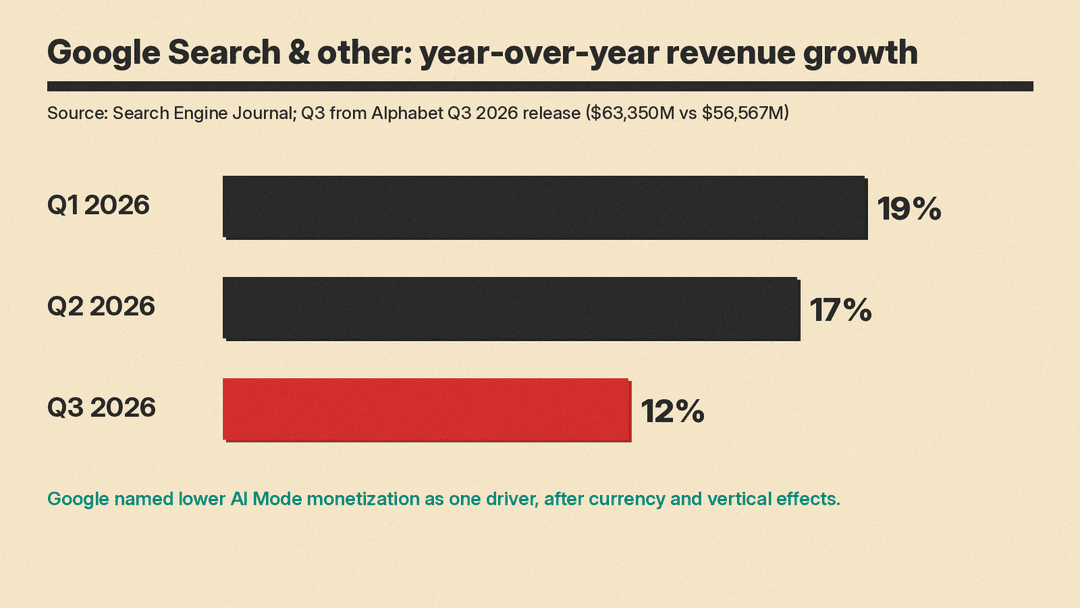
On the earnings call, Chief Business Officer Philipp Schindler gave three reasons for the slowdown. Currency came first: "It was the single largest driver of Search deceleration relative to Q2." Next were vertical-specific dynamics in retail and media and entertainment. Then he added: "it's worth noting that the strong growth in AI Mode queries had an impact because of the lower monetization we were seeing in AI Mode."
CEO Sundar Pichai framed it as a familiar trade-off in his prepared remarks: "Just like our shift to mobile over a decade ago, we are focused on building the best Search user experience, followed by monetization." He also said the company's "year-over-year query growth rate is the highest it’s been in the last five years."
Overhyped: "AI is eating Google Search"
The easy take is that AI Mode is cannibalizing Google's ad business. Google's own account does not support that, at least not yet. Schindler called currency the largest driver, and he named AI Mode after currency and the vertical effects. Search revenue still grew by more than $6.7 billion year over year. Queries are rising, not falling. In my view, a product that brings in more searches and earns less on them is a pricing problem, not a collapse.
So I would not read this quarter as the start of Search's decline. I would read it as the first time Google has put a cost on AI Mode in its own words.
Underrated: the number Google left out
Here is the part I think deserves more attention. Search Engine Journal points out that Schindler "did not state what AI mode's monetization was lower than, nor the amount of money this impacted search ad revenue." Google named the gap and kept its size private.
Instead, Google offered reasons to expect the gap to close. Schindler said "the majority of AI Mode queries are incremental, creating more monetization opportunities over time," and that many are "upper-funnel queries." Those may turn out to be true. But "over time" is not a figure, and in my reading, "upper-funnel" means the person is not ready to buy yet.
The fix is more ads inside answers
Google's plan is clear from a same-day Ads blog post. It is scaling ads in AI Mode to Australia, Canada, India, Kenya, Malaysia, New Zealand, Nigeria, Pakistan, the Philippines and Singapore, with Brazil, Mexico and the United Kingdom planned for Q4 2026. It is also launching "multiturn ads in the U.S." so ads can appear in follow-up questions. We covered the rollout in our AI Mode ads expansion story.
Google's main evidence that this works is one line: "click-through rates are already similar between sponsored and organic product list items within AI Mode." That is a narrow comparison. It covers product list items, not AI Mode as a whole, and it compares ads with the organic listings next to them, not with ads on a classic results page. It does not tell an advertiser what a click in AI Mode is worth compared with a click they already buy.
Meanwhile, according to Search Engine Journal, "All existing Search, Shopping, and Performance Max campaigns are eligible by default and cannot opt out separately." In plain terms, advertisers are already in the experiment, and they cannot test AI Mode on its own terms by switching it off.
Who wins, who carries the risk
Google wins the queries. Longer questions (Google says queries in AI Mode are "on average three times longer than traditional searches") give it more context about what a person wants, and that is valuable over the long run.
Advertisers carry the near-term risk. Their budgets flow into a surface that Google itself says earns less, under a default they cannot separate out. Users carry a smaller risk: answers that now hold ads, including in follow-up turns. Google says those ads will be labeled "Sponsored". Labels help, but trust in an answer is a different thing from trust in a list of links, and Google has had its own AI Mode answer problems.
What Google should do
Pichai's mobile comparison asks people to trust that the gap will close. If AI Mode is the future of Search, Google should give advertisers the same: a separate AI Mode report, a real opt-out, and a comparison of AI Mode ad performance against classic Search ads, not only against organic listings.
Until then, "lower monetization" is a phrase without a number, and advertisers are paying to find out what it means.
Sources
- Alphabet Q3 2026 earnings release (SEC exhibit 99.1)
- Alphabet Q3 2026 earnings call transcript (The Motley Fool)
- Q3 2026 earnings call: Remarks from our CEO (Google)
- Ads in AI Mode expand to 10 new countries (Google)
- Google Says Lower AI Mode Monetization Weighed On Search Growth (Search Engine Journal)
