
A new Chinese lab wants to show that diffusion language models can do real agent work, not only fast demos. DiffuSpace, a startup that GeekPark describes as based in Shenzhen, has released Clover-35B-A3B-Preview, its first model, with open weights under the Apache 2.0 license. The company says it beats Alibaba's similarly sized Qwen3.6-35B-A3B on agentic coding and tool-use tests while generating text faster.
Every benchmark and speed figure below comes from DiffuSpace's own launch blog (October 2026). No outside group has published a check of these numbers yet.
What a diffusion language model does differently
Most chat models, including the Qwen models Clover is compared with, are autoregressive. They write one token at a time, left to right, and each new token waits for the one before it.
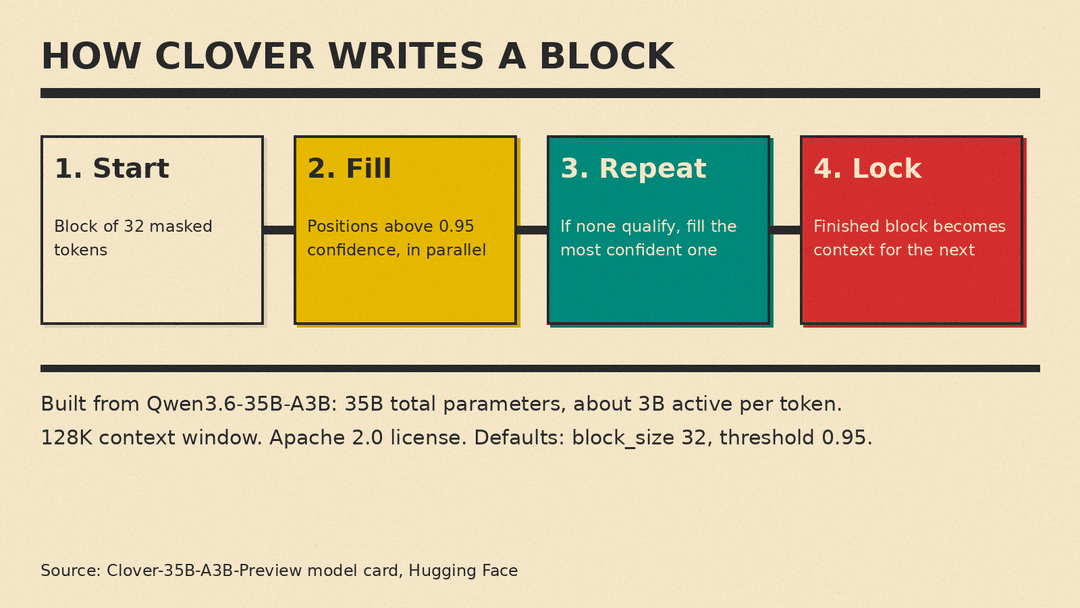
A diffusion language model works more like an image generator that starts from noise. Clover uses what its model card calls block diffusion. It starts each block of text as masked placeholder tokens and then fills in many positions in parallel. Positions where the model is confident (above a threshold of 0.95 by default) are filled together in one step. If none qualify, the single most confident position is filled so the model keeps moving. A finished block then becomes fixed context for the next block. The default block size is 32 tokens.
The practical promise is speed: filling several tokens per step instead of one. The open question for this approach has been whether quality holds up at larger sizes. That is the question DiffuSpace says Clover answers.
What DiffuSpace built
Clover is not trained from scratch. The model card says it is a text-only model derived from Qwen3.6-35B-A3B. It keeps Qwen's mixture-of-experts backbone: 40 layers, 256 routed experts, top-8 routing and one shared expert per layer. It has 35 billion total parameters, and about 3 billion are active for each token.
DiffuSpace's main change is to Qwen's Gated DeltaNet layers, a type of efficient attention. The blog says earlier text is compressed into the layer's recurrent memory, while tokens inside the current block attend to each other in both directions. The model also learns when to lean on that memory and when to use the current block. The context window is 128K tokens (131,072 tokens for prompt and answer together), and the model supports a thinking mode.
The team has history in this area. The blog says the University of Hong Kong NLP group released Dream 7B in April 2025, that members of the team started DiffuSpace building on that work, and that the Dream models have passed 2.7 million downloads on Hugging Face (company figure, October 2026).
The numbers DiffuSpace reports
These are company-reported results from the October 2026 launch blog:
- SWE-bench Verified: 73.6
- Terminal-Bench 2.1: 51.7
- τ³ Overall: 65.3
- GPQA Diamond: 83.8
- ZebraLogic: 95.8
- AA-LCR: 72.0
DiffuSpace says Clover had the top score on all six agent benchmarks in its comparison. That set included two other diffusion models, LLaDA2.2 flash and Mercury 2.5, and two autoregressive Qwen models, Qwen3.6-35B-A3B and Qwen3.5-35B-A3B. Against MiniCPM-V 4.7, which has the same 35B-A3B shape, the blog says Clover scores 28.0 points higher on SWE-bench Verified and 15.7 points higher on Terminal-Bench 2.1.
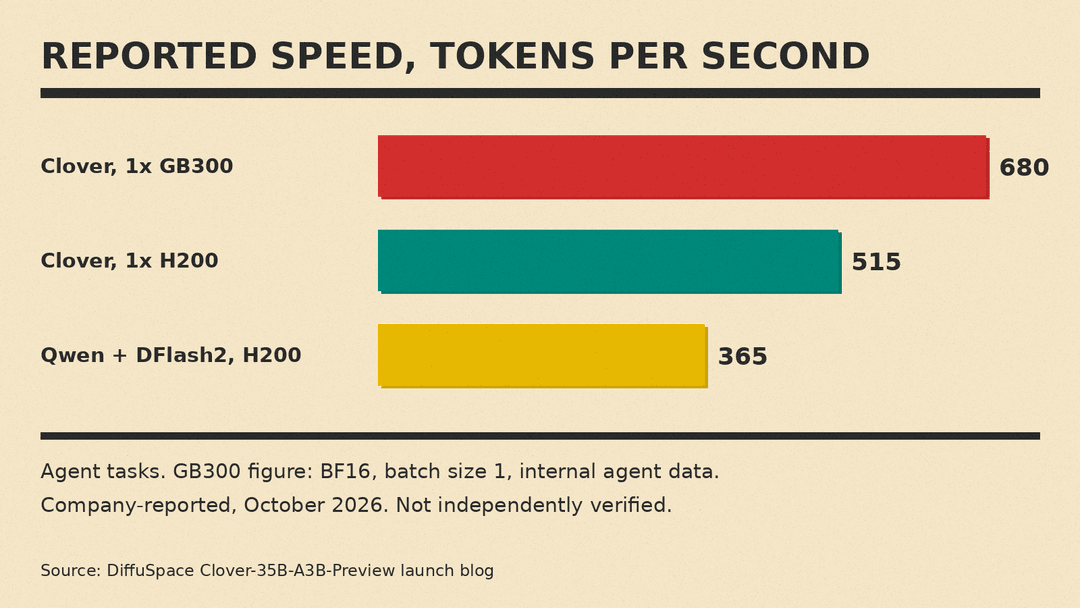
On speed, the company reports 680 tokens per second on internal agent workloads on one NVIDIA GB300 GPU (BF16, batch size 1). On one H200 it reports 515 tokens per second on agent tasks, against 365 tokens per second for a Qwen model sped up with DFlash2. In a WebMCP test of 49 tasks with three attempts each, it says Clover's median agent run time was 1.52 seconds, against 8.86 seconds for Gemini3.6 Flash.
Can you run it
The full BF16 weights are about 69 GB, so the model card asks for a GPU with that much memory plus room for inference state. DiffuSpace recommends its own SGLang build for serving and also supports llama.cpp. The blog says the team ran an INT4 version on a 16 GB NVIDIA RTX 5070 Ti and measured 101.8 tokens per second on MATH-500, against 48.5 tokens per second for similarly sized MiniCPM and Qwen models in its tests. Weights are also on ModelScope and code is on GitHub.
The license is Apache 2.0, which allows commercial use and changes as long as the license and notices are kept. The model card says the LICENSE file keeps the upstream Apache 2.0 license and Alibaba Cloud's copyright notice from Qwen3.6-35B-A3B.
Why it matters
Earlier diffusion text models include research models such as Dream 7B and commercial ones such as Inception's Mercury. Clover is a mid-sized open model aimed directly at agents, where, as DiffuSpace argues, each generation delay adds up across a task. If its numbers hold under independent tests, it suggests a lab can take an open Qwen model and convert it into a faster diffusion model without losing coding ability. That would make Alibaba's open Qwen releases a base for a new class of models, not only fine-tunes.
Caveats matter here. All results are company-reported. The model is labeled a preview. The speed comparisons use DiffuSpace's own workloads and setups. A separate decision model built on Clover is announced but not released yet, and the company says an agent harness and a desktop coding client are still in development.
