
Delaware wants to let an AI agent run a company. A senior Republican in Congress now wants to know who is behind the idea and what risks the state checked first.
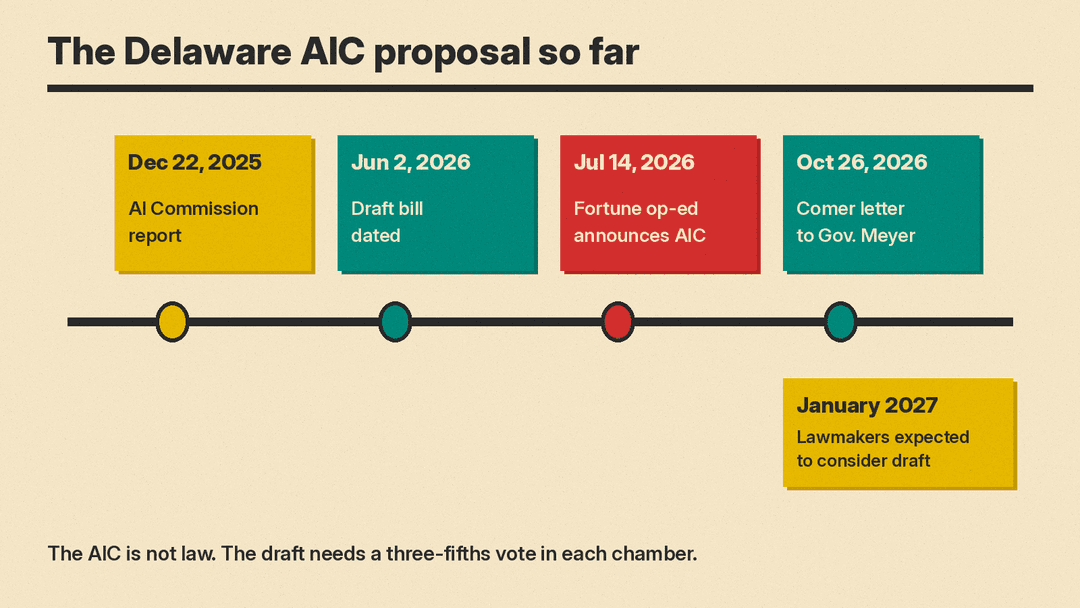
On October 26, 2026, House Oversight Committee Chairman James Comer (R-Ky.) opened an investigation into Delaware's proposal for a new kind of business entity, the Artificial Intelligence Company, or AIC. In a letter to Governor Matt Meyer, he asked for documents on how Delaware considered the risks and on "the forces driving Delaware, and possibly other states, to adopt such proposals." The committee says the answers could inform possible federal legislation to limit state AI initiatives like this one.
This post explains what the AIC would be, what the draft bill says, why Comer objects, and what happens next.
What an AIC would be
Delaware Secretary of State Charuni Patibanda-Sanchez and Norm Ai CEO John Nay announced the proposal in a July 2026 Fortune op-ed. They described the framework as a public-private partnership led by Norm Ai, a company that, per WHYY, encodes law and regulation into AI systems.
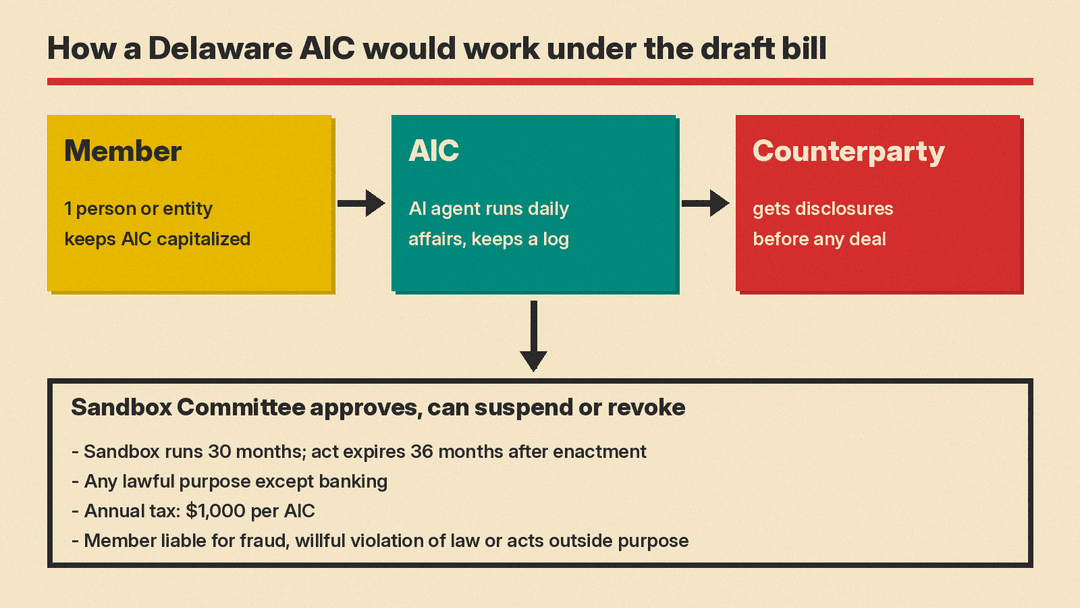
According to the Fortune piece, an AIC is a separate legal entity whose day-to-day affairs are managed by an AI agent rather than a person. At the agent's direction, it can sue and be sued in its own name, hold and dispose of property, and incur obligations. It must keep a log of its activities.
Each AIC has one member, a person or an entity. That member must keep the company adequately capitalized. The member is shielded from the AIC's debts, except where it fails to capitalize the company or uses it to commit fraud or a willful violation of law.
What the draft bill says
A 36-page draft bill, dated June 2, 2026 and published by Spotlight Delaware, fills in the details. Key points:
- Purpose. An AIC "may have any lawful purpose, regardless of whether for profit, except for the business of banking."
- Liability shield. The member is not liable for what the AIC does just because the AIC acts as its instrument, as long as the AIC was adequately capitalized at the time. The shield fails if the member used the AIC for fraud or a willful violation of law, or let it do business the member knew, or should have known, was outside its stated purpose.
- Sandbox only. AICs would operate inside a regulatory sandbox. Applicants pay a fee, disclose past convictions, judgments and investigations, and prove they are adequately capitalized.
- Who decides. A Sandbox Committee would approve applicants. Its voting members are the Secretary of State, the Attorney General, the Chief Justice of the Delaware Supreme Court, the chair of the state AI Commission, two lawyers and two AI experts named by the Governor, and two people named by the Secretary of State. Four legislators would sit as non-voting members.
- Disclosure to counterparties. Before it deals with anyone, an AIC must say it is a sandbox test, that it has liability shields under the new chapter, that Delaware does not endorse it, when the test ends, and how to complain to the Sandbox Administrator or the Attorney General.
- Time limits. The sandbox runs for 30 months. The act itself expires 36 months after enactment unless lawmakers extend it.
- Tax. Every AIC would pay an annual tax of $1,000.
Why Comer objects
Comer's letter makes two arguments.
The first is about liability. "We are concerned that Delaware's AIC proposal could be used to protect powerful AI companies and their investors from responsibility for reckless harmful actions," he wrote, "while also protecting non-transparent forces seeking anticompetitive regulatory capture behind state AI initiatives."
The second is about process. The committee says a two-page December 22, 2025 report from the Delaware Artificial Intelligence Commission, which referenced House Joint Resolution 7, mentioned a subcommittee working on a sandbox for agentic AI in corporate governance. The committee says that report did not mention any assessment of safety, harms or risks, or any consultation with independent experts.
The letter also cites Spotlight Delaware reporting that describes a lawyer at the Delaware firm Richards, Layton & Finger as the "principal drafter of the proposed legislation." According to the letter, he said the bill would let AI agents engage in just about any business activity and would protect owners of new AICs from legal liability for actions the AI might take. The letter also cites a September 2026 report that the Delaware Secretary of State's office declined to answer questions about the state's working relationship with an AI company contributing to the proposal. WHYY separately reported that the Delaware Department of State declined to say whether Norm Ai was being paid by the state.
What supporters and critics say
Delaware officials say the goal is to define liability, not to avoid it. "We're not trying to shield liability," Patibanda-Sanchez said in a July Bloomberg Law article, as cited by WHYY. "We're trying to define where exactly liability lands when there's some type of malfeasance or psychopathic behavior."
Governor Meyer, asked on a WHYY News and Delaware Public Media call-in show about rogue AI agents and whether Delaware should proceed with caution, said: "It is coming, and the solution is not ignoring it."
Patrick Callahan, who chairs the state's AI sandbox subcommittee, told WHYY that the AI incidents in the news involve technical sandboxes, sealed computing environments used to contain software, while Delaware's proposal is a regulatory sandbox. "The difference is like a firewall and a fire code," he said.
Legal scholars are split. Lawrence Cunningham of the University of Delaware's Weinberg Center told WHYY the state "would be irresponsible to ignore this," given its lead in company formation. Christopher Bruner of the University of Georgia School of Law said, "There's really no overarching regulatory plan here for dealing with the fallout that AI-governed companies could bring."
Why it matters
Delaware matters for company law. As Cunningham put it, it is "the number one place where people form [limited liability companies]" and "the number one place where larger companies are incorporated." WHYY calls the plan first-in-the-nation legislation. If it passes, it would put into law an answer to a hard question: who pays when an autonomous agent causes harm. Under this draft, the member is not liable for the AIC's debts or the agent's acts except in the cases listed above.
The probe also fits a wider fight over who regulates AI in the US. The Oversight Committee says the information it gathers could support federal efforts to limit state AI initiatives. That puts Delaware's experiment in the same debate as state and local AI rules on chatbots and ads, such as New York City's proposed chatbot rule and Pennsylvania's AI ad label law.
What happens next
The AIC is not law. WHYY reports that Delaware lawmakers are expected to consider the draft when they return in January. The draft's synopsis says it needs a three-fifths vote in each chamber because it sets fees and a tax. The letter asks for the documents as soon as possible and no later than November 9, 2026.
Sources
- House Oversight Committee: Comer investigates Delaware AIC initiative (Oct 26, 2026)
- House Oversight Committee: Comer letter to Governor Meyer (PDF, Oct 26, 2026)
- Draft bill: Artificial Intelligence Regulatory Sandbox and AIC (June 2, 2026, via Spotlight Delaware)
- Fortune: Delaware proposes testing the AIC (July 14, 2026)
- WHYY: Delaware pursues AI-run companies initiative (Sep 30, 2026)
