
Brilliant Labs launched Halo, a pair of $399 AI glasses, on October 27, 2026. The pitch centers on privacy and openness: an open-source design, a low-resolution sensor instead of a photo camera, and a promise that the raw images and audio it captures are deleted right after the AI reads them. Halo also ships with Noa, an AI companion that keeps a long-term memory of your life, and Narrative, a game that treats the world around you as the game board.
Here is what Halo does, what it costs once you add a Noa plan, and the fine print worth reading before you buy.
What Halo is
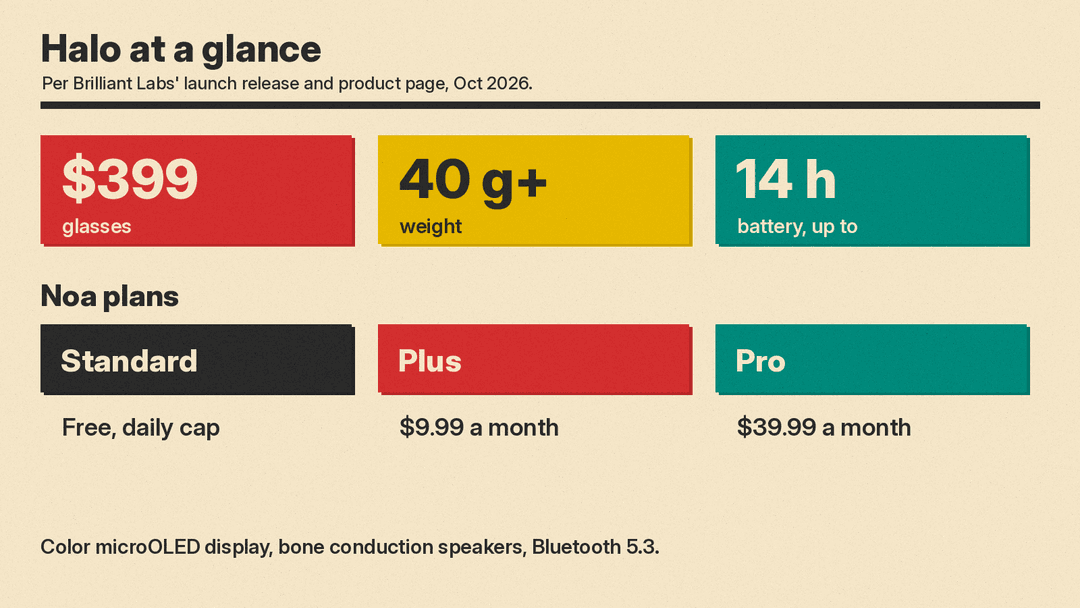
Halo is a pair of glasses that weighs just over 40 grams, according to Brilliant Labs' launch announcement. The company lists these parts:
- A full-color microOLED display
- Microphones (two, per The Deep View)
- Bone conduction speakers
- A low-resolution image sensor for "visual context"
- Bluetooth 5.3 and on-device AI
- Up to 14 hours of battery life
The Deep View, which tested the glasses for more than a week, adds that the display projects into your right eye and that you use Halo through the Noa app on iPhone or Android. It also compares the weight with "around 50 grams for Meta Ray-Bans and most of the competitors."
The Halo product page says the glasses are "shipping now" for $399. The display optic adjusts from +2 to -6 diopters, and prescription or sunglass lenses come through a partner, SmartBuyGlasses. Halo is built for an inter-pupillary distance (the space between your pupils) of 58 to 72 mm, and the company says that covers "most, but not all, people." It suggests checking first with its Eye Measure app.
Noa, the AI companion inside
Noa is the assistant you talk to. Brilliant Labs calls it "a personal AI companion that builds long-term memory around what matters to each user." Instead of starting fresh every time, Noa carries context forward, so a conversation can pick up where the last one stopped.
The company builds Halo around three things you can do with Noa:
- Ask. Talk to Noa like a voice assistant that is always with you. Ask questions about what you see and hear.
- Make. Describe a small app or workflow out loud and Noa builds it. You can share these mini-apps on Halo's own App Store. No code is needed.
- Play. Run Narrative, the built-in game (more on it below).
The product page says Halo is useful for "memory enhancement and AI dialogue about what you see and hear, including translation across a wide range of languages." The Deep View describes its main job as something like Granola, the AI meeting-notes app, but for real-world conversations: it turns what you hear into text summaries, turns what it sees into descriptions, and lets you query that record later as a long-term memory.
During setup you also create a custom avatar for your assistant, which The Deep View likens to OpenAI's Dots and Meta's Muse.
What Noa costs after you buy the glasses
The $399 covers the hardware. The product page lists three Noa plans:
- Noa Standard, free. The out-of-the-box assistant, "now including memory." Brilliant Labs says this tier is cost-optimized, "will not feel conversational," and has a daily usage cap.
- Noa Plus, $9.99 a month. Real-time conversational speech, "deep personalization and long term memory."
- Noa Pro, $39.99 a month. Everything in Plus with triple the usage limits and the "added benefit of LONG term memory."
Those are monthly prices. On yearly billing, the page lists Noa Plus at $8.25 a month and Noa Pro at $33.25 a month, billed annually. Real-time conversational speech is part of Noa Plus; the free tier, the page says, "will not feel conversational." Our Bee Frontier and Bee Eclipse explainer covers another always-listening AI device that turns what it hears into notes.
Narrative: a game played in the real world
Brilliant Labs also pitches Halo as a gaming device. The press release calls the glasses "the console for Narrative" and describes the game as "a new category of adaptive gaming" that "transforms the real world into an open-world game that continuously evolves with each player." The release says it responds to "your actions, decisions, and discoveries in real time."
The press release and product page give no rules or examples of play beyond that description. The Deep View describes it as turning "your everyday environment into an experience for discovery and collaboration."
The privacy design, and how it works
Privacy is the main selling point, and it comes in three parts.
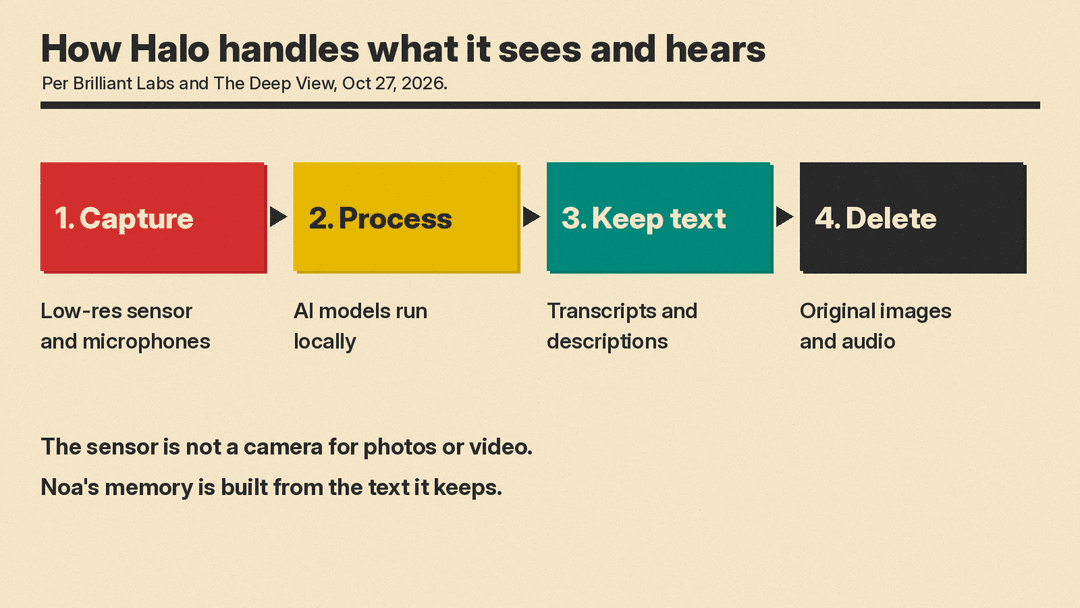
No photo or video camera. Brilliant Labs says Halo's low-resolution image sensor gives it visual context "without functioning as a traditional camera for photography or video." The Deep View calls it a low-res camera. Brilliant Labs calls it "visual note-taking": Halo can "see, understand, and remember what you see," but the images are processed on the device, "immediately discarded, and never stored."
Raw media is deleted after the AI reads it. The Deep View reports that Halo processes raw audio and images with models running locally on your phone, turns audio into transcripts and images into descriptions, then erases the originals. CEO Bobak Tavangar told the outlet: "We literally delete it." The Deep View adds that neither Brilliant Labs, the model nor the user can access the original media after that. What stays is the text: the transcripts and descriptions that make up Noa's memory.
Open source. Brilliant Labs says Halo's hardware and software are fully open source, with design files and code on GitHub. The Deep View says the company also discloses the details of every component inside the device. For developers, there is a Brilliant SDK and a Flutter SDK for iOS and Android apps.
Why it matters
The Deep View frames the launch against "the current backlash against smart glasses," one that has seen Meta release glasses without cameras. By Brilliant Labs' description, Halo's sensor gives the AI visual context but does not work as a camera for photos or video. For one example of workplace limits on camera glasses, see our report on ICE barring staff from wearing Meta smart glasses on duty.
The Deep View likens Halo's custom assistant avatar to OpenAI's Dots and Meta's Muse, and its reviewer writes that "the existence of Halo shows that the market for AI glasses continues to broaden out."
The reviewer calls it "a far different product than Meta Ray-Bans and Android XR glasses," aimed at "wearables enthusiasts, AI experimenters, and professionals who care deeply about privacy and security." Tavangar told the outlet that organizations in tech startups, medical, agriculture, manufacturing and aerospace already use it, and an enterprise option lets a company swap in its own AI agents.
The fine print
- Plans. The free Noa tier has a daily cap and, by the company's own description, does not feel conversational. Real-time conversational speech starts with Noa Plus at $9.99 a month on monthly billing, or $8.25 a month billed annually.
- Fit. Halo does not fit everyone. Check your inter-pupillary distance with the Eye Measure app before you order.
- Taxes. Import taxes are not collected at checkout and may apply on delivery, depending on your country.
- Returns. A broken or faulty unit is exchanged. Any other return gets a full refund minus a $49 restocking fee, and you pay return shipping.
- "Deleted" means the raw media. Per Brilliant Labs and The Deep View, the original images and audio are discarded after processing. The text Noa writes from them is what it remembers.
Brilliant Labs, founded in 2019, says in the release that Halo is backed by new funding from Goodwater Capital, and it lists Brendan Iribe among the company's backers. The release does not give an amount.
