
Mistral released the weights of Mistral Large 4, the 1-trillion-parameter model it calls Le Chonk, on Thursday morning. Within a few hours the reaction had settled into a familiar shape for a big open release: independent benchmarkers ran it and gave it a narrower win than Mistral claimed, the local-inference crowd started doing memory math, and Hacker News spent much of its thread arguing over whether a license with a commercial carve-out still counts as "open."
Mistral's announcement on X went up at 7:21 AM PT on October 29 and had about 2,870 likes and 171,600 views by about 9:20 AM PT. The Hacker News thread, posted at 7:13 AM PT, had 454 points and 115 comments at the same check. Reddit could not be read from our tools for this roundup, so the reactions below come from X and Hacker News.
What Mistral released
Mistral first put Mistral Large 4 out as a public preview earlier this month. In its October 29 post, the company says it spent "just three weeks of additional reinforcement learning" improving the model before releasing the weights. The headline claims:
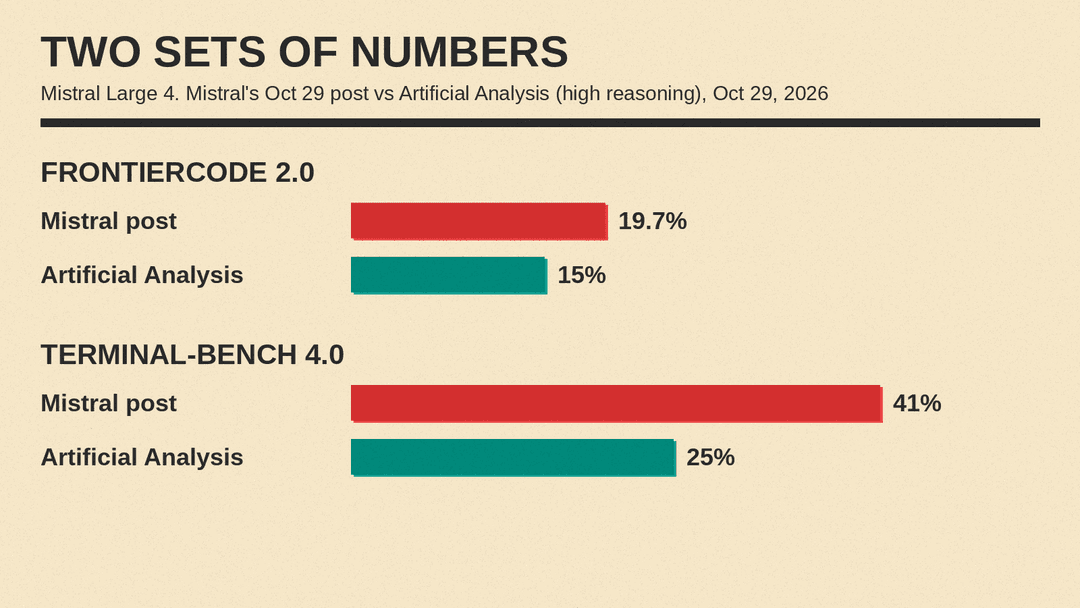
- First among open-weight models on Cognition's private FrontierCode 2.0 benchmark, at 19.7%.
- 41% on Terminal-Bench 4.0, up 13 points from the preview, with 30% fewer output tokens.
- 48% on the Artificial Analysis Coding Agent Index, "effectively tied" with GLM-5.3 while using 47% fewer tokens per task.
- Three reasoning modes: low, medium and high (the default).
- A 96.6% average refusal rate on malicious cyber requests, which Mistral calls the highest it measures among open models.
The weights are on Hugging Face as Mistral-Large-4-1T-A52B, with an NVFP4 version alongside. Mistral also says it saw "a potential for uplift to conduct real attacks" in live traffic since the preview and is changing its guardrails, and that enterprise design partners such as Orange Cyberdefense get vetted preview access to a specialized cyber variant.
The independent benchmark: a narrower lead
An independent verdict came from @ArtificialAnlys, which posted its results at 7:58 AM PT. Its framing was careful: Mistral Large 4 is "narrowly making it the #1 open weights model developed outside of China." With high reasoning it scored 26 on the Artificial Analysis Intelligence Index v5, one point above the preview and one point above Muse Spark Open, which Artificial Analysis calls the leading US-developed open-weights model.
The same thread is less flattering on coding. Artificial Analysis says the model trails DeepSeek V4.1 Flash 1017 and GLM-5.3 by 6 points on its index, "largely due to weaker coding and agentic knowledge work performance," and lists 15% on FrontierCode 2.0 against 29% and 22% for those two models. It also gives 25% on Terminal-Bench 4.0. Those are lower than the 19.7% and 41% in Mistral's own post. Neither source explains the gap in the material we read, so treat them as two different runs rather than a correction.
Where the two agree is efficiency. Artificial Analysis says Mistral Large 4 (high) uses 82K output tokens per Intelligence Index task, 39% fewer than the preview, and that the seven open models that score higher use between 113K and 225K. On its Coding Agent Index, a follow-up post says the model scores 48 in Mistral Vibe while using 8.5M tokens per task, against 49 and 15.9M for GLM-5.3 in Opencode and 46 and 16.7M for DeepSeek V4.1 Flash 1017 in DeepSeek Harness. It also reports the hallucination rate on AA-Omniscience falling to 28% from 41% for the preview, with accuracy still "relatively low at 26%."
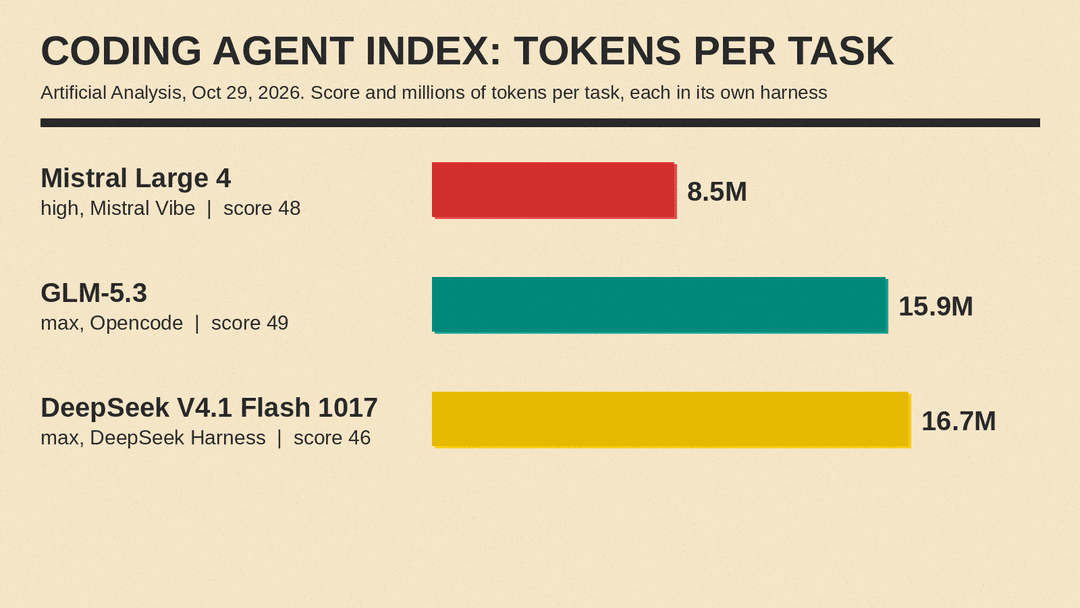
That token comparison drew pushback on X. @hivemind3637 replied that each model ran in a different harness and at a different effort level, "so some of that 2x is the harness being terse, not the model," adding: "same 3 models on one neutral harness would settle it." @brunooliveira asked the practical version: "on paper it gets glm/deepseek level results with half the tokens. I want to know if that holds up in a messy repo or only on the benchmark."
Running a trillion parameters at home
Inference projects posted day-zero support quickly. @vllm_project announced support with "FP8 and NVFP4 checkpoints, with a built-in DSpark drafter," and @sgl_project said SGLang supported it on day zero and was the first to serve it on NVIDIA Vera Rubin. @ollama listed Mistral-large-4 among recent additions to its cloud, not its local models.
@UnslothAI said its 1-bit GGUF lets the model run on a Mac Studio and, per Unsloth, "retains 91% top-1 accuracy." Unsloth co-founder @danielhanchen said the 1-bit quant is "80% smaller (223GB vs 1.1TB FP8)."
Others ran the numbers and stayed cautious. @0xWhiteMage wrote that "At 4-bit that's about 500GB for the weights alone. One spark has 128GB." @x_yinwei pointed out that Hugging Face's guide points to a 512GB Apple Silicon machine for 2-bit inference and said: "I'd check the memory budget before treating 'runs on a Mac' as a practical option." On Hacker News, jamesblonde said a server with four H200s and 540 GB of memory would still need a 4-bit or 3-bit quant, and said their organization has restrictions that rule out Chinese models.
The license fight
As of 10:15 AM PT, the two biggest Hacker News subthreads (52 and 32 replies) were about the license and one word in the title. rcr-anti wrote: "It's not open weight, it's weights available as they use a modified MIT license that is not OSI." fuddle cited the Open Source Initiative's AI definition and said the model "is definitely not open given the 'use for any purpose without having to ask for permission' requirement."
Others said the label is fine. Taek wrote that "Everyone that I know considers something to be 'open weight' if the weights are available to the public in some form or another." dannyw quoted the license's exemption for internal use and said: "I can host it, I can run it, I can use it; but if I want to sell access to it as an inference provider, I'd have to get a license." Artificial Analysis describes the license, called the MEOW License (Mistral Ecosystem Open-Weight License), the same way: running a Model-as-a-Service business needs a separate commercial license.
Price: cut in half, or not
Artificial Analysis lists the price at $0.70 per million input tokens and $2.10 per million output tokens, about half the preview's $1.36 and $4.18, and puts the cost per Intelligence Index task at $2.06, down 63%. Topfi on Hacker News said that at the original price, "in my evals, Mistral Large 4 Preview was not competitive," and that the new price "warrants a major reassessment."
almindor disagreed that this is a new cut, saying the price had already dropped during the preview, and called the model "still too expensive and very slow when thinking" for a personal project. miroljub wanted the cached-input price in every comparison: "My coding sessions have a >97% input cache rate." Artificial Analysis lists cached input at $0.07 per million tokens. ismailmaj called it "very aggressive pricing" for a model this size.
For cost per task, license terms and hardware side by side with DeepSeek V4.1 Flash 1017 and Qwen3.8-2.4T-A95B, see our comparison.
Is it any good?
Opinions split along the usual lines. segmondy wrote that Mistral's "last 2 models were a disaster and didn't live up to their self reported evals," but that more options are "better for everyone." crimsoneer, who said they added it to a personal benchmark a couple of weeks ago, called it "fine, but certainly not up to the best Chinese or US open weight models." pembrook was blunter: "The model is not competitive. I would never waste my time using it for coding work, and I'm someone in the EU." InsideOutSanta replied that "This is Mistral's first release in years that seems to actually be reasonably good."
European provenance came up repeatedly. satvikpendem guessed people would use it mainly "if they want to have EU provenance for models," while vincentshipsit said "EU provenance doesn't matter much to me" and that "from what I've seen, this isn't it," though "The price cut makes it more interesting than the preview was." d2kx said their EU company uses Mistral Large 4 alongside GLM 5.3 Flash and DeepSeek v4.1 Flash through Mistral's API and is "quite happy."
On X, @noctus91 said Mistral's Vibe CLI "feels genuinely polished now," with one complaint: "the constant permission prompts."
The safety numbers
The cyber claims got questions too. 3form asked where the matching figure is for non-malicious requests: "I can achieve the same performance with refusing when random(1000) < 967." Mistral's post says the model handles defensive tasks "without unnecessary refusals," but the 96.6% figure covers only malicious requests. On X, @himanshu19890 wrote that Mistral will keep updating API guardrails and that "Downloaded copies never get those updates," and advised self-hosters to rerun refusal evals after each quant change. Mistral's post says it will keep updating its guardrails without saying where those updates apply.
Our opinion piece argues that Mistral should say which of its promised guardrail fixes will reach the open weights, and how.
Why it matters
The early read is that Mistral Large 4 improves on the preview and narrowly ranks as the strongest open model from outside China on Artificial Analysis's index, but not a clear leader over the best Chinese open models on coding by that same measure. Its strongest independent number is token efficiency, and even that comes with a harness caveat. The license will keep it off the "open source" list, and the size keeps local use to people with hundreds of gigabytes of memory. For buyers who need a European model they can host themselves, those trade-offs may not matter much.
Sources
- Mistral: Mistral Large 4 (Le Chonk) is now open weight
- Mistral-Large-4-1T-A52B on Hugging Face
- @MistralAI announcement on X
- @ArtificialAnlys results thread
- @ArtificialAnlys Coding Agent Index post
- @UnslothAI on 1-bit GGUFs
- @vllm_project day-zero support
- @sgl_project day-zero support
- @danielhanchen on Unsloth quants
- @ollama cloud model updates
- @hivemind3637 reply on harnesses
- @brunooliveira on real-code tests
- @0xWhiteMage on memory
- @x_yinwei on the Mac memory budget
- @noctus91 on Mistral Vibe
- @himanshu19890 on guardrail updates
- Hacker News discussion
