
Meta reported third quarter 2026 results on October 21 and paired them with a change to its share structure: a new class of publicly listed, nonvoting Class C stock that the company says it can use to raise capital, pay employees and fund acquisitions. The two announcements belong together. Meta's AI spending is now large enough to push its quarterly free cash flow below zero, and the new stock may let it pay for more without diluting Mark Zuckerberg's voting control, as Reuters reported.
All company figures below come from Meta's third quarter press release unless another source is named.
The quarter in numbers
- Revenue: $64.60 billion, up 26% year over year. Analysts expected $63.37 billion, according to LSEG data cited by Reuters.
- Advertising: $63.06 billion of that revenue, with ad impressions up 10% and average price per ad up 14%.
- Operating income: $12.99 billion, down 37%, after a $9.89 billion charge tied to Meta's August agreement with 52 state attorneys general over teen mental health litigation. Meta says operating income would have been $22.88 billion without the charge.
- Net income: $9.86 billion, or $3.83 per diluted share. Meta says diluted EPS would have been $7.40 without the charge.
- Users: 3.64 billion family daily active people on average in September, up 3%. Analysts polled by StreetAccount expected 3.65 billion, CNBC reported.
- Headcount: 66,775, down 15% from a year earlier.
- Fourth quarter guidance: revenue of $73 billion to $76 billion. CNBC reported that the $74.5 billion midpoint is above the $73.73 billion analysts expected, according to LSEG.
The stock rose about 2.5% in extended trading, CNBC reported.
The AI bill
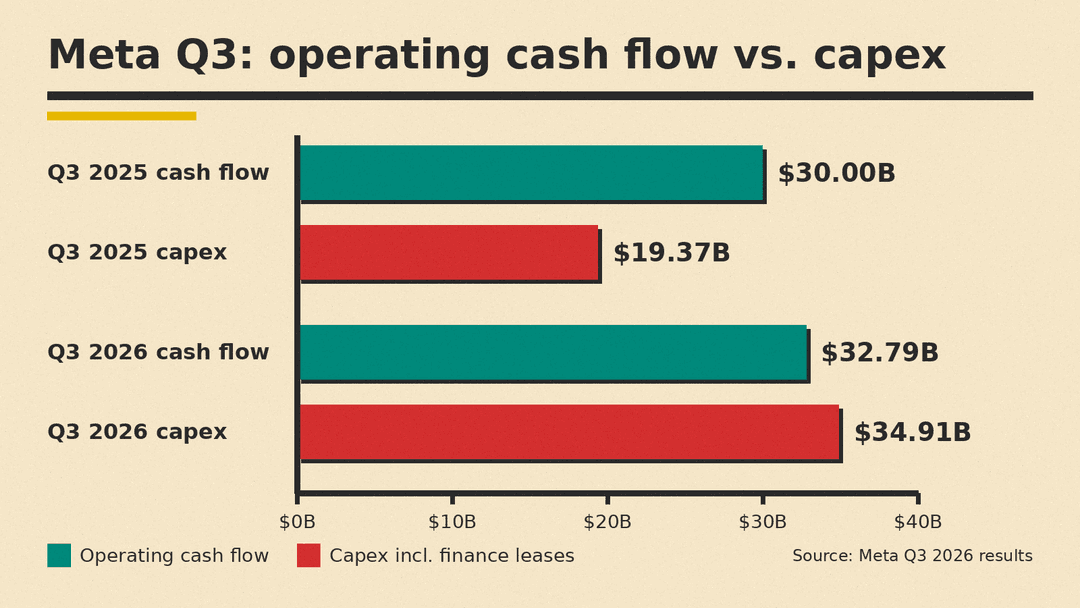
Capital expenditures, including principal payments on finance leases, were $34.91 billion in the quarter. A year earlier the same two lines in Meta's reconciliation table added up to $19.37 billion ($18.83 billion of property and equipment purchases plus $0.55 billion of finance lease principal), so quarterly capex rose about 80%.
Operating cash flow grew far less, from $30.00 billion to $32.79 billion, about 9%. The result is that Meta's free cash flow, by its own non-GAAP definition, was negative $2.12 billion for the quarter, compared with positive $10.63 billion in the third quarter of 2025. For the first nine months of 2026, free cash flow was $11.05 billion, down from $29.51 billion.
Meta also narrowed its full year 2026 capex outlook to $135 billion to $145 billion, from $130 billion to $145 billion. Analysts expected $138.27 billion for the year, CNBC reported. Total 2026 expenses are now expected at $175 billion to $179 billion, a raise Meta attributes to the legal charge.
On 2027, Meta gave no full year revenue outlook. It said it is still building its budget and capacity plans and expects "to continue investing aggressively to support both our core business and emerging AI initiatives." It said its MSL investments "will take longer to generate returns than those in our core business." Reality Labs losses are expected to fall to $18 billion to $19 billion in 2026 and to around $15 billion next year as Meta shifts spending "primarily" toward AI.
Meta's AI data centers include the Ohio cluster covered in our Meta Prometheus explainer. Unlike Alphabet and Amazon, Meta does not rent that capacity out through a cloud business, a point CNBC says investors have questioned.
Class C stock: what Meta announced
Meta's board approved a new class of nonvoting Class C common stock on the unanimous recommendation of a special committee of independent directors. According to the release:
- Meta will file an amended certificate of incorporation in Delaware, with an effective date of January 19, 2027. Shareholders have already approved it by written consent.
- Every holder of Class A and Class B shares will receive one Class C share per share held, as a one-time stock dividend. Meta expects the Class A price to reflect the effect of a two-for-one stock split after the dividend is paid. The record and payment dates have not been set.
- The dividend does not change any shareholder's voting power. Meta intends to list the Class C shares on Nasdaq.
- The committee's stated reasons include capital raising, employee compensation, potential acquisitions and keeping Zuckerberg in charge. The release says the stock "will provide Meta the ability to finance its growth."
- Meta signed a Founder Alignment Agreement with Zuckerberg covering his sales of the Class C shares he receives, his service at the company and conditions for future Class C dividends.
The new shares may let Meta fund acquisitions and attract talent without diluting Zuckerberg's voting control, Reuters reported. A Meta SEC filing says Zuckerberg could face "a significant, multi-billion-dollar tax payment" if California's proposed wealth tax, Proposition 40, becomes law, and that he committed to stay in California, or wherever Meta keeps its headquarters, for eight years unless there are material unforeseen circumstances, according to CNBC.
Where the AI revenue is supposed to come from
Meta's release says AI is "already delivering substantial incremental advertising revenue" through "stronger engagement, better recommendations, and more efficient monetization." Advertising was about 98% of revenue this quarter ($63.06 billion of $64.60 billion).
Newer revenue lines are small for now. On the earnings call, Zuckerberg said more than 10 million people in the US and Canada have set up Muse personal agents over about six weeks, that about 25% use it on a given day, and that shopping is the largest use case, with more than a quarter of users engaging in shopping, with an average purchase size of over $200, CNBC reported. Meta also sells Muse subscriptions and developer access to Muse Wonder Full, which we covered in our Muse Wonder explainer. Analysts at Bank of America do not expect Muse to contribute significantly to Meta's business this year or in 2027, according to a note cited by CNBC.
For comparison with an AI company that sells models rather than ads, see how OpenAI makes money.
Legal costs
The $9.89 billion charge relates to an August settlement that provides for payments of up to about $18.59 billion, according to Meta. Meta's release says it has a number of youth-related trials scheduled in the coming months in the US. Separately, a New Mexico judge on October 21 imposed a $25 billion penalty on Meta in a state case tied to the Cambridge Analytica revelations, Reuters and CNBC reported. That penalty came after the quarter closed and is not part of the third quarter charge.
What to watch
- The Form 8-K and information statement Meta says it will file, which should give more detail on the Class C terms and the Founder Alignment Agreement.
- Whether Meta sells Class C shares to raise cash, and whether it uses them for acquisitions.
- The 2027 capex plan, which Meta said it is still developing.
- Alphabet and Microsoft report next Wednesday and Amazon the day after, CNBC reported, which will show whether the other large AI spenders are moving in the same direction.
